Client-Side GA Session Timeout Cookie Architecture
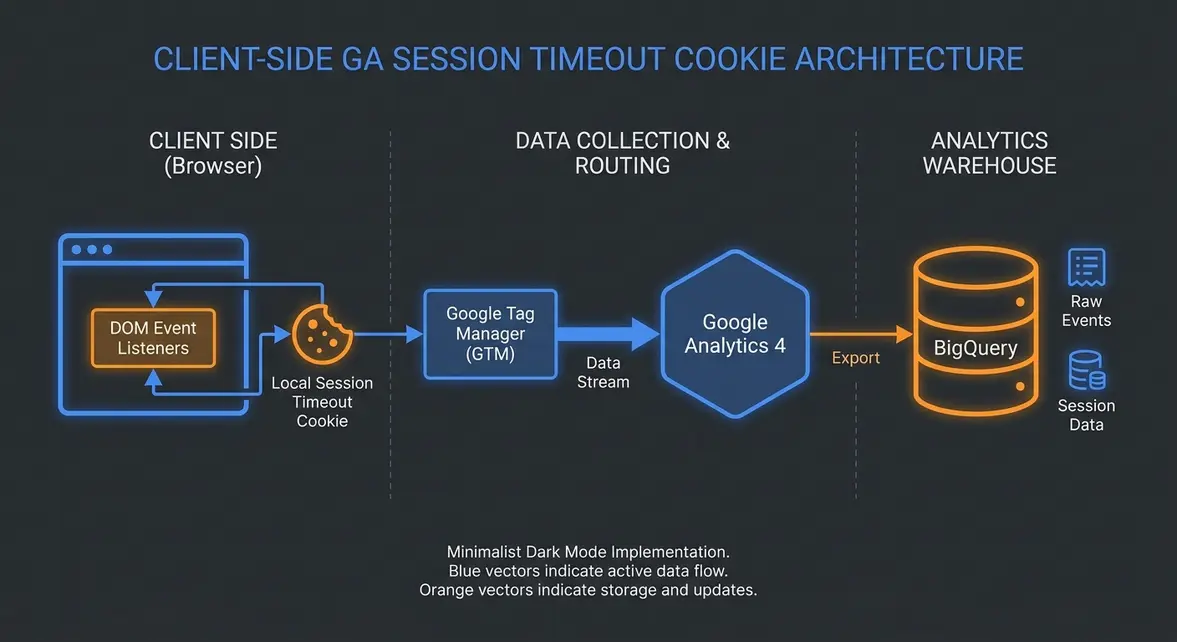
Client-Side Session State Resolution and the GA Inactivity Gap
Google Analytics aggregates raw event streams into sessions using server-side ingestion heuristics. In Google Analytics 4, sessionization relies on the ga_session_id parameter, which is generated client-side by the Google tag and evaluated against a rolling inactivity window—standardized at 30 minutes—alongside midnight cutoffs and campaign source variations. Historically, the client browser runtime operates completely blind to the actual session state calculated downstream by analytics servers. While the browser dispatches telemetry hits, it maintains no native, accessible state machine indicating whether the active session remains open or has expired due to user inactivity.
This decoupling introduces severe structural anomalies in modern web applications. Single-page applications (SPAs) executing background data fetching, post-registration product tours, or delayed conversions (such as asynchronous lead qualification forms) frequently dispatch hits after the 30-minute idle mark. Because the client runtime lacks visibility into the session timeout window, downstream reporting records these delayed events as distinct, fragmented sessions, inadvertently corrupting key conversion attribution models and inflating total session counts across production analytics pipelines.
Data Pipeline Integrity and Edge-State Attribution Synchronization
Architecting an active client-side session timeout cookie resolves this observability gap by replicating GA's rolling 30-minute window directly within the client document storage. By establishing a deterministic, first-party cookie that updates its timestamp on every qualified user interaction, engineering teams create a single source of truth for runtime application logic and downstream tag firing rules. This configuration allows Google Tag Manager (GTM) or client data layers to evaluate session vitality before triggering server-side dispatch.
Without client-side session awareness, critical data pipeline failure modes occur consistently across technical SEO and analytics reporting architectures:
-
Attribution Fragmentation: Mid-funnel conversions triggered after 30 minutes of idle review (e.g., reading a complex technical whitepaper) trigger an artificial secondary session, re-attributing the conversion to direct traffic rather than the initial organic or paid referral vector.
-
Data Layer Desynchronization: Custom events generated via client-side workers or asynchronous promises push metrics into the
dataLayerwith outdated or mismatched session identifiers. -
BigQuery Export Distortions: Unsynchronized session lifetimes result in inflated unique
ga_session_idcounts in the raw BigQuery export, complicating data normalization pipelines and requiring expensive window-function deduplication queries.
-
By executing lightweight state verification directly in the browser runtime, analytics engineers eliminate session breakage at the point of ingestion, ensuring raw warehouse exports match reporting interface expectations without post-processing penalties.
Production Runbook: Client Cookie Orchestration and Server-Side Verification
To implement a resilient session timeout mechanism, deploy a native JavaScript utility within your core application bundle or a high-priority GTM tag. This script monitors qualified interaction events, verifies the existence of a designated timeout cookie, updates the expiration timestamp dynamically using a 30-minute rolling delta, and pushes a distinct custom event when an expired session boundary is crossed.
(function() {
  var COOKIE_NAME = '_ga_session_state';
  var TIMEOUT_MINUTES = 30;
  var TIMEOUT_MS = TIMEOUT_MINUTES * 60 * 1000;

  function getCookie(name) {
    var matches = document.cookie.match(new RegExp('(?:^|; )' + name.replace(/([\.$?*|{}\(\)\[\]\\\/\+^])/g, '\\$1') + '=([^;]*)'));
    return matches ? decodeURIComponent(matches[1]) : null;
  }

  function setCookie(name, value, ms) {
    var date = new Date();
    date.setTime(date.getTime() + ms);
    document.cookie = name + '=' + encodeURIComponent(value) + '; expires=' + date.toUTCString() + '; path=/; SameSite=Lax';
  }

  function syncSession() {
    var now = Date.now();
    var cookieVal = getCookie(COOKIE_NAME);

    if (!cookieVal) {
      window.dataLayer = window.dataLayer || [];
      window.dataLayer.push({
        event: 'session_boundary_start',
        session_timestamp: now
      });
    }
    setCookie(COOKIE_NAME, now.toString(), TIMEOUT_MS);
  }

  var activityEvents = ['mousedown', 'keydown', 'scroll', 'touchstart'];
  activityEvents.forEach(function(event) {
    window.addEventListener(event, syncSession, { passive: true, once: false });
  });

  syncSession();
})();
Downstream in Google BigQuery, audit your GA4 raw export data to measure session fragmentation. The following SQL query evaluates session splitting frequency by calculating intervals between events with the same ga_session_id where the delta exceeds the 30-minute threshold.
WITH EventDeltas AS (
  SELECT
    user_pseudo_id,
    (SELECT value.int_value FROM UNNEST(event_params) WHERE key = 'ga_session_id') AS ga_session_id,
    TIMESTAMP_MICROS(event_timestamp) AS event_time,
    LAG(TIMESTAMP_MICROS(event_timestamp)) OVER (
      PARTITION BY user_pseudo_id, (SELECT value.int_value FROM UNNEST(event_params) WHERE key = 'ga_session_id')
      ORDER BY event_timestamp ASC
    ) AS prev_event_time
  FROM
    `your-gcp-project.analytics_123456789.events_*`
  WHERE
    _TABLE_SUFFIX = FORMAT_DATE('%Y%m%d', DATE_SUB(CURRENT_DATE(), INTERVAL 1 DAY))
)
SELECT
  ga_session_id,
  user_pseudo_id,
  TIMESTAMP_DIFF(event_time, prev_event_time, MINUTE) AS inactivity_gap_minutes
FROM
  EventDeltas
WHERE
  prev_event_time IS NOT NULL
  AND TIMESTAMP_DIFF(event_time, prev_event_time, MINUTE) > 30;
Enterprise B2B Impact: Pipeline Attribution Hygiene and SOC 2 Ephemeral Compliance
For B2B engineering and growth organizations handling high-ACV enterprise pipelines, attribution accuracy directly informs customer acquisition cost (CAC) calculations and marketing spend allocation. When technical buyers evaluate documentation, pricing calculators, or security whitepapers over extended durations, standard analytics architectures split single intent-driven visits into un-attributed secondary sessions. Implementing browser-level session timeout synchronization recovers accurate first-touch and multi-touch attribution chains, directly preventing the misallocation of pipeline credit to ambient direct traffic.
Furthermore, maintaining an explicit client-side session timeout cookie directly strengthens regulatory compliance posture under GDPR and ePrivacy frameworks. By formalizing an ephemeral, client-enforced session cookie that does not rely on cross-site persistent tracking mechanics, organizations limit unsolicited data harvesting during extended user dormancy. This predictable edge-state lifecycle ensures that background processes and telemetry scripts cease execution immediately upon session termination, reducing data leakage liabilities and stabilizing Core Web Vitals by unbinding background event listeners during dormant tab states.
System Telemetry Source: Original Engineering Report
Blueprint di Crescita Correlati
Tutti gli Esperimenti →Vuoi implementare questa architettura nella tua pipeline?
Evita i lunghi cicli di vendita e le infinite call di scoperta. Invia il tuo collo di bottiglia di acquisizione o conversione per una diagnosi tecnica approfondita in asincrono.