LLM Prompt Tracking: Architecting AI Visibility Pipelines
Decoupling SERP Parity from Generative Engine Optimization
Securing a position-one ranking on Google desktop and mobile SERPs no longer guarantees brand discovery. Conversational large language models (LLMs) and retrieval-augmented generation (RAG) engines—including ChatGPT Search, Perplexity Sonar, Claude, and Google Gemini—synthesize recommendations through semantic vector search and probabilistic token sampling rather than direct anchor-text PageRank algorithms. Consequently, high-ranking B2B web assets routinely suffer total omission or severe semantic hallucination within generative user sessions.
Traditional rank tracking monitors explicit URL positions against fixed query strings in search engine result pages. In contrast, prompt tracking operates across non-deterministic generative surfaces where response synthesis changes based on temperature parameters, retrieval context windows, and real-time grounding via search APIs. Engineering visibility requires monitoring the underlying retrieval corpus: evaluating whether an enterprise entity, its technical specifications, and its product comparisons exist within the embedding spaces that generative engines query during synthesis.
RAG Pipeline Reverse-Engineering and Synthetic Evaluation Vectors
Tracking visibility across generative platforms requires shifting from passive log-file inspection and browser-rendered DOM scraping to automated synthetic prompt execution. Generative engines utilize dual-stage architectures: a dense retrieval stage (using vector databases such as Milvus, Pinecone, or pgvector to extract top-k document chunks via cosine similarity) followed by an LLM-based re-ranking and generative synthesis stage. If brand documentation fails chunk-level density thresholds or lacks structural entity definitions, the retrieval stage drops the asset before synthesis commences.
To diagnose and remediate visibility deficits, data engineering teams must model synthetic prompt suites simulating downstream buyer queries across three discrete intent vectors:
- Categorical Extraction: Unbranded queries targeting category problem-spaces (e.g., 'What are the top SOC 2 compliance automation platforms with AWS native integrations?') to calculate unprompted entity retrieval share.
- Comparative Attribution: Explicit head-to-head evaluation prompts (e.g., 'Compare Vendor A vs Vendor B on SSO support and seat pricing') to extract hallucination frequency, pricing drift, and feature parity errors.
- Grounding Source Tracing: Inspection of real-time search citations returned by generative search tools to isolate whether retrieval agents pull from owned domains, third-party review aggregators, or legacy technical forums.
By mapping citation graphs and calculating entity salience scores within the synthesized output, technical growth teams can systematically identify whether visibility gaps stem from indexation failures, low retrieval relevance, or unfavorable sentiment weighting in pre-training data.
Automated LLM Visibility Pipeline: Puppeteer/API Ingestion to BigQuery
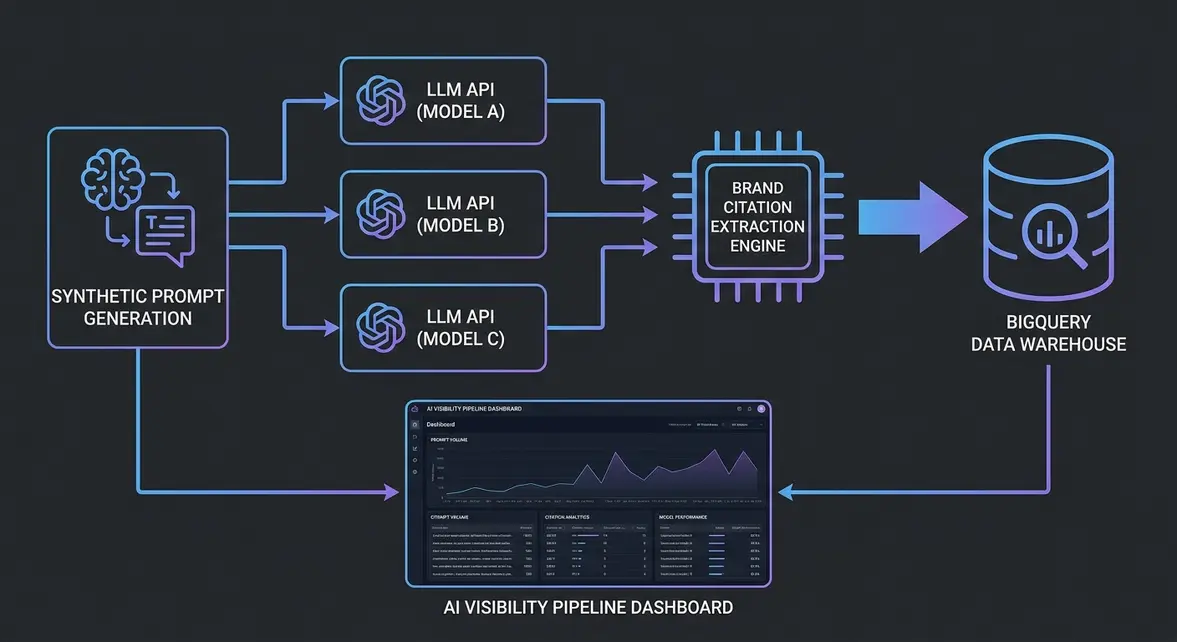
Deploying a production prompt tracking architecture involves executing scheduled synthetic queries through headless instrumentation or direct API integrations with grounded search toggled on. The execution worker dispatches prompts, structures the raw text completion, extracts cited URIs, and streams normalized JSON metrics into BigQuery for longitudinal visibility scoring.
Below is a Node.js worker implementation utilizing the OpenAI API with web-search tooling enabled, parsing structured citation and visibility metrics:
import OpenAI from 'openai';
import { z } from 'zod';
import { zodResponseFormat } from 'openai/helpers/zod';

const openai = new OpenAI({ apiKey: process.env.OPENAI_API_KEY });

const BrandVisibilitySchema = z.object({
  brandMentioned: z.boolean(),
  positionRank: z.number().nullable(),
  sentimentScore: z.number().min(-1).max(1),
  citedDomains: z.array(z.string()),
  competitorsDetected: z.array(z.string()),
  featureInaccuracies: z.array(z.string()),
});

export async function evaluatePromptVisibility(
  targetBrand: string,
  promptText: string
) {
  const response = await openai.beta.chat.completions.parse({
    model: 'gpt-4o',
    messages: [
      {
        role: 'system',
        content: `You are an evaluation engine. Analyze the prompt response regarding market solutions. Target brand to evaluate: ${targetBrand}.`,
      },
      { role: 'user', content: promptText },
    ],
    response_format: zodResponseFormat(BrandVisibilitySchema, 'visibility_analysis'),
    temperature: 0.2,
  });

  return response.choices[0].message.parsed;
}
Downstream telemetry is piped directly into a partitioned Google BigQuery table to monitor entity share-of-voice (SoV) and citation coverage over time:
CREATE TABLE IF NOT EXISTS `analytics_growth.llm_prompt_tracking` (
  run_timestamp TIMESTAMP,
  prompt_id STRING,
  prompt_category STRING,
  target_brand STRING,
  is_visible BOOL,
  position_rank INT64,
  sentiment_score FLOAT64,
  cited_urls ARRAY<STRING>,
  competitor_list ARRAY<STRING>
)
PARTITION BY DATE(run_timestamp)
CLUSTER BY target_brand, prompt_category;

-- Aggregating Brand Share of Voice across Generative Queries (Trailing 30 Days)
SELECT
  target_brand,
  prompt_category,
  COUNT(1) AS total_prompt_runs,
  ROUND(COUNTIF(is_visible) / COUNT(1) * 100, 2) AS generative_sov_percentage,
  ROUND(AVG(sentiment_score), 3) AS mean_sentiment,
  ROUND(AVG(position_rank), 1) AS mean_position
FROM `analytics_growth.llm_prompt_tracking`
WHERE run_timestamp >= TIMESTAMP_SUB(CURRENT_TIMESTAMP(), INTERVAL 30 DAY)
GROUP BY 1, 2;
Enterprise MRR Attribution and Generative Funnel Governance
Securing visibility inside generative responses directly influences pipeline velocity. Enterprise software buyers increasingly conduct mid-funnel vendor elimination inside conversational LLM interfaces prior to engaging a sales rep or submitting a form. When an LLM asserts that an enterprise platform lacks a required protocol (such as SAML SSO, HIPAA attestation, or multi-region data residency), that vendor is disqualified silently without generating a web session.
By implementing automated prompt tracking, enterprise growth teams detect inaccurate product claims within LLM grounding pipelines and deploy programmatic technical SEO countermeasures. These remediations include shipping schema-optimized machine-readable specifications (SoftwareApplication JSON-LD), deploying high-authority Markdown documentation specifically formatted for web-crawler tokenizers, and resolving third-party reference data errors across review networks that supply RAG indexers. Bridging this data-layer gap converts dark generative traffic into attributable pipeline while protecting contractual brand positioning at scale.
System Telemetry Source: Original Engineering Report
Blueprint di Crescita Correlati
Tutti gli Esperimenti →Vuoi implementare questa architettura nella tua pipeline?
Evita i lunghi cicli di vendita e le infinite call di scoperta. Invia il tuo collo di bottiglia di acquisizione o conversione per una diagnosi tecnica approfondita in asincrono.