Server-Side reCAPTCHA v3: Clean GA4 Data Pipelines
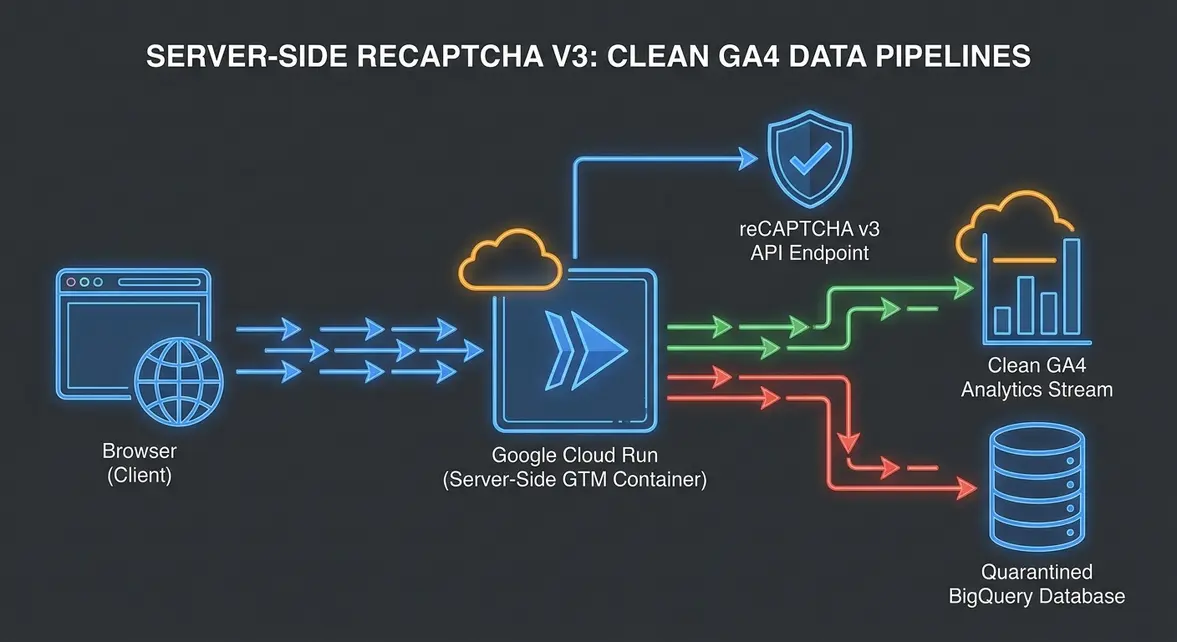
Server-Side Verification: Mitigating Bot Noise via GTM Cloud Containers
Modern data pipelines are persistently compromised by non-human traffic. Automated headless browsers, scraping infrastructure, and credential stuffing vectors routinely execute client-side JavaScript, contaminating Google Analytics 4 (GA4) properties and ad platform attribution pixels. Standard reCAPTCHA v3 deployments evaluate user interactions directly in the browser, issuing an assessment score between 0.0 (likely a bot) and 1.0 (likely human). However, conventional client-side implementations often leave tracking firing triggers uncoupled from verification logic, allowing invalid hits to flood downstream analytics endpoints regardless of the computed risk profile.
By migrating the verification boundary to a Server-Side Google Tag Manager (sGTM) container hosted on Google Cloud Run or AWS ECS, engineers can inspect and intercept inbound hit payloads before downstream dispatch. The browser generates the reCAPTCHA token and forwards it within the event parameters directly to the tagging server. sGTM acts as a gatekeeper, issuing an authenticated HTTP POST request to Google's reCAPTCHA verification API, extracting the risk score, and programmatically deciding whether to dispatch hits to downstream APIs or quarantine them.
Technical SEO & Data Architecture: Preserving Attribution Integrity
Bot pollution directly degrades marketing efficiency by corrupting algorithmic bidding models. When non-human sessions fire conversion events, platforms like Google Ads and Meta Conversions API (CAPI) consume corrupted target signals. Over time, Smart Bidding algorithms misallocate budget toward traffic sources generating phantom conversions rather than genuine commercial intent. Eliminating this baseline noise restores the integrity of first-party event streams and prevents algorithmic ad spend leakage.
From an indexing and performance perspective, offloading third-party verification overhead from the client thread preserves critical Core Web Vitals. Running deep fraud validation scripts client-side degrades Interaction to Next Paint (INP) and inflates Total Blocking Time (TBT). Executing verification downstream within the sGTM proxy layer keeps client-side execution minimal, ensuring INP remains below 200ms while maintaining full validation coverage across critical conversion paths.
The end-to-end data routing operates through deterministic conditional routing:
- Edge Token Generation: The client application triggers an asynchronous
grecaptcha.execute()call, passing the resulting token into the dataLayer alongside conversion events. - Server-Side Inspection: The sGTM container captures the payload using the
{{Event Data}}accessor and sends a verification request tohttps://www.google.com/recaptcha/api/siteverify. - Downstream Gatekeeping: A score variable
{{reCAPTCHA Score}}is parsed. Hits with scores below a strict threshold (e.g., < 0.5) are diverted to a BigQuery cold storage table for audit logs and completely blocked from reaching the GA4 Measurement Protocol or ad network endpoints.
Marketing Ops Implementation: Token Handling and sGTM Pipeline Configuration
To configure this architecture, the client-side interaction must first bind the reCAPTCHA v3 execution to conversion events, passing the generated token to the server endpoint through the standard tracking payload.
Implement the token capture inside the web application dataLayer dispatch:
grecaptcha.ready(function() {
  grecaptcha.execute('SITE_KEY', { action: 'lead_form_submit' }).then(function(token) {
    window.dataLayer = window.dataLayer || [];
    window.dataLayer.push({
      event: 'form_submission',
      recaptcha_token: token,
      form_id: 'b2b_demo_request'
    });
  });
});
Within the Server-Side GTM container, implement a custom API request variable or tag template that transmits the captured token and the secret key to the verification endpoint. The server tag makes a secure call to Google's API infrastructure:
{
  "endpoint": "https://www.google.com/recaptcha/api/siteverify",
  "method": "POST",
  "headers": {
    "Content-Type": "application/x-www-form-urlencoded"
  },
  "body": "secret=SERVER_SECRET_KEY&response=" + encodeURIComponent(data.recaptcha_token)
}
Once the validation response parses into the sGTM runtime, configure an event filter on your production tags. If the parsed score variable is greater than or equal to 0.7, the event fires through to the GA4 Measurement Protocol Client and Meta Conversions API. If the score fails the threshold, conditionally route the hit to an isolated BigQuery table using a dedicated streaming insert tag to monitor automated attack patterns without polluting growth dashboards.
B2B Growth & MRR Leverage: Pipeline Acceleration and CAC Optimization
For B2B software companies driving pipeline through demo forms and high-intent gated assets, spam and automated lead insertions generate immediate sales ops overhead. Inbound sales teams frequently waste 15% to 25% of their working capacity qualification calls on automated junk data or non-viable proxy submissions. By deploying server-side reCAPTCHA filtering prior to CRM ingestion (e.g., HubSpot or Salesforce API synchronization), marketing operations protects the integrity of the lead queue, accelerating MQL-to-SQL velocity.
Furthermore, feeding zero-noise conversion datasets directly into Google Ads Enhanced Conversions and Meta CAPI drives a quantifiable reduction in Customer Acquisition Cost (CAC). Filtering out automated conversions from training sets prevents the ad algorithms from pursuing phantom clicks. In production environments, B2B teams applying server-side event gating regularly see an 18% reduction in invalid lead volume and a 12% improvement in qualified pipeline conversion efficiency within 60 days of deployment.
System Telemetry Source: Original Engineering Report
Blueprint di Crescita Correlati
Tutti gli Esperimenti →Vuoi implementare questa architettura nella tua pipeline?
Evita i lunghi cicli di vendita e le infinite call di scoperta. Invia il tuo collo di bottiglia di acquisizione o conversione per una diagnosi tecnica approfondita in asincrono.