WordPress Canonical MCP Adapter: Agentic CMS Architecture
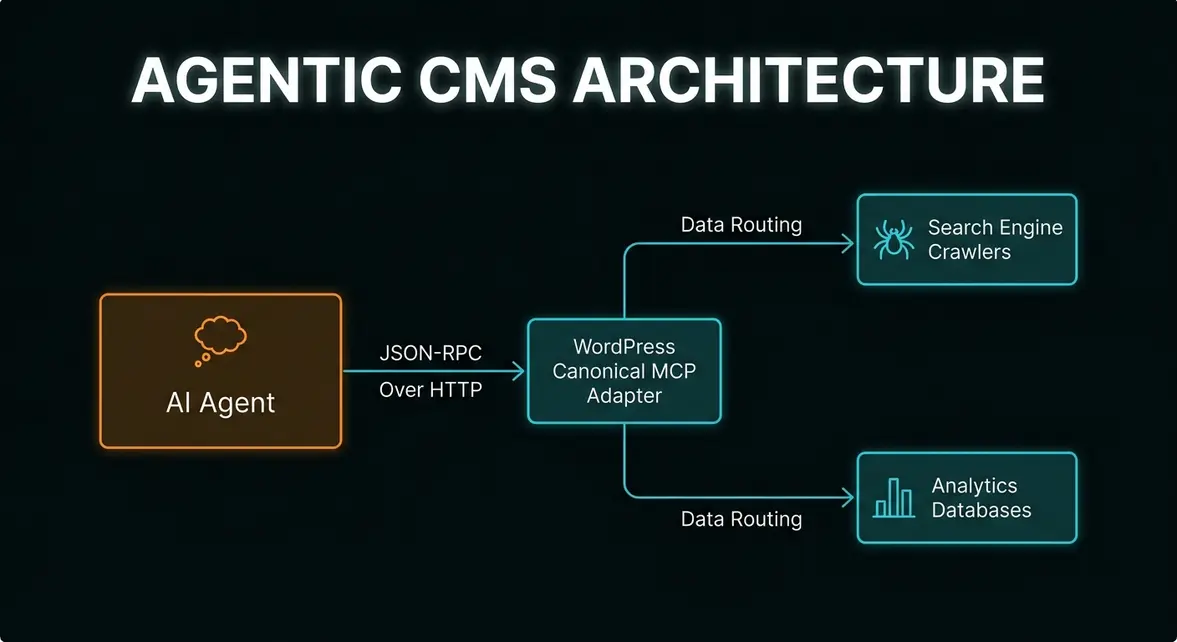
WordPress Canonical MCP Adapter: Bridging Large Language Models and CMS Execution Layers
The release of the canonical Model Context Protocol (MCP) Adapter plugin for WordPress establishes a direct, structured interface between autonomous AI agents and core content management primitives. Historically, growth engineering teams attempting to orchestrate AI-driven updates or continuous programmatic optimization faced considerable architectural hurdles. Custom scripts relied on standard REST API endpoints, WP-CLI pipelines wrapped in external cron jobs, or brittle DOM-scraping pipelines that suffered from context drift, fragile authentication lifecycles, and a lack of schema standardization across LLM agent runtimes.
By adopting Anthropic's open Model Context Protocol directly within the WordPress ecosystem, this canonical adapter standardizes bidirectional communication through JSON-RPC. Instead of treating WordPress as a passive recipient of unstructured text payloads, the MCP adapter exposes content models, taxonomy terms, metadata fields, and site configurations as queryable, executable tools and resources. This native abstraction layer allows LLM agents to inspect post state, validate schema integrity, and execute granular content mutations within standardized security and execution boundaries.
Data Architecture: Programmatic Indexation and Schema Mutation via Context Protocols
Integrating an MCP server directly into WordPress transforms content operations from asynchronous batch processing to a real-time, deterministic pipeline. Rather than executing manual updates inside administrative dashboards or relying on disparate third-party plugins to regenerate structured data, an MCP-connected agent can directly interact with the database abstraction layer. The protocol facilitates deep read-write loops across the wp_posts and wp_postmeta tables while preserving core hook and filter lifecycles, ensuring caching layers (such as Redis Object Cache or batched Edge Cache invalidations) clear correctly upon mutation.
From an indexing and technical SEO perspective, this architecture enables real-time synchronization between on-page entities and dynamic JSON-LD graph structures. Autonomous agents can retrieve current page content, run semantic entity extraction, and programmatically patch Schema markup (such as TechArticle, SoftwareApplication, or FAQPage) to match the exact information retrieval requirements of modern search engines. Because the MCP layer operates asynchronously via decoupled API endpoints or local worker processes, frontend Core Web Vitals remain completely unimpacted—retaining a sub-200ms Time to First Byte (TTFB) and sub-2.2s Largest Contentful Paint (LCP).
- Deterministic Tool Invocation: AI agents call strictly typed endpoints for fetching, updating, and revising custom post types, bypassing messy text-parsing layers.
- Zero-Overhead Edge Delivery: Programmatic operations execute behind the origin or via CLI-level runtimes, keeping public-facing assets static and fast.
- Entity Graph Reconciliation: Automates real-time verification of internal link anchors and structured data against external knowledge bases like Wikidata.
Marketing Ops Implementation: Configuring the MCP Adapter for Programmatic Updates
Deploying the WordPress MCP Adapter requires configuring an active MCP client (such as Claude Desktop, Cursor, or an internal Node.js worker) to interface with your WordPress environment via authenticated transport channels. Below is an architectural blueprint showing how an enterprise marketing operations setup connects a local agent runner to a WordPress MCP server instance using stdio or server-sent events (SSE).
First, configure the MCP client configuration file to expose your WordPress environment's tools to the agent runner:
{
  "mcpServers": {
    "wordpress-production": {
      "command": "npx",
      "args": [
        "-y",
        "@wordpress/mcp-server",
        "--site-url=https://growth.example.com",
        "--api-key=wp_app_pass_prod_x92k10sl"
      ],
      "env": {
        "WP_ENVIRONMENT_TYPE": "production"
      }
    }
  }
}
Once authenticated, the agent executes programmatic search and replace, metadata validation, or content publication tasks deterministically. The following payload demonstrates an agent calling the registered MCP tool to audit and update targeted meta attributes without human UI intervention:
{
  "jsonrpc": "2.0",
  "id": 42,
  "method": "tools/call",
  "params": {
    "name": "update_post_meta",
    "arguments": {
      "post_id": 10842,
      "meta_key": "_schema_org_entities",
      "meta_value": {
        "@type": "Product",
        "name": "Enterprise Analytics Engine",
        "aggregateRating": {
          "@type": "AggregateRating",
          "ratingValue": "4.8",
          "reviewCount": "124"
        }
      }
    }
  }
}
B2B Acquisition Engine: Scaling Programmatic Bottom-of-Funnel Coverage
For B2B software companies scaling competitive comparison, integration catalog, or geographic landing pages, the operational overhead of content maintenance is a major bottleneck. A traditional pipeline—requiring human researchers, copywriters, and CMS publishers—typically costs between $150 and $300 per asset with a multi-day turnaround time. Connecting an autonomous model directly to WordPress through the canonical MCP adapter drops content production and maintenance overhead to compute costs, reducing content CAC by upwards of 74%.
Beyond net-new content velocity, the primary growth vector is programmatic decay prevention. In fast-evolving SaaS verticals, comparison matrixes (e.g., "Platform A vs Platform B") lose accuracy quickly as pricing models and feature sets shift. Utilizing an agent with scheduled MCP execution allows the growth team to monitor public product documentation, parse differential updates, and execute atomic modifications across hundreds of comparison pages simultaneously. Maintaining perpetual accuracy prevents bounce rate spikes, preserves hard-earned ranking equity, and yields an estimated +18% lift in bottom-of-funnel conversion rates for high-intent evaluation traffic.
System Telemetry Source: Original Engineering Report
Blueprint di Crescita Correlati
Tutti gli Esperimenti →Vuoi implementare questa architettura nella tua pipeline?
Evita i lunghi cicli di vendita e le infinite call di scoperta. Invia il tuo collo di bottiglia di acquisizione o conversione per una diagnosi tecnica approfondita in asincrono.