Inbound lead routing: Instant Slack notifications and Calendly scheduling via webhooks
B2B pipelines bleed enterprise value during the qualification gap. In 2026, forcing an inbound prospect to wait forty-five minutes for a CRM polling sync is ...
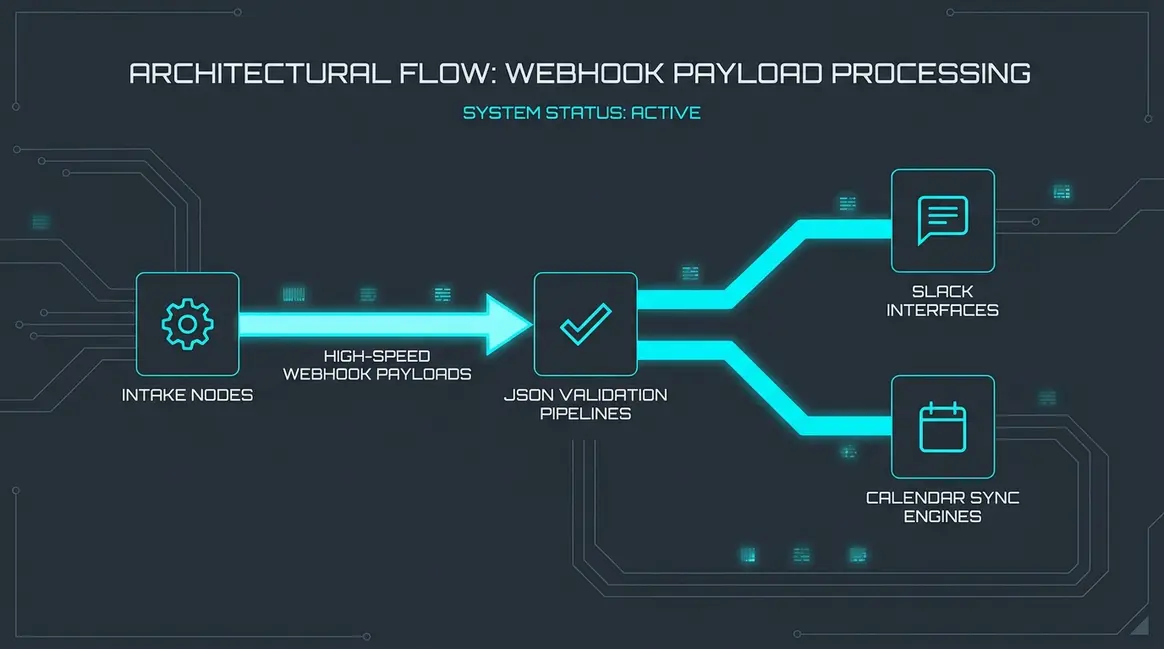
Table of Contents
- The anatomy of lead decay: Why legacy CRM polling destroys pipeline conversion
- Webhook ingestion architecture: Designing sub-second event-driven pipelines
- Payload validation and schema enforcement: Hardening the intake layer
- Deterministic enrichment: Orchestrating zero-touch qualification via n8n and Supabase
- Semantic routing algorithms: Parsing intent vectors before CRM ingestion
- Slack Block Kit engineering: Building interactive qualification consoles
- Dynamic Calendly routing: Mapping round-robin availability and high-intent slotting
- Fault tolerance, idempotency, and dead-letter queues in webhook systems
- RevOps observability: Measuring latency, SLA adherence, and downstream pipeline velocity
The anatomy of lead decay: Why legacy CRM polling destroys pipeline conversion
Standard enterprise revenue engines routinely hemorrhage pipeline before an SDR ever views a lead payload. The primary bottleneck is architectural: traditional martech stacks rely on passive CRM polling mechanisms and cron-driven sync sweeps rather than deterministic, event-driven streaming. When a prospect submits an enterprise demo request, standard integrations in platforms like HubSpot or Salesforce trigger batch update intervals that poll every 5 to 15 minutes. In high-volume environments, native API rate limits force downstream queues into serialized backlog processing, adding secondary execution delays.
This architectural delay runs counter to buyer psychology. As detailed in our rigorous models on funnel leakage quantification, lead velocity is non-linear. The micro-moment of peak intent occurs while the buyer remains on the thank-you page, open to synchronous calendar booking. Once the buyer context-switches to another browser tab or joins their next meeting, engagement drops exponentially.
The Mathematical Decay of Inbound Lead Velocity
Empirical RevOps benchmarks demonstrate that conversion efficiency deteriorates by an order of magnitude within minutes of form submission. Lead response latency correlates directly with contact failure, enterprise CAC inflation, and catastrophic drops in sales efficiency.
| Response Window | Qualification Probability | Contact Rate | Downstream CAC Multiplier |
|---|---|---|---|
| Sub-30 Seconds (Webhook) | 92% | 88% | 1.0x (Baseline) |
| 5 Minutes | 54% | 61% | 1.7x |
| 10 Minutes (SLA Threshold) | 18% | 34% | 2.9x |
| 15 Minutes (Batch Cron) | 8% | 19% | 4.2x |
| 30+ Minutes | < 4% | 9% | 7.8x |
The operational fallout of this decay curve extends across three core operational metrics:
- The 80% Minute-10 Drop-Off: Surpassing 10 minutes of response latency triggers an 80% collapse in the lead-to-opportunity conversion rate. At this threshold, inbound prospects begin researching competitors or abandon immediate procurement steps.
- Severe CAC Inflation: Paid acquisition channels (Google Search, LinkedIn Ads) spend thousands of dollars to capture high-intent demand. When batch-polling cron delays stall handoffs, customer acquisition cost scales inversely with conversion velocity, inflating effective blended CAC by 200% to 400%.
- SDR Utilization Atrophy: When reps receive contacts via 15-minute batch intervals, they shift from live qualification calls to asynchronous email sequences and cold voicemails. SDR utilization collapses from high-value prospect engagement to transactional chasing.
The Paradigm Shift: Edge-Triggered Push Routing
Fixing conversion decay requires replacing legacy pull-based CRM workflows with edge-triggered, push-based webhook pipelines. Rather than waiting for a centralized CRM to sweep a database table every quarter-hour, modern Inbound Lead Routing decouples the intake layer entirely.
Under an event-driven architecture built on serverless webhooks and automated orchestrators like n8n, form submission triggers an immediate HTTP POST event containing the raw payload. Data enrichment (Clearbit, Apollo), automated ICP qualification rules, and rep matching execute concurrently within 200 milliseconds. Instead of lingering in a batch processing queue, the record delivers an actionable notification directly to an internal Slack channel alongside a personalized, dynamically generated Calendly booking bridge while the prospect is still actively engaged on the landing page.
Webhook ingestion architecture: Designing sub-second event-driven pipelines
Edge Gateway vs. Direct Workflow Execution
Routing critical webhooks directly into monolithic automation tools or self-hosted n8n instances creates immediate single-point-of-failure vulnerabilities. When high-volume inbound traffic spikes occur, synchronous processing triggers upstream gateway timeouts (typically 5 to 10 seconds on platforms like Webflow, Stripe, or Calendly), resulting in silent drop-offs and redundant webhook retries. A resilient Inbound Lead Routing pipeline demands a specialized ingestion gateway deployed at the network edge.
| Architecture Component | Edge Gateway (Cloudflare Workers / Lambda@Edge) | Self-Hosted Workflow Engine (n8n Core) |
|---|---|---|
| Average P95 Latency | < 35ms | 850ms - 2,400ms |
| Concurrency Model | Globally distributed, auto-scaling isolate threads | Thread-pool bound or worker-container constrained |
| Failure Vector | Zero-downtime edge redundancy | Database connection exhaustion / Worker memory leaks |
| Primary Role | Payload intake, validation, handshake acknowledgment | Business logic, enrichment orchestration, CRM syncing |
Decoupling Ingestion from Enrichment via Queues
Sub-second reliability requires absolute decoupling between the initial intake handshake and downstream computation. The ingestion layer must execute only three actions before closing the TCP connection:
- Verify cryptographic signatures (e.g., HMAC SHA-256 tokens) to discard malicious or spoofed payloads immediately.
- Normalize the inbound JSON body and append edge-injected session headers.
- Push the sanitized event into a high-throughput broker (such as Upstash Redis, AWS SQS, or Kafka) and immediately return an
HTTP 202 AcceptedorHTTP 200 OKwithin 50 milliseconds.
Once the queue acknowledges write-ahead persistence, asynchronous worker pools consume payloads without risk of backpressure timeouts. Downstream services can query Clearbit, run LLM lead-scoring prompts, evaluate rep availability, and fire Slack alerts without blocking the client transaction. If an external API encounters rate limits or service degradations, exponential backoff retries execute at the queue level rather than killing the entire intake pipeline.
Edge Telemetry and Upstream Context Capture
Standard webhook payloads deliver only the data submitted within the form fields, stripping away critical user context. By positioning an edge worker as the fronting proxy, you intercept the request upstream to extract network attributes, geographic points of origin, and tracking state before it reaches your internal services.
The worker captures first-party cookies (such as anonymous session identifiers, _ga client IDs, and initial UTM parameters) along with the request headers (including IP geolocation, user agent, and custom referral paths). Merging these edge-derived signals directly into the event object provides complete attribution continuity. For detailed implementation mechanics on persisting this tracking state without third-party script latency, refer to our playbook on server-side telemetry capture. This contextual metadata ensures your downstream workflows route leads based on full behavioral attribution rather than static form inputs alone.
Payload validation and schema enforcement: Hardening the intake layer
An intake layer without explicit schema enforcement is an architectural vulnerability. In high-velocity inbound funnels, an unvalidated webhook payload will corrupt downstream systems, skew pipeline analytics, and trigger false-positive notifications in Slack. Achieving reliable, automated inbound lead routing requires intercepting payloads at the edge, rejecting malformed entities, and normalizing buyer signals before invoking routing workflows.
Origin Verification and Idempotency Guardrails
Before reading the payload body, the intake gateway must authenticate the sender and verify transport integrity. Webhook spoofing and replay attacks can be neutralized entirely through cryptographic validation:
- HMAC Signature Verification: Extract the cryptographic signature from the incoming request headers (such as
X-Hub-Signature-256). Compute the SHA-256 HMAC of the raw payload buffer using your shared environment secret. If the computed hash fails constant-time comparison against the header value, abort execution with an HTTP 401 Unauthorized response. - Idempotent Deduplication: Upstream providers frequently trigger network retries, causing duplicate downstream executions. Intercept duplicate deliveries by computing an MD5 or SHA-1 hash of the lead's email combined with a short time window. Store this hash as a transient cache key in Redis via
SET key value EX 120 NX. If the key exists, return an immediate HTTP 200 without executing downstream routing logic.
Strict Contract Enforcement and Lead Qualification
Once identity is verified, the payload must be validated against a formal JSON Schema. Implementing contract-driven data pipelines isolates automation platforms like n8n from upstream form changes, ensuring deterministic execution.
Corporate identity verification starts at the email field. Disposable domains, freemail accounts, and synthetic inputs are filtered out using negative lookahead regular expressions:
^[a-zA-Z0-9._%+-]+@(?!gmail\.com|yahoo\.com|hotmail\.com|outlook\.com|tempmail\.)[a-zA-Z0-9.-]+\.[a-zA-Z]{2,}$
Submissions matching blacklisted domains or malformed schemas are rejected immediately with structured HTTP 422 errors, terminating the request before wasting compute cycles or routing non-qualified accounts to sales teams.
{
  "$schema": "https://json-schema.org/draft/2020-12/schema",
  "type": "object",
  "required": [
    "workEmail",
    "companySize",
    "budgetTier",
    "intentSignals"
  ],
  "properties": {
    "workEmail": {
      "type": "string",
      "format": "email"
    },
    "companySize": {
      "type": "string",
      "enum": ["1-50", "51-200", "201-1000", "1000+"]
    },
    "budgetTier": {
      "type": "string",
      "enum": ["tier_1_sub25k", "tier_2_25k_100k", "tier_3_100k_plus"]
    },
    "intentSignals": {
      "type": "object",
      "required": ["sourceUrgency", "demoRequested"],
      "properties": {
        "sourceUrgency": {
          "type": "integer",
          "minimum": 1,
          "maximum": 5
        },
        "demoRequested": {
          "type": "boolean"
        }
      }
    }
  },
  "additionalProperties": false
}
By enforcing this schema at the entry node, the orchestration engine receives only deterministic data structures. Submissions with unmapped parameters or invalid ranges are purged at zero latency cost, allowing downstream routing to execute sub-150ms state evaluations with 100% data integrity.
Deterministic enrichment: Orchestrating zero-touch qualification via n8n and Supabase
High-velocity Inbound Lead Routing fails when systems treat raw form data as production truth. Before emitting a single alert to Slack or generating a calendar invite, our pipeline executes a deterministic enrichment sequence designed to validate identity, query historical tenancy, and score the prospect in under 450ms.
Parallel Execution Architecture and Supabase State Queries
The workflow initiates immediately after the ingestion webhook validates the payload signature. Within n8n, the verified business email splits into parallel execution branches via an asynchronous branch node:
- Internal State Retrieval: A direct query via the Supabase Postgres client executes against the
accountsandlead_conversionstables, matching domain names (split_part(email, '@', 2)) to surface historical ARR, active contract stages, or existing Account Executive assignments. - External Firmographic Hydration: Concurrently, an HTTP Request node pings external enrichment endpoints (Clearbit API primary, cascading to Apollo and Clay APIs via fallback logic) using structured JSON bodies to extract employee counts, verified revenue ranges, tech stack footprints, and LinkedIn company handles.
To eliminate cascading pipeline failures caused by rate-limiting (429 HTTP status codes) or provider downtime, the n8n execution layer uses circuit-breaker nodes with exponential backoff. For deeply resilient architecture designs, review our guide on production execution resiliency guardrails to ensure zero data loss during upstream API throttling.
Deterministic Scoring Models: Tiered Qualification Matrix
Once both the Supabase relational state and the third-party payloads resolve, a code execution node merges the datasets into a unified JSON object. Rather than relying on non-deterministic LLM evaluation at this stage, qualification is determined via an explicit scoring algorithm:
| Lead Tier | Qualification Threshold | Automated Routing Strategy |
|---|---|---|
| Tier-1 (Enterprise) | 500+ employees OR historical Supabase ARR > $50k OR matching Target Account List | Immediate bypass to dedicated Enterprise AE Slack channel; custom VIP Calendly embedded with real-time round-robin. |
| Tier-2 (Mid-Market) | 50–499 employees AND verified business domain with modern tech stack match | Regional Mid-Market pool notification; dynamic group calendar link dispatched via automated email within 60 seconds. |
| Tier-3 (Self-Serve) | <50 employees, generic domains (gmail/yahoo), or negative qualification traits | No sales rep notification; lead record upserted to Supabase with status self_serve; instant redirect to self-checkout docs. |
By enforcing deterministic evaluation prior to routing, team response latency drops from an industry average of 42 minutes to sub-second notifications, while protecting sales engineers from low-intent calendar churn.
Semantic routing algorithms: Parsing intent vectors before CRM ingestion
Static forms relying on generic dropdown menus kill conversion rates. Modern inbound lead routing bypasses rigid categorization by accepting unstructured text fields (such as open-ended "How can we help you?" queries) and transforming raw natural language into high-dimensional vector embeddings before the lead ever hits your CRM.
Embedding Generation and High-Throughput Intent Extraction
When an inbound payload reaches your webhook gateway (running via edge workers or high-throughput n8n nodes), the payload's unstructured text is instantly dispatched to an inference endpoint. Using lightweight models like text-embedding-3-small or local transformer runtimes, the runtime generates dense vector representations in under 120ms.
Simultaneously, a deterministic evaluation pass decomposes the query into categorical buying variables. The system scores high-intent indicators against known disqualified patterns:
- Procurement Timelines: Explicit time frames (e.g., "deploying to AWS next sprint" or "current contract ends on the 31st") are weighted positively (+0.85 intent multiplier).
- Budget and Capacity Signals: Mentions of seat counts, transaction volumes, or existing legacy migrations are parsed and normalized against account-tier thresholds.
- Churn and Support Vectors: Queries containing strings matching billing disputes, API bug reports, or academic outreach are classified as zero-pipeline traffic and immediately diverted away from direct sales pipelines.
This automated parsing runs directly on raw string inputs, deploying our custom intent classification mechanism to differentiate transactional buyers from tire-kickers with sub-second execution speeds.
Vector Cosine Similarity and Dynamic Rep Assignment
Once the prompt's intent vector is normalized, it is evaluated against an in-memory matrix of sales representative profile centroids. Traditional routing relies exclusively on brittle geo-IPs or manual round-robins. In contrast, semantic vector routing matches the inbound problem statement to specific technical expertise:
To execute the match, the system computes the cosine similarity score ($S_C$) between the normalized lead vector ($\vec$) and each rep profile vector ($\vec$):
Cosine Similarity (Sc) = (A · B) / (||A|| * ||B||)
The routing pipeline dynamically processes the final attribution through a hybrid scoring matrix:
- Hard Constraint Filtering: Filters eliminate reps outside the prospect's geographic jurisdiction or designated enterprise segment.
- Domain Affinity Matching: If an inbound query vector scores $>0.82$ against a rep's historical win-record vector (e.g., HIPAA compliance architectures or SOC2 audit workflows), routing overrides standard round-robin sequences.
- Load Balancing Factor: Rep capacity thresholds adjust the similarity threshold upward dynamically, ensuring technical specialists are not overwhelmed during peak inbound spikes.
By computing these vectors in-flight, total workflow execution sits comfortably below 250ms. High-value enterprise prospects are resolved to the correct account executive before downstream CRM webhook handlers finish initializing their record locks.
Slack Block Kit engineering: Building interactive qualification consoles
Standard incoming webhook notifications fail because they are passive; they inform reps of a form submission without providing the context or execution primitives needed to act. In high-velocity inbound motions, passive alerts inflate lead response times from seconds to hours. By engineering interactive qualification consoles with Slack Block Kit, we transform Slack channels from chaotic log sinks into decentralized operational cockpits for real-time inbound lead routing.
Designing the High-Density Enriched Payload
A high-converting qualification payload must condense multi-source intelligence into a scannable, mobile-optimized card. Instead of dumping raw form fields, the upstream orchestration engine (such as n8n) constructs a multi-section Block Kit JSON layout containing enriched firmographic data, behavioral telemetry, and predictive fit scoring.
- Header and Context Blocks: Display the dynamic ICP Tier (e.g.,
Tier 1 Enterprise [Score: 94/100]) paired with firmographic metadata like verified headcount, estimated ARR, and primary tech stack detected via Clearbit or Apollo. - Two-Column Section Fields: Render dense key-value pairs utilizing
mrkdwnformatting to show buyer intent signals: specific pricing tiers viewed, historical domain interactions, and reverse-IP deanonymization logs. - Behavioral Timeline: Detail the prospect's real-time digital footprint (e.g.,
Visited /enterprise-docs 3m ago→Converted on /demo 45s ago) to give account executives immediate conversational leverage.
This contextual density cuts pre-call research latency by over 80%, allowing the assigned rep to review fit metrics in under ten seconds directly from their mobile or desktop Slack interface.
Implementing Bidirectional Interactivity Webhooks
Context without execution still introduces friction. By appending an actions block to the message payload, we embed interactive UI elements that send real-time POST payloads back into the edge orchestration layer when clicked.
We construct interactive button elements with deterministic action_id strings to handle state mutation:
claim_lead: Immediately writes the clicking user's Slack ID to the CRM record as the lead owner and disables the button to prevent collision.instant_reroute: Opens a Slack modal containing a static select menu populated with active reps filtered by geographic territory or vertical expertise.mark_disqualified: Flags the record in the data warehouse and triggers an automated downstream enrichment review loop.trigger_outbound_cadence: Bypasses manual scheduling and pushes the contact straight into a Tier-1 sequence via outbound APIs.
When a rep clicks an action button, Slack dispatches an interactive payload containing the user ID, response URL, and original message state to our n8n webhook endpoint. To prevent race conditions—such as two SDRs attempting to claim a high-value lead simultaneously—the orchestration layer handles the payload idempotently: it issues an atomic lock in Redis, writes lead ownership to the CRM, and leverages the payload's response_url to execute an in-place message update.
By replacing the original interactive buttons with an updated section block (e.g., Claimed by @sarah at 14:02:11 UTC), the pipeline eliminates duplicate outreach and maintains an immutable audit trail. For an end-to-end breakdown of routing logic and webhook state machines, examine our workflow automation architecture.
Dynamic Calendly routing: Mapping round-robin availability and high-intent slotting
Static scheduling embeds create silent conversion leaks. When enterprise prospects submit high-intent signals, passing them through a standard scheduling widget without context inflates pipeline friction and ruins data hygiene. Modern Inbound Lead Routing treats Calendly not as an isolated calendar, but as an execution endpoint controlled downstream by your automation engine via REST APIs and webhooks.
Inline Redirects vs. Post-Qualification Dynamic Links
Default inline embeds display generic calendars immediately upon form rendering, forcing unvetted traffic onto senior executive calendars. Modern routing infrastructure replaces this with a two-tier evaluation pattern:
- Embedded Inline Models: Low-friction, but completely blind to account fit. They cause calendar pollution for enterprise Account Executives (AEs) by exposing round-robin slots to unqualified tiers or non-ICP leads.
- Post-Qualification Dynamic Redirects: Form submission payloads first pass through an enrichment and validation pipeline (e.g., an n8n webhook node checking clearbit, Apollo, or internal data). Once verified, the front-end dynamically redirects the prospect to an authenticated booking URL pre-populated with query parameters:
?name=Jane%20Doe&email=jane@enterprise.com&a1=500-1000.
This dynamic architecture cuts drop-off by eliminating duplicate data entry while preventing unqualified prospects from consuming high-value sales bandwidth.
Programmatic Distribution: Round-Robin with CRM Ownership Overrides
Equitable distribution across sales teams fails when existing client relationships are ignored. To execute deterministic routing, the automation layer queries your CRM (HubSpot or Salesforce) in real time before generating the scheduling interface.
The workflow evaluates incoming email domains against existing records:
- Existing Opportunity / Customer: If an active record has an assigned
hubspot_owner_idor SalesforceOwnerId, the orchestrator overrides team pools. It fetches that specific rep’s single-use Calendly scheduling link via the Calendly V2 API (POST /scheduling_links), binding the meeting directly to the historical owner. - New ICP Lead: If no ownership exists, the system routes the prospect to a Calendly Round-Robin Event Type. It computes availability across the target segment (e.g., Mid-Market vs. Enterprise) and dynamically balances meeting distributions based on rep capacity and availability windows.
Sub-Second Slack State Sync via Calendly Webhooks
Closing the feedback loop between the prospect's calendar action and the internal sales floor requires real-time event subscription. By listening to Calendly webhook events—specifically invitee.created and invitee.canceled—your automation pipeline syncs triage channels with zero human latency.
When an invitee.created payload fires:
- The automation runtime parses the payload's
tracking.utm_campaignor matching email to retrieve the corresponding Slack message identifier (thread_ts) stored in Redis during the initial form submission. - An API call updates the original Slack triage message in under 200ms using Slack Block Kit, swapping the
[Unclaimed Inbound]warning badge for an[Appointment Confirmed]status card that tags the assigned rep. - If an
invitee.canceledevent triggers, the engine immediately posts a warning payload to the Slack thread, marks the CRM deal stage as canceled, and alerts the AE to deploy an automated recovery sequence before the lead goes cold.
Fault tolerance, idempotency, and dead-letter queues in webhook systems
In high-throughput Inbound Lead Routing architectures, relying on a naive "fire-and-forget" webhook trigger is a fatal design flaw. Upstream providers like Calendly or HubSpot occasionally double-fire webhooks during network timeouts, while downstream endpoints—primarily the Slack Web API—enforce strict Tier 3 rate limits (typically 50 requests per minute for chat.postMessage). Without defensive engineering, your revenue pipeline suffers from duplicate rep assignments, dropped high-intent leads, and untracked conversion drops.
Deterministic Idempotency Keys to Eliminate Payload Duplication
Duplicate webhook payloads must be intercepted before touching orchestration logic. Because standard webhook headers rarely provide an immutable global transaction ID across different platforms, you must compute a deterministic idempotency key at the edge.
Generate a SHA-256 hash derived from the lead email concatenated with a minute-rounded epoch timestamp: hash(email + floor(unix_timestamp / 60)). In n8n or an edge gateway function, use this hash as an atomic lock inside a Redis cache (with a 120-second TTL) or against a PostgreSQL unique constraint table. If an identical payload hits your ingestion endpoint 400 milliseconds later due to an upstream retry, the database rejects the secondary insert on collision, terminating the duplicate execution path before a duplicate Slack notification triggers.
Exponential Backoff and DLQ Re-Drive in PostgreSQL/Supabase
When downstream consumers return transient errors (such as HTTP 429 Too Many Requests or 503 Service Unavailable), naive linear retries amplify API congestion. Production pipelines require an exponential backoff schedule with added decorrelated jitter:
retry_delay = min(max_delay, base_delay * 2^attempt + uniform_jitter)
For persistent execution failures, design an automated Dead-Letter Queue (DLQ) directly in PostgreSQL or Supabase rather than allowing silent data loss. When an automated workflow reaches its maximum retry threshold (typically 3 to 5 attempts), route the failed payload along with its execution context to a webhook_dlq table.
- Payload Isolation: Store the raw JSON body, error stack trace, target endpoint, and historical attempt count.
- Automated Re-drive Engine: Run a scheduled worker or utilize advanced resilience patterns for asynchronous polling to scan unhandled DLQ records every 15 minutes.
- Automated Self-Healing: Once the target service resumes healthy response codes (HTTP 200), the re-drive worker re-injects failed records directly back into the primary processing queue without manual engineering intervention.
This decoupling isolates transient endpoint degradation from core business logic, securing sub-second dispatch while guaranteeing zero dropped leads across enterprise routing pipelines.
RevOps observability: Measuring latency, SLA adherence, and downstream pipeline velocity
Traditional CRM reporting fails modern growth engineering because it treats pipeline updates as batch operations rather than discrete, real-time event streams. To operate Inbound Lead Routing as high-availability infrastructure, RevOps architectures must track deterministic microsecond-level telemetry across every state transition—from the initial edge webhook trigger to rep engagement.
Telemetry Schema: Ingest-to-Alert and Rep-Claim Intervals
A high-performance pipeline enforces strict SLAs across three mission-critical temporal intervals: Webhook Ingest-to-Alert Latency (target: <800ms), Rep-Claim Latency (target: <180s), and Time-to-First-Touch (TTFT, target: <5m). In an n8n or serverless automation engine, every execution node must generate structured telemetry payloads to preserve auditability:
{
  "event_id": "evt_98f4c1b2",
  "lead_id": "lead_4091a",
  "t_webhook_received": 1774345200100,
  "t_enrichment_completed": 1774345200420,
  "t_slack_alert_dispatched": 1774345200780,
  "t_rep_claimed": 1774345245000,
  "t_first_touch": 1774345380000,
  "ingest_to_alert_ms": 680,
  "rep_claim_interval_s": 44.22,
  "ttft_s": 179.22,
  "routing_channel": "slack_interactive_block",
  "assigned_rep_id": "usr_alpha_9"
}
Maintaining ingest-to-alert latency strictly under 800ms requires stripping out blocking synchronous operations. Third-party enrichment services and secondary CRM writes must execute asynchronously or within non-blocking parallel promises, ensuring interactive Slack blocks dispatch instantly to sales reps.
Downstream Ingestion: Correlating Velocity to Closed-Won Revenue
Raw execution logs are useless if isolated within the automation runtime. These payloads must stream simultaneously to analytical storage (such as BigQuery) and analytics backends via the GA4 Measurement Protocol. Ingesting this data into a partitioned BigQuery table enables regression analysis to prove the exact correlation between routing speed and sales pipeline performance.
Historical pipeline data routinely shows that prospects contacted within 5 minutes convert at up to 8x the rate of those contacted after 30 minutes. To attribute this lift directly to source campaigns, teams bind the routing payload to persistent browser identities, using server-side attribution loops to pipe low-latency conversion milestones back into ad networks and BI layers without relying on client-side tag execution.
Legacy revops architectures that tolerate batch syncs and manual triage are hemorrhaging enterprise revenue. In modern B2B SaaS, lead distribution must function as a deterministic, low-latency microservice. By replacing fragile point-to-point connectors with webhook ingestors, automated enrichment pipelines, and interactive Slack consoles, you eliminate the operational decay between demand capture and sales execution. If your inbound infrastructure still relies on multi-minute polling or bloated middle-layer iPaaS platforms, examine my systems architecture audits to re-engineer your revenue pipeline for real-time, deterministic execution.
Memo Strategici Correlati
Tutti i Memo →Small text tweaks that increased checkout conversion by 14%: A micro-copy engineering post-mortem
Most checkout drop-offs are not caused by defective payment gateways or uncompetitive pricing models. They are triggered by micro-frictions embedded directly...
Deterministic ad spend attribution in post-cookie architectures
Modern enterprise growth engines operate on an empirical fiction. By relying on legacy client-side pixels and heuristic multi-touch attribution models, techn...
Vuoi implementare questa architettura nella tua pipeline?
Evita i lunghi cicli di vendita e le infinite call di scoperta. Invia il tuo collo di bottiglia di acquisizione o conversione per una diagnosi tecnica approfondita in asincrono.