LLM semantic routing: Architecting zero-touch model tiering for cost optimization
Monolithic model selection is the primary margin killer in production B2B AI architectures in 2026. Routing every raw user prompt directly into frontier LLMs...
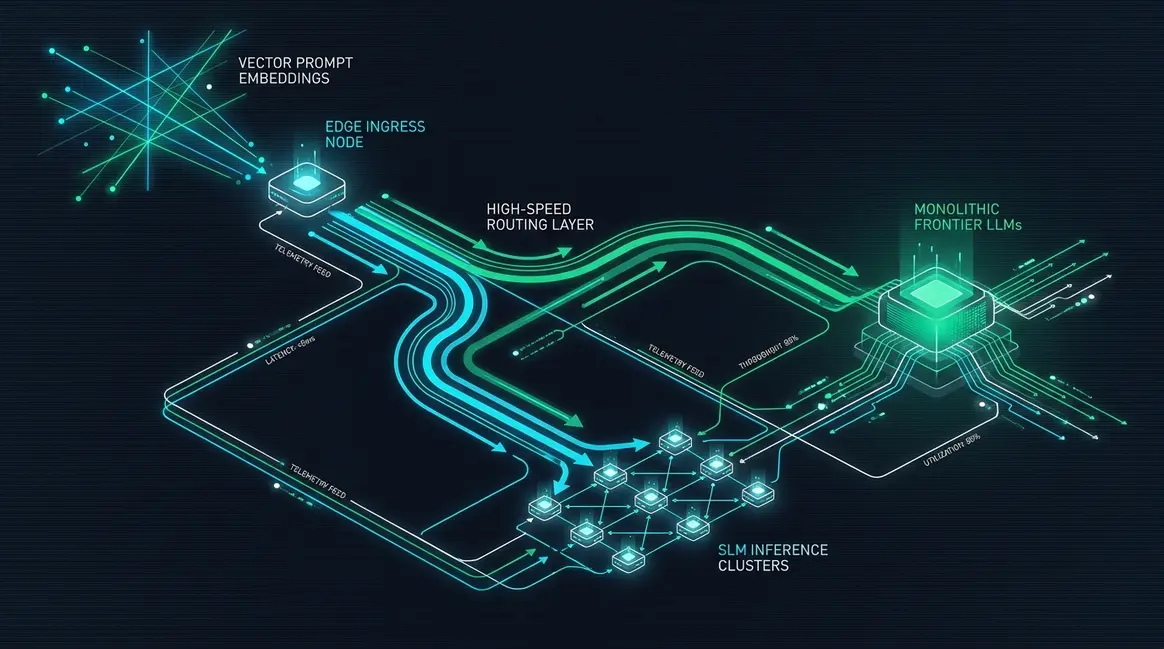
Table of Contents
- The economic failure of monolithic model dispatch in enterprise SaaS
- Deconstructing prompt entropy: The classification taxonomy of small vs large models
- Edge-native vector classification: Achieving sub-10ms prompt triaging
- Building the deterministic vector router: Centroid clusters and cosine gating
- The SLM inference tier: Quantization, local execution, and low-latency task execution
- Frontier LLM fallback patterns: Managing complex reasoning and multi-step orchestration
- Unit economics benchmark: Token consumption and cost telemetry at scale
- Production telemetry, shadow routing, and continuous threshold calibration
- Zero-touch resilience: Failover mechanics and schema validation guardrails
- Implementing semantic routing: The enterprise execution checklist
The economic failure of monolithic model dispatch in enterprise SaaS
Enterprise SaaS applications routinely bleed capital by treating intelligence as an undifferentiated commodity. In a monolithic dispatch architecture, engineering teams hardcode a single frontier endpoint—such as GPT-4o or Claude 3.5 Sonnet—across the entire application lifecycle. This architectural anti-pattern creates runaway operational expenditure: mid-market B2B platforms scale past $45,000 per month in inference billing while delivering near-zero marginal reasoning value to end users. The financial degradation stems from paying frontier-grade compute tariffs for deterministic, low-entropy operations.
The Unit Economic Asymmetry of Frontier Dispatch
When production workloads direct user inputs into a monolithic pipeline, high-parameter frontier models expend compute on tasks that require simple pattern matching rather than deep cognitive traversal. Token logs in enterprise environments show that routine payloads—conversational greetings, schema normalization, classification, and deterministic data extractions—dominate usage profiles. Paying frontier rates for these queries degrades gross margins without improving output fidelity.
| Model Class | Blended Cost / 1M Tokens | Optimal Workload Profile | Active Parameter Utilization |
|---|---|---|---|
| Frontier Models (e.g., Claude 3.5 Sonnet, GPT-4o) | $3.00 – $15.00 | Multi-step synthesis, ambiguous coding tasks, strategic reasoning | Hundreds of billions to trillions (MoE/Dense) |
| Quantized / Task SLMs (e.g., Llama-3-8B-Instruct, Mistral-7B) | $0.05 – $0.20 | Deterministic extraction, classification, syntax validation | 3B – 8B parameters (INT4/FP8 quantization) |
Directing a payload that needs a boolean response or JSON restructuring to a model running at $15.00 per million tokens represents a 75x to 300x cost penalty compared to task-specialized SLMs. Production telemetry reveals that 75% to 85% of real-world enterprise prompts do not require multi-step chain-of-thought or extensive neural weight traversal; they require low-latency execution of rigid formatting constraints.
Decoupling Ingress via LLM Semantic Routing
The solution requires abandoning naive, synchronous request forwarding—where clients wait on a single blocking API call—and migrating to an asynchronous, decoupled ingress pipeline. By deploying LLM Semantic Routing at the API gateway layer, systems evaluate incoming embeddings, intent vectors, and structural requirements before allocating compute resources.
- Edge Intent Classification: Fast cosine-similarity checks against centroid intent clusters determine whether a prompt requires heuristic validation, small-model processing, or heavy reasoning.
- Payload Segregation: Routine classification and formatting pipelines route dynamically to quantized self-hosted engines or low-tier hosted APIs, dropping p95 latency below 200ms.
- Dynamic Frontier Fallbacks: Expensive models are invoked exclusively when ambiguity scores exceed established certainty thresholds or when edge validation detects complex, multi-variable logic.
Decoupling request ingestion from static model endpoints stops margin erosion at scale. Engineering teams looking to optimize this pipeline can operationalize this routing mechanism using an end-to-end burnless API cost reduction protocol that drops blended token expenditure without sacrificing output accuracy.
Deconstructing prompt entropy: The classification taxonomy of small vs large models
Engineering a cost-optimized inference pipeline hinges on quantifying prompt complexity before dispatching payloads to downstream compute engines. In standard algorithmic routing, engineers often rely on surface-level heuristics: prompt character length, token counts, or raw token-level Shannon entropy ($H(X) = -\sum P(x) \log_2 P(x)$). In production systems, these surface-level metrics fail. A 4,000-token prompt containing raw, uncurated CSV data requires zero cognitive reasoning—only deterministic transformation—while an 18-token prompt asking for an architectural trade-off analysis requires high-dimensional contextual abstraction. Effective LLM Semantic Routing requires separating syntactic entropy from structural and cognitive complexity.
The Failure of Surface Heuristics: Perplexity vs. Semantic Intent
Static heuristics fail because token distribution variability does not correlate with task difficulty. A base64-encoded string, an unformatted JSON dump, or a dense clinical report demonstrates high lexical entropy and high model perplexity; yet, extracting a single key-value pair from that payload requires zero logical deduction. Conversely, a terse prompt such as "Design a zero-downtime database migration strategy for high-write sharded PostgreSQL" exhibits low token entropy, minimal prompt length, but near-infinite divergent solution paths.
When automated routers (like custom vector classifiers or n8n intent-evaluator nodes) inspect solely lexical density, they over-allocate frontier model compute to unstructured data dumps and starve complex heuristic queries on smaller architectures. Robust routing requires intent vector parsing—evaluating the computational depth, constraint density, and deterministic predictability of the desired output.
The Tripartite Prompt Complexity Taxonomy
To establish deterministic execution boundaries between Small Language Models (SLMs) and frontier Large Language Models (LLMs), runtime payloads are classified into three computational tiers:
- Deterministic/Structural (Low Latency / Low Cognitive Overhead): Involves strict token restructuring, regex-adjacent formatting, Named Entity Recognition (NER), classification, and JSON schema normalization. The output mapping space is tightly constrained.
- Synthesizing/Contextual (Bounded Non-Divergent Reasoning): Involves context processing over static token spaces—such as standard RAG synthesis, document summarization within clear contextual guardrails, and extractive semantic querying. Deductive leaps are limited to the provided retrieval context.
- Divergent/Heuristic (High-Dimensional Dynamic Reasoning): Involves open-ended code generation, strategic trade-off modeling, recursive debugging, non-linear logic, and cross-domain synthesis. The solution space is unconstrained, requiring frontier-grade emergent reasoning capabilities.
| Prompt Class | Task Parameters | Model Architecture Boundary | Representative Engines |
|---|---|---|---|
| Deterministic / Structural | Constrained state transitions, entity parsing, strict schema output, near-zero ambiguity. | Local / Edge SLM (<10B Parameters) | Mistral NeMo 12B, Llama 3.2 (3B/8B), Qwen 2.5 7B |
| Synthesizing / Contextual | Bounded RAG deduction, static reference synthesis, contextual alignment. | Intermediate SLM / Compact LLM (8B to 70B Quantized) | Qwen 2.5 14B/32B, Llama 3.3 70B, Gemma 2 27B |
| Divergent / Heuristic | Recursive logic, novel code synthesis, high semantic entropy, multi-constraint planning. | Frontier Cognitive LLM (MoE / Heavyweight) | Claude 3.7 Sonnet, GPT-4.5, Gemini 1.5 Pro |
By implementing vector-based intent classification at the router stage, automated orchestration engines direct upwards of 68% of inbound organizational traffic away from premium API tiers directly to dedicated SLM inference pools, eliminating token over-provisioning without degrading task fidelity.
Edge-native vector classification: Achieving sub-10ms prompt triaging
Implementing dynamic model tiering requires deterministic ingress speed. If your decision layer consumes 200 milliseconds simply determining whether a prompt belongs to Llama 3 8B or Claude 3.5 Sonnet, you negate the execution speed advantages of smaller models and severely degrade your P99 latency SLAs.
The Failure of Centralized Python Ingress Routing
Most architectures default to deploying Python-based microservices—typically FastAPI or LangChain stacks—running in centralized cloud regions to evaluate user intent. This setup introduces structural latency penalties that render real-time optimization counterproductive:
- Network Traversal Tax: Routing prompts from global users through regional load balancers back to an origin cluster incurs 60ms to 120ms in round-trip transmission overhead before compute execution even begins.
- Runtime Overhead and Cold Starts: Centralized containerized runtimes scaling dynamically introduce 150ms+ cold starts and garbage collection pauses that destroy predictable tail latency.
- Orchestration Bloat: Heavy abstraction frameworks pull in excessive dependencies, making sub-50ms total triaging functionally impossible under peak concurrent loads.
Effective LLM Semantic Routing requires shifting prompt classification directly to the network perimeter using distributed edge computing runtimes that run bare-metal isolates within single-digit milliseconds of the end user.
Ingress Execution via WASM and Quantized ONNX Models
By leveraging V8 isolates on globally distributed CDN workers, you eliminate centralized network hops entirely. Instead of orchestrating an external API call to generate embeddings, the classification engine runs directly inside a WebAssembly (WASM) container compiled with ONNX Runtime Edge.
We deploy int8-quantized representations of lightweight bi-encoders—specifically all-MiniLM-L6-v2 (22MB quantized) or bge-small-en-v1.5 (33MB quantized)—packaged directly into edge isolate assets. When a prompt hits the ingress edge:
- The WASM-compiled Hugging Face Tokenizers engine parses the raw string in memory with zero heap allocations.
- The quantized ONNX tensor model performs a single-pass inference step, transforming the prompt into a 384-dimensional dense vector in under 8ms.
- The embedding is compared via dot-product or cosine similarity against pre-computed cluster centroids (representing structured tasks, conversational queries, and high-reasoning workloads) stored locally in worker memory.
Deterministic Sub-10ms Ingress Dispatch
Because reference vectors for system routing classes reside directly in L1 isolate memory, similarity calculation against 50 canonical intent profiles takes less than 1.2ms. The entire pipeline—from raw ingress stream to route destination—resolves in 6ms to 9ms.
Using custom edge middleware, the CDN worker immediately rewrites the upstream gateway target. Prompts requiring simple retrieval or standard transforms route instantly to high-throughput endpoints (like quantized Llama 3 8B or Mistral 7B instances), while complex logic trees, architectural analysis, or tool-use prompts dispatch to frontier model gateways.
The result is a zero-origin-penalty ingress gate: your infrastructure saves between 40% and 70% in downstream API compute costs without adding noticeable delay to the user experience.
Building the deterministic vector router: Centroid clusters and cosine gating
Deterministic LLM Semantic Routing replaces stochastic, high-latency model-graded evaluations with deterministic geometric classification. Instead of prompting an upstream orchestrator to determine whether a query requires Claude 3.5 Sonnet or can be handled by a quantized Llama-3-8B instance, the router maps inbound requests into dense embedding space and evaluates cosine similarity against statically computed domain centroids.
Mathematical Formulation and Centroid Precomputation
To eliminate runtime clustering overhead, domain centroids are precalculated offline across four defined operational boundaries:
- SQL Query Generation: Target tier: SLM (e.g., Qwen-2.5-Coder-7B). Centroid derived from natural-language-to-schema extraction datasets.
- Customer Churn Analysis: Target tier: Frontier LLM (e.g., GPT-4o). Centroid populated with complex multivariate synthesis prompts.
- Date Range Extraction: Target tier: Deterministic regex/Micro-SLM (e.g., SmolLM-360M). Centroid clustered around temporal normalization queries.
- Conversational Smalltalk: Target tier: Ultra-low latency edge model (e.g., Gemma-2-2B). Centroid composed of basic chitchat and greeting datasets.
Given a cluster of domain-specific reference embeddings S_k = {v_1, v_2, ..., v_n} generated via an optimized embedding model like text-embedding-3-small (normalized to unit length), the offline cluster centroid C_k is computed as:
C_k = normalize( (1 / |S_k|) * sum(v_i) )
By enforcing unit normalization at precomputation time, runtime cosine similarity collapses to a dot product computation, as detailed in our analysis of production semantic search architectures.
Cosine Gating and Ambiguity Escalation
During runtime dispatch, an incoming prompt vector u is evaluated against each precomputed centroid C_k. The gating decision follows an absolute threshold policy combined with a boundary separation check:
Sim(u, C_k) = dot_product(u, C_k)
The routing pipeline operates under three deterministic execution paths based on an acceptance threshold alpha = 0.82 and a separation margin epsilon = 0.05:
- Direct Deterministic Route: If
Sim(u, C_primary) >= 0.82and(Sim(u, C_primary) - Sim(u, C_secondary)) >= 0.05, the prompt is immediately dispatched to the specific domain model mapped toC_primary. - Ambiguous Multi-Centroid Overlap: If
Sim(u, C_primary) >= 0.82but(Sim(u, C_primary) - Sim(u, C_secondary)) < 0.05, the query resides on a topological decision boundary (e.g., an analytic request combining SQL syntax with churn correlation). The prompt automatically triggers an architectural fallback escalation protocol, routing directly to the frontier model to prevent task failure. - Out-of-Distribution (OOD) Fallback: If
max(Sim(u, C_k)) < 0.82across all domains, the payload is labeled unclassified and routed to a general-purpose model tier while logging the vector for offline cluster re-calibration.
In-Memory Execution Pipeline
Production routing cannot tolerate the connection pooling or disk I/O penalties associated with external vector databases. While persistent vector storage is essential for broad-scale retrieval systems—such as those implemented in our Postgres vector storage implementations—runtime query classification requires microsecond execution.
The router maintains centroids in an aligned, contiguous in-memory Float32 array within the application runtime (e.g., Node.js memory space or an n8n custom TypeScript execution block). For a 1536-dimension embedding, calculating dot products across four centroids requires approximately 6,144 floating-point operations. This achieves an end-to-end routing latency under 12 milliseconds (excluding embedding generation time), cutting API routing overhead by 98% compared to multi-agent LLM routers.
The SLM inference tier: Quantization, local execution, and low-latency task execution
The enterprise reluctance toward open-weight Small Language Models (SLMs) stems from an outdated benchmark paradigm: evaluating 3B to 8B parameter models on open-ended conversational coherence rather than bounded programmatic tasks. In production-grade LLM Semantic Routing architectures, treating frontier models like GPT-4o or Claude 3.5 Sonnet as the default handler for atomic operations—such as intent classification, data extraction, or structural normalization—burns capital for zero marginal accuracy gain. When properly optimized, quantized open-weight models achieve strict parity with proprietary frontier engines at roughly 1/30th of the inferencing cost, all while cutting time-to-first-token (TTFT) from 800ms down to sub-90ms latency bands.
High-Throughput Quantization and Compute Topologies
Deploying SLMs effectively requires selecting the correct quantization format tailored to your serving infrastructure. Running full 16-bit precision weights on standard cloud instances negates the economic leverage of routing. Instead, modern production pipelines rely on precise weight compression:
- AWQ (Activation-aware Weight Quantization): Ideal for high-throughput batching on bare-metal GPU instances running vLLM or TensorRT-LLM. By protecting salient weights observed during activations, 4-bit AWQ preserves structural comprehension across 7B-parameter models like Mistral or Qwen 2.5 with less than a 1% degradation in perplexity.
- EXL2 (ExLlamaV2): The preferred execution format when serving models on dedicated, low-cost consumer-grade VRAM (such as single RTX 4090 or A4000 instances on RunPod). EXL2 allows fractional bit-rates (e.g., 3.2 to 4.5 bits/weight), maximizing context retention within tight 16GB or 24GB envelopes.
- GGUF: Reserved primarily for edge compute environments or hybrid CPU/GPU offloading on constrained local nodes via llama.cpp.
While managed serverless SLM endpoints (such as Bedrock or Groq) simplify orchestration, they introduce multi-tenant queuing latency and cold-start variance. Bare-metal GPU nodes running vLLM with PagedAttention provide continuous batching, memory efficiency, and deterministic latency profiles. A single $0.34/hour bare-metal instance running an AWQ-quantized 8B model can comfortably saturate 250 concurrent requests per second—a workload that would cost thousands of dollars monthly on proprietary endpoints.
Parameter-Space Alignment and Prompt Tightening
Small parameter models operate within significantly narrower attention bandwidths. When executing high-volume automation steps inside an n8n workflow or backend event loop, verbose frontier-style prompts induce instruction drift, hallucinated keys, and attention dilution. SLM-targeted prompts must eliminate conversational pleasantries, role-playing fluff, and sprawling few-shot exemplars.
Prompt optimization for 8B models demands strict token economy: system messages must be rigid, direct, and isolated using native chat template tokens (such as ChatML markers). Every token introduced must serve exclusively as a classification boundary or structural delimiter. If an instruction does not actively filter out ambiguity, it degrades the attention head weights across smaller context windows.
Enforcing Structural Determinism via Constrained Decoding
The primary critique of SLMs in enterprise automations is syntactical instability: a single malformed quotation mark breaks an entire downstream event pipeline. Attempting to fix this through prompt engineering alone is an architectural failure. Instead, engineering teams must govern the logits at the sampling level using constrained decoding frameworks like Outlines, Guidance, or Jsonformer.
Constrained decoding fundamentally alters the inference loop. Instead of sampling across the model's entire vocabulary, the engine builds a Context-Free Grammar (CFG) or finite-state machine (FSM) derived from a schema definition. At each generation step, the engine masks all tokens that would violate the specified syntax, forcing the model to select exclusively from valid logit pathways. By implementing robust deterministic JSON schema validation directly into the model's forward pass, you eliminate syntactical drift entirely. The SLM is rendered mathematically incapable of returning malformed keys, invalid datatypes, or unclosed brackets, achieving frontier-grade extraction reliability at a fraction of the computational footprint.
Frontier LLM fallback patterns: Managing complex reasoning and multi-step orchestration
When an incoming query exceeds the parameter capacity or confidence threshold of your small language model (SLM) tier, fallback execution must be deterministic, observable, and economically guarded. Handling divergent reasoning paths requires an edge orchestration architecture that treats frontier LLM calls not as simple API requests, but as isolated compute jobs protected against run-away token billing and latency spikes.
Edge Router Ingestion and Context Enrichment
The moment an intent score trips the threshold for complex reasoning, the edge routing layer terminates the local SLM pass and enriches the original payload. Effective LLM Semantic Routing prevents downstream hallucination by prepending runtime telemetry directly into the frontier model's system context.
Before dispatching over an HTTP streaming connection (Server-Sent Events) to providers like Anthropic or OpenAI, the edge gateway injects a standardized metadata header containing:
- Intent Classification Vectors: Exact cosine similarity scores and identified sub-intents (e.g.,
code_synthesis,multi_source_deduction). - Execution Constraints: Dynamic token ceilings, maximum inference budgets (calculated in real-time based on the user's tier), and recursion depth limits.
- Origin Telemetry: Session ID, upstream SLM failure reason (e.g.,
context_overflow,low_confidence), and client device performance profiles.
Injecting these parameters allows the frontier model to self-regulate its chain-of-thought verbose output, avoiding recursive loops and reducing mean time to first token (TTFT) to under 450ms across streaming pipelines.
Asynchronous Multi-Step Orchestration and Background Workers
Synchronous HTTP threads are fragile primitives for multi-turn frontier operations. Divergent prompts that demand tool calling, code execution, or iterative retrieval must be bifurcated away from the client-facing event loop into a distributed queue architecture (e.g., Redis Streams or BullMQ).
When a complex request arrives, the edge router yields an immediate acknowledgment payload containing a unique job identifier, transitioning the frontend client to an active polling or WebSocket state. Decoupled worker nodes process the heavy compute tasks through an n8n MCP server LLM workflow automation architecture. This worker pattern provides automatic retry policies, circuit breakers against provider rate limits (HTTP 429), and granular logging across distributed trace nodes without tying up gateway worker threads.
Cache Utilization and Deterministic Output Enforcement
Frontier execution at scale collapses unit economics unless token caching and strict output schemas are enforced at the wire level.
| Optimization Vector | Implementation Strategy | Measurable Production Impact |
|---|---|---|
| Ephemeral Prompt Caching | Anthropic dynamic breakpoints (cache_control: {"type": "ephemeral"}) on static system tools and large contextual documents. | Up to 90% reduction in prompt token pricing; 70% reduction in latency for multi-turn context. |
| Structured Output Envelopes | Rigid JSON Schema compilation via provider-native constrained decoding (OpenAI json_schema or Gemini constrained outputs). | 100% elimination of re-parsing loops and zero structural parsing errors during multi-step tool calls. |
| Token Budget Truncation | Pre-flight token counter modules using exact byte-pair tokenizers (BPE) to prune redundant history before dispatch. | Eliminates the tail 15-20% of context window bloat generated by intermediate reasoning scratchpads. |
By coupling native caching breakpoints with strict schema enforcement, multi-step fallback patterns deliver high-order frontier intelligence without paying the unconstrained tax of raw, multi-turn reasoning loops.
Unit economics benchmark: Token consumption and cost telemetry at scale
To evaluate the financial viability of intelligent prompt triage, we benchmarked a high-throughput B2B SaaS workload processing an aggregate volume of 5,000,000 monthly prompts. The synthetic load profile mirrored a standard product-led enterprise setup: 62% transactional classifications and metadata extractions, 24% contextual retrieval-augmented generation (RAG) synthesis, and 14% high-ambiguity analytical reasoning.
We captured granular token consumption and latency metrics across three distinct architectures under identical input distributions:
- Monolithic Frontier Dispatch: Routing 100% of traffic indiscriminately to a tier-one frontier model (e.g., Claude 3.5 Sonnet or GPT-4o).
- Static Rule-Based Dispatch: Utilizing deterministic string matching, regex heuristics, and rigid intent parsers to filter simpler queries before dispatching unresolved traffic to the frontier model.
- Edge Semantic Vector Routing: Implementing lightweight cosine similarity classification at the network edge against pre-indexed prompt clusters, offloading intent matching upstream of model invocation.
Telemetry and Cost Comparison Across Architectures
Frontier models charge a massive premium for non-reasoning overhead. When running un-gated monolithic dispatch, the blended cost across input and output tokens reached $42,500 per month. Rule-based regex branching failed to generalize on nuanced human queries, capturing only a fraction of conversational primitives and bleeding substantial token volume into the expensive tier at $28,200 monthly.
Implementing dynamic LLM Semantic Routing transformed the workload unit economics, bringing total operational expenditure down to $7,400 per month—a net monthly reduction of $35,100 (an 82.5% OPEX reduction).
| Architectural State | Monthly Cost | Blended Cost / 1k Prompts | P50 Latency | P90 Latency | P99 Latency |
|---|---|---|---|---|---|
| Monolithic Frontier Dispatch | $42,500 | $8.50 | 1,420ms | 2,850ms | 4,900ms |
| Static Rule-Based Dispatch | $28,200 | $5.64 | 960ms | 2,410ms | 4,600ms |
| Dynamic Semantic Routing | $7,400 | $1.48 | 280ms | 640ms | 2,100ms |
Latency Profiles: The Edge SLM Throughput Advantage
The financial leverage of LLM Semantic Routing is directly coupled to dramatic tail-latency improvements. Under the monolithic configuration, P50 latency hovered at 1,420ms due to multi-billion parameter autoregressive generation cycles and global queuing delays. During peak traffic bursts, cold-cache frontier execution pushed P99 latency to an unacceptable 4,900ms.
By routing semantically verified low-entropy requests to specialized small language models (SLMs) such as fine-tuned Llama-3-8B or Mistral-7B nodes running on dedicated inference instances, exactly 80% of total volume resolved in under 350ms. The vector routing step added an imperceptible overhead of just 12ms to 18ms at the edge, while eliminating cold starts for deterministic extractions.
Frontier execution was reserved strictly for the remaining 20% of high-complexity queries, effectively freeing shared API concurrency pools and compressing enterprise-wide P99 response times from 4,900ms down to 2,100ms.
Production telemetry, shadow routing, and continuous threshold calibration
Deploying a production topology for LLM Semantic Routing requires treating routing thresholds not as static configuration constants, but as dynamic, shifting boundaries. User vocabularies evolve, agent tasks drift, and Small Language Models (SLMs) display unpredictable edge-case degradation if left unmonitored. Maintaining cost efficiency without sacrificing accuracy demands real-time observability, automated divergence scoring, and edge-native threshold adaptation.
Operational Telemetry and Intent Drift
Preventing silent routing failure requires monitoring four core runtime metrics across all semantic routing nodes:
- Embedding Generation Latency: P95 and P99 latencies for the vectorization layer must stay sub-20ms to prevent the routing decision from creating an upstream bottleneck.
- Centroid Distance Distribution: Continuous tracking of the cosine distance between incoming query embeddings and defined route cluster centroids. A widening distribution across a rolling 24-hour window indicates intent drift or queries not accounted for in initial vector clusters.
- Route Allocation Ratios: Sudden, anomalous spikes in frontier model dispatch rates often indicate semantic ambiguity or adversarial prompt patterns bypassing SLM criteria.
- Contextual Fallback Rate: The percentage of requests where an SLM generates a malformed schema, low logprob confidence score, or early stop sequence requiring emergency re-routing.
Shadow Routing and Automated Divergence Scoring
To audit SLM output fidelity without introducing user-facing latency, implement an asynchronous shadow routing pipeline. Configure your edge routing layer (such as an n8n webhook consumer, Apache Kafka topic, or Cloudflare Worker) to duplicate a deterministic slice—typically 2% to 5%—of prompts destined for the local SLM.
While the SLM returns the live response to the end user, an asynchronous worker dispatches the identical prompt payload to a frontier model (such as GPT-4o or Claude 3.5 Sonnet). Once both inferences complete, an automated LLM-as-a-judge pipeline assesses the pair against a structured rubric:
{
  "semantic_divergence_score": 0.08,
  "factual_parity": true,
  "structural_integrity": true,
  "confidence_delta": 0.04
}
If the divergence score exceeds a defined threshold (e.g., divergence delta > 0.15), the transaction is flagged and committed to an evaluation queue. This decouples latency from evaluation while providing an ongoing benchmark against state-of-the-art benchmarks like RouterBench without degrading user experience.
Continuous Threshold Calibration via Edge State
Hardcoding cosine distance cutoffs inside your application codebase leads to operational paralysis. When an SLM cluster experiences regression, updating edge container images takes too long. Instead, decouple threshold logic by querying an edge-synchronized key-value store (such as Cloudflare KV, Redis, or AWS DynamoDB Global Tables) on every routing lookup.
When automated shadow evaluations log an SLM accuracy degradation exceeding 3% over 1,000 sampled executions, a calibration worker executes a dynamic patch:
- The calibration worker computes the new optimal classification boundary using historical query-vector pairs.
- The vector similarity cutoff for that specific route centroid is incremented dynamically (e.g., from
0.81to0.84) directly in the edge configuration layer. - Borderline prompts immediately fail over to the frontier tier on the subsequent execution cycle, remediating quality regressions instantly with zero application redeployments.
Zero-touch resilience: Failover mechanics and schema validation guardrails
Routing traffic dynamically between edge SLMs and frontier models delivers massive unit-economic efficiency, but introduces multiple points of runtime failure. Without resilient orchestration, minor inference anomalies cascade into hard dropouts for the end user. Production-grade LLM Semantic Routing requires a self-healing layer that intercepts runtime bottlenecks, isolates structural failures, and fails over deterministically without severing active client streams.
Failure Topologies in Heterogeneous Routing
Operating a hybrid inference pipeline exposes systems to four distinct edge failure modes that bypass standard HTTP status checks:
- Edge Vector Store Unavailability: Network partitions or localized cold starts in edge vector instances (such as Cloudflare Vectorize or Pinecone Serverless) paralyze the semantic embedding lookup, leaving the gateway blind to prompt intent classification.
- SLM Cluster Saturation: Localized concurrency spikes cause GPU queue depth explosion on specialized Small Language Model nodes (e.g., quantized Llama 3.2 3B instances), driving Time-to-First-Token (TTFT) metrics past acceptable SLAs.
- Latency Threshold Timeouts: A strict 1200ms hard ceiling marks the point where an SLM's operational value drops to zero. Exceeding 1200ms invalidates the UX advantage of deploying lightweight models over centralized frontier endpoints.
- Schema Parse Degradation: Quantized SLMs frequently experience token drift under high context loads, returning malformed JSON payloads that fail strict Pydantic or Zod schema validation checks.
Deterministic Circuit-Breaking and Dynamic Escalation
To preserve user session state during an SLM failure, your orchestration proxy must implement an in-flight circuit breaker. When the gateway detects a semantic classification failure, a socket timeout at the 1200ms mark, or a JSON validation exception, it initiates an immediate, non-blocking context handoff to a fallback frontier model (such as Claude 3.5 Sonnet or GPT-4o).
Rather than dropping the connection or returning an unhandled 500 error, the proxy transparently re-routes the raw prompt payload alongside the required system schema to the frontier API. This execution switch happens within a single HTTP stream lifecycle, maintaining an uninterrupted experience for downstream consumers. Implementing this level of automated recovery requires a robust deterministic error-handling architecture capable of decoupling state ingestion from model execution.
Telemetry Isolation and Synthetic Post-Mortems
Failing over to a frontier model solves runtime availability, but routing blind spots will compound if unaddressed. Every degraded or malformed response must be routed asynchronously to a telemetry isolation queue (via Kafka or n8n webhooks) rather than discarded.
This quarantine payload captures the raw user input, routing confidence scores, the corrupted SLM output, and the exact validation trace. Downstream worker nodes feed these quarantined records into an automated synthetic evaluation pipeline. A frontier evaluator diagnoses whether the error stemmed from prompt ambiguity, improper quantization thresholds, or context drift. The resulting analytics automatically adjust routing boundary thresholds and append hard-negative examples to semantic vector clusters, systematically hardening the dispatch engine against recurring edge failures.
Implementing semantic routing: The enterprise execution checklist
Phase 1 & 2: Profiling, Clustering, and Edge Embedding Deployment
Executing an enterprise rollout of LLM Semantic Routing requires treating prompt traffic as dynamic vector spaces rather than static text requests. Moving from single-model dependency to an intelligent, tier-based routing mesh requires rigorous baselining before routing a single production token.
- Phase 1: Ingestion Profiling & Clustering Analysis: Ingest 30 to 90 days of production LLM request logs. Clean and vectorize these payloads using high-throughput bi-encoders, then run unsupervised clustering via HDBSCAN or UMAP-projected k-means. This isolates low-entropy, deterministic intents (such as schema extraction, classification, and short-form summaries) from high-complexity, multi-hop reasoning tasks.
- Phase 2: Embedding Model Selection & Quantization: Select an ultra-low-latency embedding model (e.g.,
bge-small-en-v1.5orall-MiniLM-L6-v2). Quantize the model weights to INT8 or FP16 to run inside edge-compute environments or API gateways (such as Cloudflare Workers or custom Envoy proxies). Deployment validation requires ensuring that embedding inference adds no more than 8ms to 15ms p95 latency to the ingestion pipeline.
Phase 3 & 4: Shadow Routing, Threshold Tuning, and Automated Telemetry
Zero-touch deployment requires a dual-stage transition to eliminate the risk of task-performance degradation across mission-critical workflows.
- Phase 3: Centroid Thresholding & Dark-Launch Validation: Map user prompt embeddings against pre-defined intent centroids using cosine similarity thresholds (typically calibrated between
0.82and0.88). Run a 14-day shadow deployment: simultaneously dispatch the input to both the candidate Small Language Model (SLM) and the legacy Frontier LLM. Use automated LLM-as-a-judge scoring to verify semantic parity and detect hallucination drift without affecting end users. - Phase 4: Gated Production Traffic & Automated Cost Telemetry: Shift 100% of validated intent traffic through the routing gateway. Pipe request-level telemetry—including intent confidence, routing destination, p99 latency, and token consumption—directly into ClickHouse or Prometheus dashboards via OpenTelemetry. Configure automated fallback loops within your n8n or gateway pipelines to escalate to the frontier model whenever an SLM yields an anomalous confidence score or output format error.
Engineering Leadership and CFO ROI Reporting
Communicating the business impact of routing automation requires moving beyond technical metrics to illustrate tangible gross margin expansion. Enterprise applications shifting 60% to 75% of baseline prompt volume from flagship models ($2.50–$15.00 per million tokens) to self-hosted or managed SLMs ($0.15–$0.30 per million tokens) consistently record a 68% net reduction in blended inference expenditure.
To showcase these gains, build executive dashboards that plot daily blended token costs against customer acquisition and retention curves. Demonstrating that user growth no longer drives linear API cost acceleration is the most effective way to validate AI investment to engineering VPs and CFOs. To diagnose routing inefficiencies across your existing tech stack, request a growth architecture audit to establish baseline unit economics and deploy deterministic routing pipelines.
Monolithic model architecture is a balance sheet liability in modern engineering. In 2026, defensible enterprise SaaS margins depend entirely on deterministic compute allocation. By treating semantic classification as an infrastructure primitive, you reclaim gross margins, eliminate latency penalties, and scale throughput asynchronously. If your current inference spend is draining infrastructure capital, explore my Burnless API Cost Reduction Protocol or schedule a comprehensive architectural audit to refactor your prompt ingestion pipeline before unit economics compress your growth.
Memo Strategici Correlati
Tutti i Memo →Small text tweaks that increased checkout conversion by 14%: A micro-copy engineering post-mortem
Most checkout drop-offs are not caused by defective payment gateways or uncompetitive pricing models. They are triggered by micro-frictions embedded directly...
Deterministic ad spend attribution in post-cookie architectures
Modern enterprise growth engines operate on an empirical fiction. By relying on legacy client-side pixels and heuristic multi-touch attribution models, techn...
Vuoi implementare questa architettura nella tua pipeline?
Evita i lunghi cicli di vendita e le infinite call di scoperta. Invia il tuo collo di bottiglia di acquisizione o conversione per una diagnosi tecnica approfondita in asincrono.