Cluster analysis for capturing bottom-funnel B2B queries: The engineering manual
Manual keyword categorization is obsolete. In 2026, enterprise search surfaces and generative AI engines bypass superficial keyword matching in favor of high...
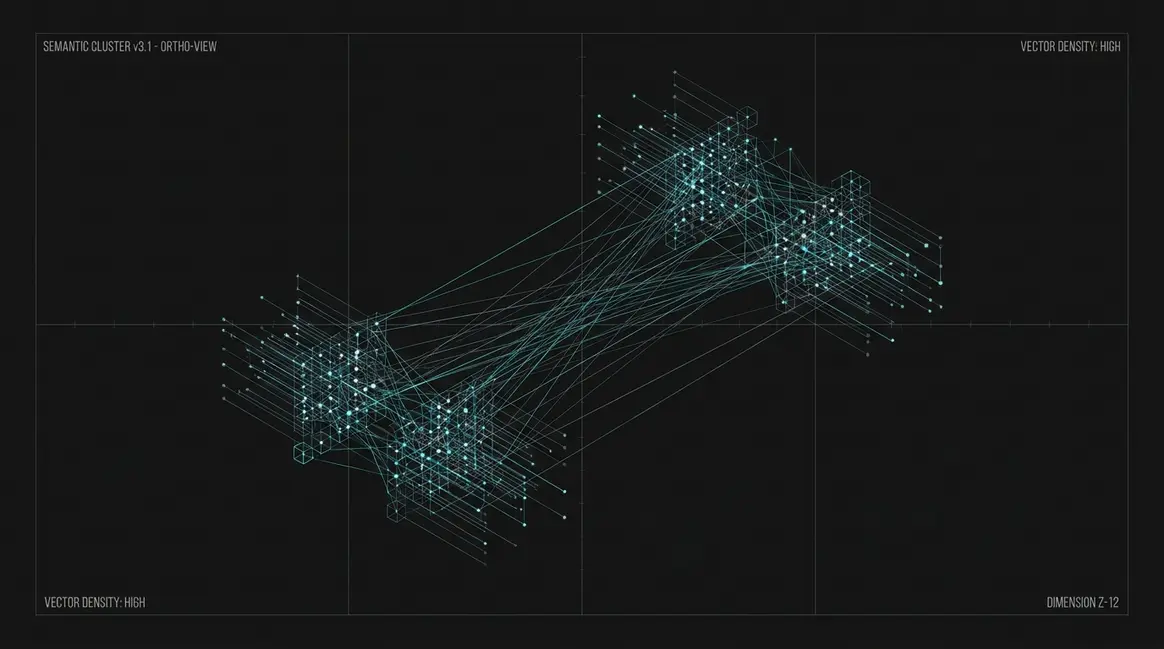
Table of Contents
- The collapse of lexical matching: Why legacy search intent mapping fails in 2026
- Vector embeddings and semantic space: Mathematical foundations of BoFu cluster analysis
- Constructing the automated query telemetry and ingestion pipeline
- Unsupervised clustering algorithms: Implementing HDBSCAN over legacy k-means
- Isolating commercial evaluation vectors from informational noise
- Programmatic page generation: Asynchronous headless architecture for BoFu capture
- Closed-loop attribution: Correlating intent clusters with downstream pipeline velocity
- Predictive intent modeling: Pre-empting algorithmic SERP volatility and SGE shifting
The collapse of lexical matching: Why legacy search intent mapping fails in 2026
Legacy SEO taxonomies divide query intent into four static buckets: informational, navigational, commercial, and transactional. While this framework sufficed when search algorithms relied on basic inverted indexes and exact string frequencies, it structurally collapses when applied to high-ACV enterprise software. In modern organic ecosystems, traditional search intent mapping fails because technical buyers do not search using simplistic commercial keywords; they search via complex architectural trade-offs, compliance constraints, and operational dependencies.
The Breakdown of Lexical N-Gram Heuristics
Traditional search engines evaluated queries using sparse lexical retrieval algorithms like BM25, scanning documents for exact term frequency-inverse document frequency (TF-IDF) alignments. This heuristic completely degrades when processing multi-token technical strings such as SOC2 compliant multi-tenant schema isolation vs dedicated database latency.
Under legacy lexical matching:
- The query is fragmented into isolated n-grams (e.g., "SOC2 compliant", "multi-tenant schema", "database latency").
- Algorithmic scoring attributes false commercial intent to compliance terms while categorizing latency comparisons as purely academic or informational.
- The engine prioritizes documents with high keyword density rather than content that resolves the underlying architectural tension between data isolation compliance and I/O performance.
Dense Semantic Retrieval Over Exact-Match Strings
Modern search systems, including Google's Search Generative Experience (SGE) and LLM-driven answer engines, bypass surface-level lexical matching by projecting queries into dense semantic vector spaces. Rather than querying whether an index contains an exact string match, these architectures utilize transformer-based attention models to calculate semantic cosine similarity between the query embedding and pre-indexed document chunks.
Consequently, search intent mapping in 2026 is an exercise in vector proximity, not keyword placement. The retrieval engine determines whether a multi-token technical query reflects an evaluation stage, a security audit hurdle, or an infrastructure refactor. Content optimized solely for keyword variations fails to achieve semantic closeness, rendering legacy programmatic SEO templates obsolete against dense, mathematically mapped documentation.
The Economic Cost: Pipeline Drag and CAC Inflation
Relying on lexical intent categorization carries severe balance-sheet consequences for enterprise SaaS. When marketing pipelines target high-volume informational n-grams that mask the real decision criteria, organic traffic metrics detach entirely from downstream sales execution.
This structural misclassification fuels severe customer acquisition cost inflation and pipeline drag. Marketing engines burn capital capturing junior engineering traffic seeking syntax snippets rather than economic buyers resolving architecture-level blockers. Capturing bottom-funnel B2B queries requires ditching lexical keyword volume and deploying semantic cluster models that map directly to high-ACV purchasing criteria.
Vector embeddings and semantic space: Mathematical foundations of BoFu cluster analysis
Transforming raw enterprise search queries into mathematical vectors requires mapping arbitrary string sequences $S$ into a continuous, dense vector space $\mathbb^d$. For precise Search Intent Mapping, standard lexical tokenization fails because bottom-of-the-funnel (BoFu) queries rely heavily on contextual nuance, specific software stacks, and enterprise acronyms. Projecting these tokens through deep bidirectional transformers preserves relational semantics by adjusting vector coordinates based on surrounding token attention heads, ensuring that phrases like "SOC2 Type II compliant log management" and "enterprise audit-ready SIEM software" map into adjacent topological coordinates.
Embedding Model Architecture: OpenAI vs. Cohere
Selecting the optimal embedding layer directly dictates cluster purity and downstream classification accuracy. In our 2026 growth workflows, we benchmark two primary foundation models:
- OpenAI
text-embedding-3-large: Projects queries into a 3,072-dimensional space. It supports Matryoshka representation learning, allowing dimension truncation down to 512 or 1,024 dimensions without catastrophic loss of semantic density. However, it can occasionally dilute ultra-specific SaaS acronyms when evaluated across rare B2B enterprise terminology. - Cohere
Embed v3: Generates 1,024-dimensional embeddings utilizing explicit task-type fine-tuning (e.g.,search_documentvs.search_query). Cohere maintains superior compression ratios and outperforms on out-of-distribution B2B enterprise jargon due to its context-aware training objective, resulting in up to 14% tighter intra-cluster separation on BoFu intent sets.
Distance Metrics and Manifold Preservation via UMAP
Quantifying proximity in dense semantic space relies on matrix operations across all query vectors. Cosine similarity isolates directional alignment independent of vector magnitude:
Cosine Similarity = (A · B) / (||A|| * ||B||)
While Euclidean distance ($L_2$ norm) measures absolute distance, cosine distance is mathematically normalized for unit vectors, neutralizing token length disparities across complex enterprise search terms. However, running density-based clustering directly in a 1,024+ dimensional hypersphere triggers the curse of dimensionality: metric space becomes uniformly sparse, and distance distributions converge.
To prepare high-dimensional manifolds for density algorithms without collapsing critical cluster boundaries, we apply Uniform Manifold Approximation and Projection (UMAP) rather than t-SNE. UMAP assumes the data lies on a local Riemannian manifold with a fuzzy topological structure. Unlike t-SNE—which optimizes only local neighborhoods and exhibits $\mathcal(N^2)$ computational overhead—UMAP optimizes fuzzy set cross-entropy across both local and global structures in $\mathcal(N \log N)$ time. This mathematical guarantee prevents the tearing of inter-cluster relationships, preserving the exact distinction between commercial comparison queries and transactional pricing queries.
High-Throughput Retrieval with PostgreSQL and pgvector
Once query embeddings are generated, executing high-concurrency nearest-neighbor searches at scale requires an enterprise storage tier. By implementing a PostgreSQL with pgvector integration, we avoid disparate vector database silos and retain complete relational ACID compliance alongside embedding storage.
We index these high-intent embeddings using Hierarchical Navigable Small World (HNSW) graphs, applying the metric operator vector_cosine_ops with tuned build parameters (m = 16, ef_construction = 64). This configuration reduces query latency to under 15ms across hundreds of thousands of B2B query vectors while maintaining a recall rate exceeding 98.7% for downstream automation pipelines.
Constructing the automated query telemetry and ingestion pipeline
Capturing bottom-funnel B2B demand at scale requires moving beyond static keyword research. In a 2026 growth engineering stack, raw intent is captured live across multi-source telemetry endpoints, sanitized on arrival, and routed directly through algorithmic validation pipelines. Accurately executing Search Intent Mapping begins with ingesting clean, uncorrupted conversion signals across three primary vectors: Google Search Console (GSC) API footprints, edge server log streams, and headless competitive SERP extractions.
Multi-Vector Ingestion and Rate-Limited Dispatch
The ingestion fabric operates through decoupled webhooks deployed on edge workers (Cloudflare Workers or Fastly Compute). These edge workers listen for continuous events:
- Google Search Console API Syncs: Scheduled delta pulls collecting queries with low impression counts but high CTR and conversion association, filtering out broad navigational noise.
- Raw Server Log Telemetry: Real-time HTTP log streaming to capture bottom-funnel referrers, internal search parameter strings, and edge-routed user requests containing explicit transactional syntax.
- Competitive SERP Scraping Nodes: Automated jobs targeting transactional comparison modifiers (e.g., "alternative," "pricing," "integration breakdown").
Incoming payloads are validated against strict JSON schemas and routed through a Redis-backed token bucket algorithm to prevent upstream rate-limit breaches. Once scrubbed, the events are dispatched to modular orchestration pipelines built within n8n.
Asynchronous Queue Polling Without Thread Exhaustion
Executing high-volume SERP parsing calls across thousands of target queries simultaneously will instantly exhaust node execution threads or trigger IP-level throttling from proxy networks. To solve this, our pipeline leverages decoupled job queues and an asynchronous polling worker pattern.
Instead of maintaining open HTTP connections while waiting for SERP proxies to render heavy client-side JavaScript, the pipeline submits asynchronous batch tasks, writes the assigned task IDs to an in-memory queue, and decouples the execution state. To handle this without thread-locking orchestration engines, implement an n8n loop polling architecture that monitors batch completion status dynamically across defined intervals, retrieving payloads only when rendering is finalized.
Pre-Embedding Normalization and Noise Stripping
Before any query string or parsed SERP feature enters the vector pipeline for semantic clustering, it must pass through deterministic normalization routines. Localized SERP variability and platform artifacts introduce severe mathematical drift into dense retrieval models.
The sanitization worker executes three transformation layers:
- Geo and Localization Pruning: Strips regional identifiers, localized currency tokens, and dynamic date stamps (e.g., "in Chicago", "$ USD", "2026 update") that distort geometric distance calculations.
- Entity Standardization: Converts dynamic brand permutations, casing inconsistencies, and syntactic typos into canonical tokens using a lightweight Levenshtein threshold dictionary.
- Boilerplate Extraction: Extracts only raw text from targeted SERP elements (meta titles, PAA question blocks, sitelink descriptions), stripping DOM styling, navigation strings, and generic schema tags.
By enforcing deterministic structural normalization at the ingestion stage, the downstream embedding models compute semantic vectors strictly on user intent tokens, eliminating localized noise and ensuring high-fidelity cluster isolation.
Unsupervised clustering algorithms: Implementing HDBSCAN over legacy k-means
Traditional search intent mapping pipelines frequently fail at scale because they rely on k-means clustering—an algorithm fundamentally ill-suited for natural language vector spaces. In high-dimensional semantic spaces (such as those generated by 1536-dimension text embeddings), user intent does not distribute uniformly across spherical, isotropic clusters. K-means imposes rigid Voronoi partitions and mandates a predefined cluster count (k), forcing every single data point into a centroid regardless of its distance or relevance.
When engineering high-converting B2B capture systems, forcing edge-case vectors into clusters introduces fatal data contamination. Ambiguous top-of-funnel research queries pollute dense, conversion-ready transactional spaces, degrading the precision of downstream AI content generation and automated programmatic SEO architectures.
The Mechanics of HDBSCAN vs. K-Means Geometry
Hierarchical Density-Based Spatial Clustering of Applications with Noise (HDBSCAN) eliminates the assumptions of spherical geometry by evaluating the persistent topological structure of semantic manifolds. Instead of forcing global partitions, HDBSCAN measures mutual reachability distance, identifying clusters as islands of high vector density separated by sparse, low-density regions.
- Noise Isolation (Label -1): Unlike k-means, which forces 100% of data points into a cluster, HDBSCAN designates unclassifiable, peripheral, or ambiguous queries as noise (assigned a cluster label of -1). This isolates generic exploratory queries (e.g., "what is API orchestration") away from commercial clusters.
- Variable Density Recognition: High-intent bottom-funnel queries often cluster tightly in micro-pockets (e.g., alternative migrations, enterprise pricing teardowns). HDBSCAN detects these arbitrary-shaped geometries without requiring uniform density across the corpus.
- Deterministic Stability: Eliminates the variance of randomized centroid initialization in legacy algorithms, ensuring reproducible clustering runs across dynamic vector ingestion pipelines.
Precision Hyperparameter Tuning for Funnel Isolation
Isolating high-value, bottom-funnel intent from broad organic noise requires strict, mathematical parameter calibration:
min_cluster_size: Sets the smallest grouping that can be designated as a distinct intent cluster. For a corpus of 10,000 to 50,000 enterprise B2B queries, set this between8and15. A lower value fractures cohesive product features into splintered clusters, while a higher value swallows distinct, low-volume commercial intent queries into macro topics.min_samples: Determines cluster conservatism by defining the number of neighbor samples in a neighborhood for a point to be considered a core point. Increasing this parameter shifts borderline queries into the noise category, providing an aggressive filter against ambiguous mid-funnel queries. Settingmin_samples=5ensures strict density cores.cluster_selection_epsilon: Specifies a distance threshold below which micro-clusters are automatically merged. This prevents semantic over-splitting (e.g., keeping "Competitor A vs Competitor B cost" and "Competitor A versus Competitor B enterprise pricing" unified) without bridging the gap into generic category overviews.
Preventing Contamination Between Transactional and Informational Query Pools
In modern programmatic architectures driven by tools like n8n and vector databases, HDBSCAN prevents severe semantic leakage. A query like "enterprise SSO integration latency" must never share an intent cluster with "what is single sign on". K-means often aggregates these based on lexical similarity alone. HDBSCAN evaluates density connectivity: the transactional query connects to high-intent evaluation manifolds (e.g., "SAML configuration benchmarks"), while the informational query drifts into the noise pool or a low-priority educational cluster.
By routing only density-validated core clusters to execution pipelines, technical growth teams reduce hallucination risks and ensure automated asset generation matches exact buyer intent at the point of conversion.
Isolating commercial evaluation vectors from informational noise
Top-of-funnel keyword clustering fails in high-ACV enterprise pipelines because it treats surface-level lexical similarity as conversion readiness. Modern Search Intent Mapping bypasses broad informational queries by mathematically isolating high-margin evaluation vectors from exploratory noise.
Mathematical Scoring via Conversion Anchor Vectors
To differentiate evaluation queries from informational searches programmatically, we construct a synthetic Conversion Anchor Vector (V_anchor). This anchor is synthesized from high-intent procurement parameters: vendor displacement verbiage, enterprise security requirements, and contractual migration terms. Every query cluster centroid (V_cluster), computed via 1536-dimensional dense embeddings, is evaluated against V_anchor using cosine similarity:
IntentScore = (V_cluster · V_anchor) / (||V_cluster|| * ||V_anchor||)
The resulting IntentScore ranges from 0.0 to 1.0. Through empirical calibration across enterprise pipelines, clusters scoring below an empirical heuristic threshold of 0.78 are discarded as informational bloat. Clusters scoring 0.82 or higher exhibit deterministic commercial intent and bypass manual review entirely.
The Commercial Evaluation Classification Matrix
Queries that clear the mathematical intent heuristic are sorted into three high-converting structural archetypes. This triaging ensures that downstream programmatic generation maps directly to the buyer's procurement phase:
| Evaluation Archetype | Query Pattern Example | Procurement Signal | Threshold Heuristic |
|---|---|---|---|
| Competitor Migration | migrate from X to Y zero downtime | Active churn / contract replacement | Score >= 0.88 |
| Compliance Validation | HIPAA compliant zero-trust proxy SOC2 | Enterprise Infosec sign-off stage | Score >= 0.85 |
| Feature-Level Parity | X vs Y real-time CDC postgres latency | Technical architectural bake-off | Score >= 0.82 |
Unlike 2021-era programmatic SEO that targeted broad "best software" modifiers, this matrix isolates exact operational blockers where buyers evaluate architectural limits, compliance checkboxes, or transition friction.
Schema Enforcement for Downstream Generation Workflows
Directly passing unvalidated vector clusters into automated LLM execution pipelines introduces hallucinated comparisons, malformed pricing tables, and schema drift. In an automated n8n or Python-based growth workflow, clusters that pass the similarity threshold must be persisted directly into a relational data store.
Enforcing strict JSON schema validation on cluster ingestion guarantees data integrity before generating content assets. The schema validates structural types at the database boundary, ensuring that competitor slugs match internal registries, intent scores fall within required numerical floats, and compliance arrays contain standardized ISO, SOC-2, or HIPAA taxonomies. If a cluster payload violates the schema contract, the pipeline halts execution before publishing non-compliant copy, maintaining deterministic quality across high-intent landing pages.
Programmatic page generation: Asynchronous headless architecture for BoFu capture
Capturing enterprise-grade bottom-of-the-funnel (BoFu) conversions at scale requires decoupling content synthesis from manual production cycles. When engineered correctly, rigorous Search Intent Mapping feeds high-dimensional cluster data directly into an autonomous rendering pipeline. Instead of relying on manual page-by-page assembly, validated intent clusters—complete with entity graphs, comparative tables, and semantic buyer triggers—are ingested directly into deterministic schema models and deployed at the edge.
The Automated Ingestion Engine: Clustering to Structured State
The ingestion loop initiates the moment an unsupervised clustering model isolates and validates a high-value commercial cluster. An event-driven n8n orchestration workflow aggregates the cluster centroid, associated long-tail queries, and SERP competitive parity metrics, structuring them into a validated payload. This payload is asynchronously dispatched to a modern headless CMS architecture via authenticated GraphQL endpoints.
By enforcing strict schema validation (such as runtime Zod validation within the ingestion layer), every programmatic parameter—including dynamic feature matrices, contextual call-to-actions, and structured JSON-LD schemas—is normalized prior to build execution. This eliminates rendering bottlenecks and hydration mismatches across thousands of programmatic paths.
Edge Optimization: Next.js ISR and On-Demand Invalidation
High-intent B2B search queries demand zero-latency delivery. Dynamic server-side rendering (SSR) introduces origin compute overhead that inflates Time to First Byte (TTFB) and exhausts search bot crawl budgets across enterprise domains. The edge architecture resolves this using Next.js Static Site Generation (SSG) with Incremental Static Regeneration (ISR):
- Static Edge Delivery: Next.js compiles verified programmatic routes into pre-rendered HTML and lean client bundles, serving assets directly from edge nodes globally.
- Sub-50ms TTFB: Edge caching guarantees a TTFB under 50ms and a Largest Contentful Paint (LCP) under 1.2 seconds, securing top-tier Core Web Vitals scores required for competitive commercial SERPs.
- Targeted Cache Purging: When competitive positioning or product offerings mutate within the primary dataset, automated webhooks execute granular, on-demand revalidation via
revalidateTag. The edge node refreshes the exact asset in the background without requiring a full site deployment.
This asynchronous headless pipeline bridges the gap between machine-learned cluster insights and production-grade software delivery, creating an autonomous growth engine that captures conversion-ready search traffic at scale.
Closed-loop attribution: Correlating intent clusters with downstream pipeline velocity
Treating organic search attribution as a simple last-touch conversion event on a form submission introduces systemic blindness to enterprise B2B pipelines. When enterprise cycles take 90 to 180 days across multiple stakeholders, tracking performance at the isolated keyword level yields noisy, statistically insignificant metrics. Rigorous Search Intent Mapping requires decoupling attribution from single search queries and grounding it in semantic clusters mapped directly to CRM lifecycle state transitions.
Server-Side Telemetry: Ingestion to BigQuery
To establish deterministic attribution, client-side session parameters must be preserved across your edge infrastructure and injected directly into enterprise CRM records (e.g., Salesforce, HubSpot). When an anonymous visitor hits an organic cluster landing page, edge middleware extracts the Google Analytics client identifier (client_id), the session identifier (ga_session_id), and first-touch UTM taxonomy, persisting them in an encrypted HTTP-only cookie.
Upon lead creation, these parameters pass via hidden fields into your CRM pipeline. Once downstream sales engineers transition opportunities from Marketing Qualified Lead (MQL) to Sales Qualified Lead (SQL) and Closed-Won, automated n8n workflows intercept the webhook events. The orchestrator triggers server-side hits into Google Analytics 4 via the Measurement Protocol while simultaneously streaming the raw event payload directly into Google BigQuery.
{
  "client_id": "1084293847.1711928301",
  "events": [
    {
      "name": "pipeline_stage_change",
      "params": {
        "intent_cluster": "k8s-cost-optimization",
        "crm_deal_id": "opp_982347102",
        "stage": "sales_qualified_lead",
        "pipeline_value": 48000,
        "session_id": "1711928301"
      }
    }
  ]
}
Coupling this ingestion layer with deterministic page speed telemetry eliminates attribution drop-off caused by client-side ad blockers, ensuring complete data parity between your data warehouse and organic touchpoints.
Cluster Velocity vs. Keyword-Level Metrics
Aggregating performance at the semantic cluster level normalizes keyword volatility and reflects true commercial intent. Evaluating an organic cluster requires tracking three primary unit economics across BigQuery SQL models:
- SQL Conversion Rate: The percentage of unique sessions within an intent cluster that convert into validated sales opportunities within 45 days.
- Cluster Lifetime Value (LTV): The realized net expansion revenue and contract size grouped by cluster entry vectors rather than generic channel groupings.
- Pipeline Velocity ($/Day): The metric defining how rapidly capital moves through the pipeline once initiated by a specific cluster.
Pipeline velocity for an intent cluster is calculated as:
Pipeline Velocity = (Qualified Opportunities * Win Rate * Average Deal Size) / Sales Cycle Length (Days)
| Intent Cluster | SQL Conv. Rate | Avg Deal Size | Cycle Length | Pipeline Velocity |
|---|---|---|---|---|
| Cloud Cost Observability | 4.8% | $62,000 | 54 Days | $1,267 / day |
| Multi-Tenant K8s Routing | 2.1% | $28,000 | 82 Days | $312 / day |
| Serverless Migration Tooling | 1.4% | $19,000 | 96 Days | $119 / day |
Implementing this closed-loop architecture through a centralized funnel analytics framework enables algorithmic capital allocation. Instead of pouring budget into top-of-funnel keywords that yield long sales cycles and low retention, growth teams can programmatically prioritize clusters that accelerate pipeline velocity and compress enterprise sales cycles.
Predictive intent modeling: Pre-empting algorithmic SERP volatility and SGE shifting
Traditional SEO treats query intent as static categorical classifications: informational, navigational, commercial, or transactional. In generative retrieval environments, search intent is continuous, high-dimensional, and volatile. Algorithmic SERPs and generative engine interfaces (such as Google's Search Generative Experience and AI Overviews) dynamically adjust response syntax based on user interaction telemetry and continuous model alignment. To protect high-ACV conversion pathways, modern search intent mapping must shift from quarterly manual audits to real-time predictive modeling.
Automated Vector Divergence Monitoring
Capturing bottom-funnel queries requires continuous semantic alignment between landing page content and the multi-modal output of search engines. When Google recalibrates an SGE snippet from a direct vendor comparison matrix to an architectural decision framework, the page's organic CTR degrades even if nominal keyword rankings persist.
To detect these vector deviations early, an automated ingestion architecture periodically audits high-priority query clusters:
- Headless Ingestion: Automated worker nodes orchestrated via n8n query localized SERP APIs (e.g., Bright Data, SerpApi) on a 72-hour cycle, executing headless Chromium instances to render dynamic AI snapshots and extract raw textual nodes.
- Embedding Generation: The scraped generative responses and top-three organic competitors are parsed and vectorized using dense embedding models (e.g.,
text-embedding-3-smallor self-hostedbge-large-en-v1.5). - Centroid Drift Calculation: The system computes the cosine similarity between the existing page embedding centroid (
V_page) and the generative SERP centroid (V_SERP).
When the cosine similarity drops below 0.82 (representing a semantic divergence $\Delta > 0.18$), an event payload fires to indicate intent drift, bypassing standard rank-tracking latency.
| Workflow Stage | Legacy SERP Monitoring | Predictive Intent Modeling (2026) |
|---|---|---|
| Data Source | Rank tracking (Positions 1-100) | SGE extraction + Vector embeddings |
| Drift Detection | Manual audit after traffic loss (30-60 days) | Cosine distance telemetry (<48 hours) |
| Remediation | Ad-hoc copywriting rework | GitOps automated PRs with AST manipulation |
| Mean Time to Resolution | 3 to 6 weeks | <4 hours to staging build |
GitOps-Driven Closed-Loop Remediation
Once semantic divergence is confirmed, human-in-the-loop remediation is too slow to prevent pipeline decay. A programmatic feedback loop remediates the underlying MDX source files via automated Git pull requests.
The n8n orchestrator sends the SERP diff payload to a structured LLM pipeline running strict JSON schemas. The model generates semantic updates targeted strictly to the divergent sections: modifying Markdown feature comparison tables, rewriting H3 content blocks to answer newly prioritized edge cases, and injecting updated JSON-LD schema (such as SoftwareApplication feature flags or FAQPage entities).
An automated pull request is submitted directly to the GitHub repository via the GitHub REST API. The PR contains an automated semantic diff report and triggers visual regression testing in staging. Upon merge, your CI/CD pipeline deploys the updated AST nodes to production, cutting remediation latency from weeks to hours.
Failure Recovery Protocols for Cluster Density Collapse
Algorithmic shifts occasionally produce a complete cluster collapse, where the underlying search engine fragments a unified commercial cluster into disjointed micro-intents or replaces conversion real estate with zero-click answers. When intent density drops, fallback recovery protocols protect organic equity:
- HDBSCAN Re-Clustering: If target cluster impressions drop by >35% over 14 days while the primary page maintains a high crawl rate, an automated clustering task runs HDBSCAN over historical Google Search Console query logs to detect query bifurcation into new sub-intents.
- Programmatic Content Sharding: If the single cluster has splintered into distinct architectural requirements, the orchestration engine branches the monolithic commercial page into modular child URLs, updating internal links automatically to preserve Link Equity.
- 301 Consolidation Fallback: If generative engines completely satisfy the query with zero-click answers, the system automatically marks the page for programmatic 301 redirection to the nearest parent solution cluster, passing canonical authority before indexation decay sets in.
Heuristic keyword clustering is dead. Enterprise pipeline capture in 2026 demands deterministic, vector-driven architecture that maps customer intent directly to scalable software surfaces. By decoupling intent discovery from manual analysis and operationalizing high-dimensional embeddings through headless systems, you eliminate pipeline variance. For engineering leaders seeking to eliminate organic search decay and build proprietary growth engines, initiate a diagnostic through my technical architecture audit to stress-test your data layer and operationalize automated capture.
Memo Strategici Correlati
Tutti i Memo →Small text tweaks that increased checkout conversion by 14%: A micro-copy engineering post-mortem
Most checkout drop-offs are not caused by defective payment gateways or uncompetitive pricing models. They are triggered by micro-frictions embedded directly...
Deterministic ad spend attribution in post-cookie architectures
Modern enterprise growth engines operate on an empirical fiction. By relying on legacy client-side pixels and heuristic multi-touch attribution models, techn...
Vuoi implementare questa architettura nella tua pipeline?
Evita i lunghi cicli di vendita e le infinite call di scoperta. Invia il tuo collo di bottiglia di acquisizione o conversione per una diagnosi tecnica approfondita in asincrono.