Automated B2B Research Agent with n8n & Notion Memory
The Signal
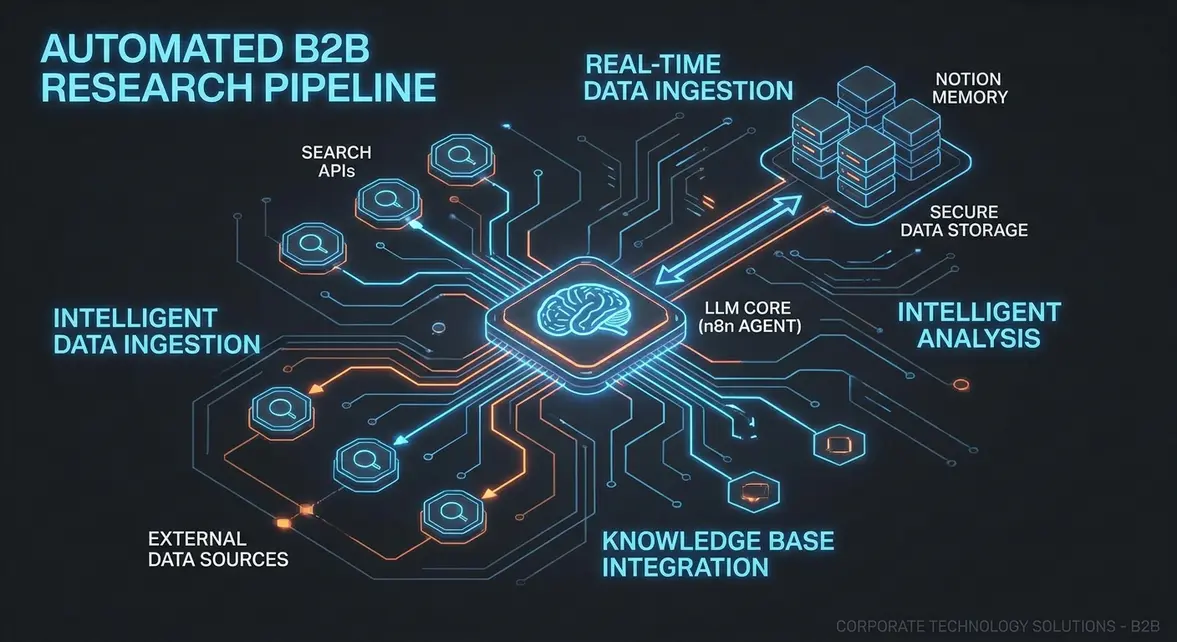
Finding viable B2B business ideas often requires sifting through endless noise, spam, and duplicate concepts. A new n8n workflow automates this top-of-funnel research by combining multi-source search APIs with stateful memory. This system acts as an autonomous research agent, delivering validated, high-quality business concepts daily.
The Architecture Shift
This workflow moves beyond simple API scraping by introducing stateful memory and high-availability search routing. By leveraging a 7-day historical context window, the system effectively eliminates duplicate data processing. This architectural approach ensures high signal-to-noise ratios in automated research.
- High Availability: Implements primary search via Serper API with an automatic fallback to Tavily API if the primary fails.
- Stateful Memory: Connects to a Notion database to retrieve a 7-day history, providing context to the LLM to filter out duplicates.
- AI Quality Control: Utilizes Claude 3 Haiku or GPT to analyze ideas based on revenue potential, setup cost, automation level, and risk.
- Smart Filtering: Programmatically rejects scams, MLMs, and purely manual service jobs before they reach the output stage.
Implementation Pattern
Deploying this autonomous research agent requires orchestrating several distinct micro-services within n8n. The workflow is triggered via a daily cron schedule to ensure consistent data delivery. Here is the step-by-step execution logic:
- Trigger & Search: A daily cron job initiates queries across multiple keywords using the Serper API.
- Fallback Routing: A branching node checks the Serper response; if empty or failed, it routes the query to the Tavily API.
- Context Retrieval: The system fetches the last 7 days of idea history from a connected Notion database.
- LLM Processing: Raw search data and historical context are sent to the LLM with strict prompts to return structured JSON.
- Validation & Storage: A code node parses the JSON output, updates the Notion history log, and pushes high-scoring ideas to Telegram.
Fractional CTO Perspective
For solo founders and lean B2B teams, top-of-funnel market research is a massive time sink. Automating this process with an intelligent, stateful agent shifts human capital from data gathering to strategic execution. The OPEX required to run this n8n workflow is negligible compared to the hours saved.
Furthermore, the architectural pattern demonstrated here is highly extensible for enterprise use cases. You can adapt this exact framework for competitor monitoring, lead generation, or automated threat intelligence. It is a prime example of using low-code orchestration to build enterprise-grade autonomous agents.
System Telemetry Source: Original Engineering Report
Related Growth Blueprints
All Blueprints →Need this architecture deployed in your pipeline?
Skip the synchronous sales cycle and endless discovery calls. Submit your core acquisition or conversion bottleneck for a deep-dive asynchronous growth diagnostic.