Automated RFP Intake Pipeline via n8n & PDF Vector
The Signal
Sales and consulting teams face a critical timing problem with RFPs. Proposals require days of focused effort, but documents often languish in shared inboxes. This delay shrinks the competitive response window and directly impacts win rates.
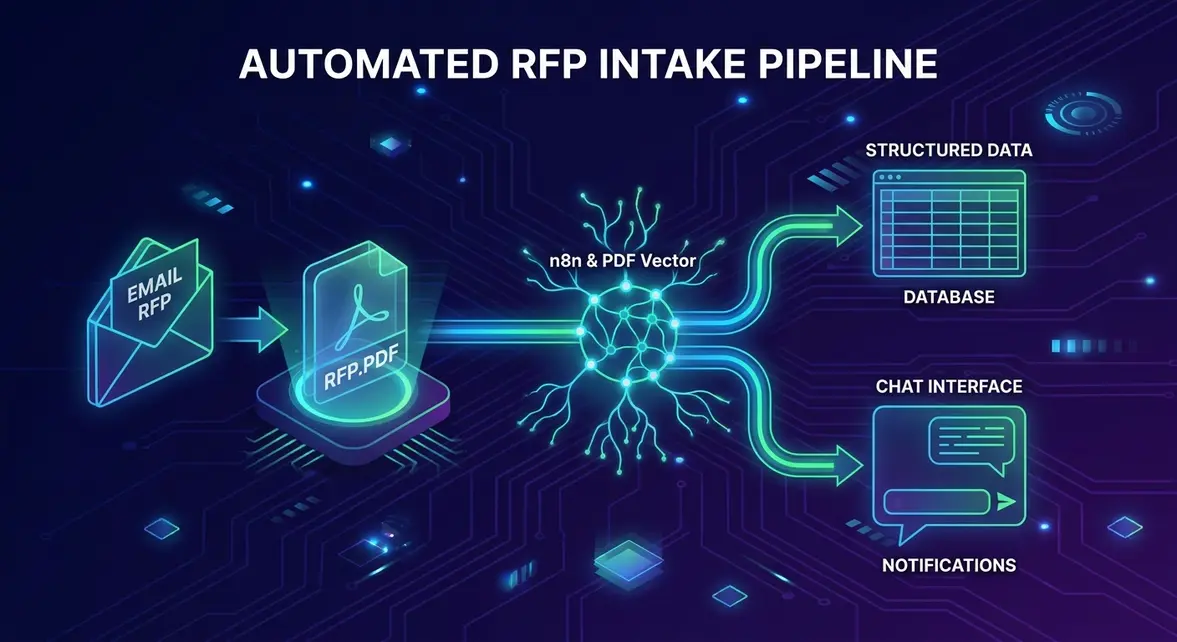
To solve this, an automated intake workflow was engineered using n8n. It intercepts RFPs the moment they arrive, extracts critical evaluation criteria, and routes the brief to Slack. This reduces time-to-awareness from days to roughly 15 seconds.
The Architecture Shift
Moving from manual inbox monitoring to an event-driven extraction pipeline fundamentally changes sales operations. The system leverages LLM-backed vector extraction to parse unstructured 40-page PDFs into structured JSON payloads. This enables programmatic routing and automated urgency scoring.
- System Latency: Processing time drops from hours of manual reading to 12-15 seconds per document.
- Data Accuracy: Achieves 97% accuracy on basic opportunity data and 94% on complex evaluation criteria weights.
- Scalability: The serverless-style n8n architecture handles concurrent RFP arrivals without human bottlenecking.
- Cost Efficiency: Consumes only 3-4 API credits per document, keeping operational expenditure negligible.
Implementation Pattern
The pipeline operates on a self-hosted n8n instance to utilize community nodes. It requires OAuth2 access to a shared inbox and API keys for vector processing. Here is the execution flow:
- Event Trigger: A Gmail node listens for specific subjects containing attachments.
- Payload Extraction: The PDF Vector community node ingests the primary attachment and extracts structured data.
- Business Logic: A date parser calculates days until the deadline, assigning urgency tags from Normal to OVERDUE.
- State Management: The structured payload is appended to a Google Sheet acting as the central RFP tracker.
- Notification: A formatted Slack message broadcasts the brief, budget, and criteria weights to the sales channel.
Fractional CTO Perspective
This is a textbook example of high-leverage automation. By eliminating the administrative friction of RFP triage, highly paid sales engineers spend their time writing rather than reading. The immediate visibility into evaluation criteria allows teams to make faster bid/no-bid decisions.
Furthermore, this architecture is highly extensible. Future iterations can integrate directly with CRMs like Salesforce or HubSpot. Engineering teams could also add a logic gate to automatically reject RFPs that fall below a specific budget threshold.
System Telemetry Source: Original Engineering Report
Related Growth Blueprints
All Blueprints →Need this architecture deployed in your pipeline?
Skip the synchronous sales cycle and endless discovery calls. Submit your core acquisition or conversion bottleneck for a deep-dive asynchronous growth diagnostic.