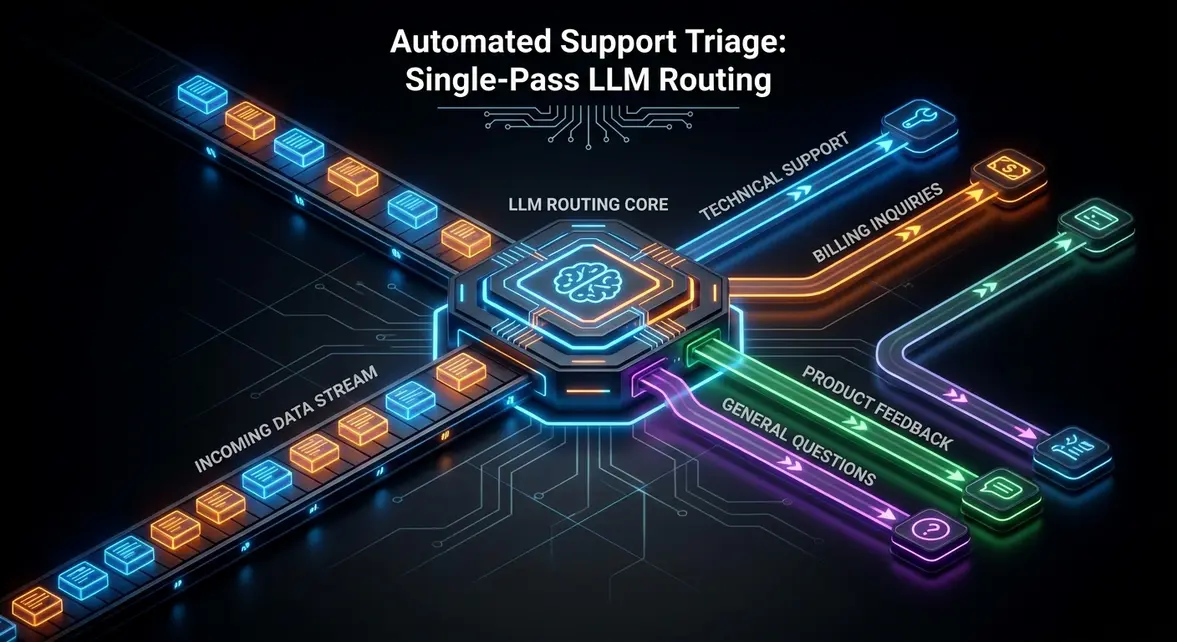
Automated Support Triage: Single-Pass LLM Routing
The Signal
Manual inbox triage is a massive OPEX drain for scaling B2B teams.
Basic LLM classification often fails in production due to ambiguous inputs and language nuances.
This build log details a single-pass, bilingual routing engine that categorizes, scores confidence, and prioritizes support tickets.
The Architecture Shift
Moving from simple classification to a multi-dimensional scoring model changes the game.
By extracting four distinct data points in one API call, we eliminate secondary processing latency.
Here is how this architectural shift impacts core system metrics:
- Systems Impact: Consolidates sentiment analysis, translation, and categorization into a single node.
- Performance: Single-pass extraction drastically reduces API latency and token consumption.
- Scalability: Native bilingual support allows seamless expansion into European markets without duplicating workflows.
- Observability: Low-confidence routing preserves the model's best guess, creating a feedback loop for prompt optimization.
Implementation Pattern
The workflow leverages n8n to orchestrate the data pipeline from ingestion to notification.
It ensures no message is lost while providing immediate context to human operators.
- Ingestion: A Gmail trigger polls the support inbox, filtering for specific labels to exclude personal mail.
- Preparation: A custom code node packages the email payload into a clean format for the LLM.
- Extraction: The easybits Extractor evaluates the payload against bilingual prompts to output category, summary, confidence, and priority.
- Safety Routing: A Set node intercepts low-confidence results, rewriting their category to "Other" while preserving the original guess.
- Distribution: A Switch node directs the payload to dedicated Slack channels, appending priority emojis and translated summaries.
Fractional CTO Perspective
Automating support triage is not just about saving time; it is about protecting MRR.
When high-priority, churn-risk emails are buried under routine billing questions, customer satisfaction plummets.
This architecture reduces OPEX by eliminating manual sorting and accelerates response times for critical issues.
System Telemetry Source: Original Engineering Report
Related Growth Blueprints
All Blueprints →Need this architecture deployed in your pipeline?
Skip the synchronous sales cycle and endless discovery calls. Submit your core acquisition or conversion bottleneck for a deep-dive asynchronous growth diagnostic.