Google Ads Remarketing in sGTM: Setup Architecture
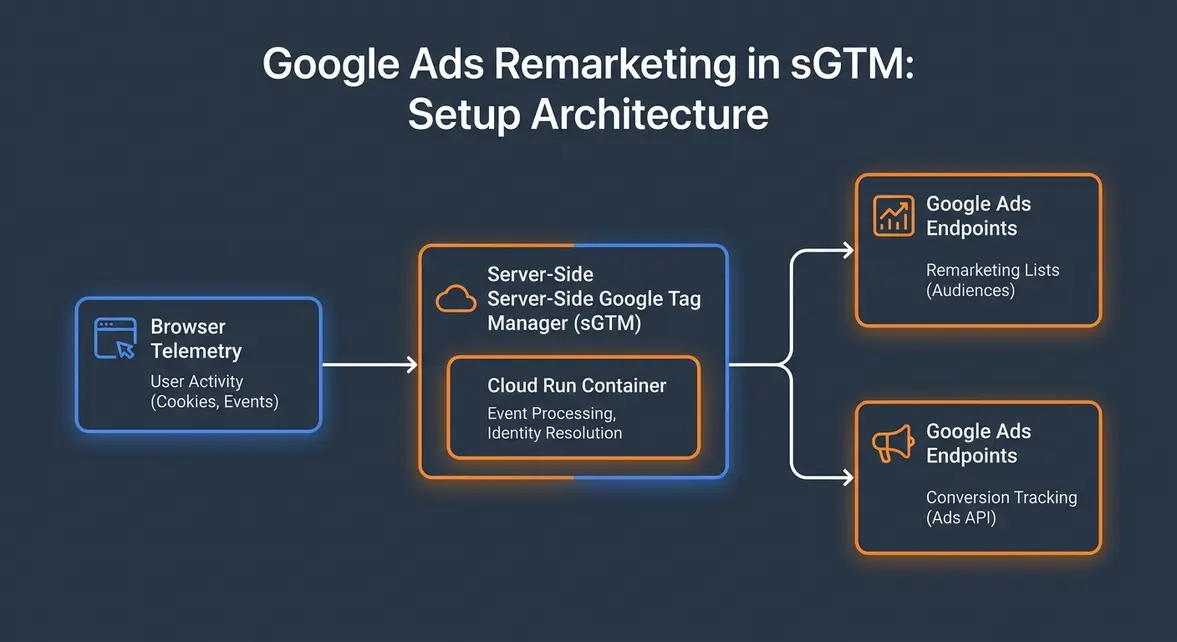
Server-Side Google Ads Remarketing: The Architectural Pivot Away from Browser-Based Tags
Legacy client-side Google Ads remarketing implementations depend on client-loaded vendor scripts such as conversion.js or gtag.js running directly within the browser runtime. These scripts inject third-party contexts, fire multiple asynchronous network roundtrips to DoubleClick endpoints, and depend on unstable third-party cookies that are systematically degraded by modern browser privacy frameworks like Apple ITP, Firefox Enhanced Tracking Protection, and standard ad-blocking extensions. This architectural pattern consistently bleeds up to 30-40% of visitor telemetry before the remarketing pixel can evaluate user state.
The arrival of the official Google Ads Remarketing tag for Server-Side Google Tag Manager (sGTM) transitions tracking execution from the client execution thread to an isolated cloud environment running on GCP Cloud Run or AWS Fargate. Instead of orchestrating third-party DOM nodes and executing arbitrary tracking vendor JavaScript on the visitor's device, the browser sends a unified, consolidated telemetry stream to a first-party collection subdomain. The sGTM container unpacks the payload, extracts audience signals and normalized product identifiers, and executes direct server-to-server HTTP POST requests to Google's ingestion endpoints.
Technical SEO, Performance Budgets, and First-Party Identity Resolution
From a Core Web Vitals and performance engineering standpoint, migrating remarketing tags off the critical rendering path delivers measurable page stability. Client-side tag orchestration frequently increases Total Blocking Time (TBT) by contending for main-thread CPU execution against core application bundles. By moving remarketing execution to sGTM, browser thread contention is eliminated, directly improving Interaction to Next Paint (INP) and reducing First Contentful Paint (FCP) overhead.
The architectural shift establishes robust first-party identity management and auditability:
- First-Party Cookie Isolation: The tracking subdomain (e.g.,
telemetry.domain.com) sets persistent first-party cookies (such asFPIDand_gcl_au) via secure HTTP response headers (Set-Cookie: HttpOnly; Secure; SameSite=Lax), bypassing client-side 7-day script-write cookie expiration restrictions imposed by ITP. - Network Request Consolidation: Eliminates duplicate telemetry beacons. A single incoming payload dispatched by a Web GTM container or client API handles GA4, Google Ads Conversion Tracking, and Google Ads Remarketing simultaneously through server-side tag mapping.
- Zero Client-Side DOM Scraping: Hashed user parameters (such as SHA-256 normalized email strings for Enhanced Conversions) and transactional metadata are routed strictly via memory buffers, stopping DOM-sniffing scripts from intercepting high-value business metadata.
Static inspection tools and performance crawlers register clean audit traces because vendor-specific tracking domains are abstracted behind your primary infrastructure. This architecture prevents third-party network payload warnings within automated search engine ranking diagnostics.
Marketing Ops Implementation: High-Throughput Runbook and Ingestion Pipelines
Deploying Google Ads Remarketing in sGTM requires configuring the Web container to transmit custom e-commerce parameters and user state, setting up sGTM Client parsing, and firing the server tag based on the consolidated event bus. The client-side implementation must sanitize and cryptographically hash all PII before dispatching the payload to the sGTM ingress endpoint.
Use the following production script to compute SHA-256 hashes using the browser Web Crypto API and push structured remarketing parameters into the dataLayer:
async function pushRemarketingEvent(eventName, rawEmail, productData) {
  const normalizeAndHash = async (value) => {
    if (!value) return null;
    const cleanValue = value.trim().toLowerCase();
    const msgBuffer = new TextEncoder().encode(cleanValue);
    const hashBuffer = await crypto.subtle.digest('SHA-256', msgBuffer);
    const hashArray = Array.from(new Uint8Array(hashBuffer));
    return hashArray.map(b => b.toString(16).padStart(2, '0')).join('');
  };

  const hashedEmail = await normalizeAndHash(rawEmail);

  window.dataLayer = window.dataLayer || [];
  window.dataLayer.push({
    event: eventName,
    user_data: {
      sha256_email_address: hashedEmail
    },
    google_ads_items: productData.map(item => ({
      id: item.sku,
      google_business_vertical: 'retail',
      price: item.unitPrice,
      quantity: item.qty
    }))
  });
}
Within the sGTM environment, instantiate the Google Ads Remarketing tag. Map the Conversion ID using a server variable {{Constant - Google Ads Conversion ID}}. If using dynamic remarketing, set the dynamic remarketing event data path to read from the incoming GA4 or Custom Client event object. Ensure you validate event ingestion and downstream delivery by capturing logs directly in BigQuery via Cloud Run stdout.
To monitor tag execution health, catch drop-offs, and maintain a queryable audit ledger for privacy compliance, route sGTM access logs into a partitioned BigQuery table using the following schema:
CREATE TABLE tracking_audit.sgtm_google_ads_egress (
  timestamp TIMESTAMP DEFAULT CURRENT_TIMESTAMP(),
  client_id STRING NOT NULL,
  event_name STRING NOT NULL,
  conversion_id STRING NOT NULL,
  http_status INT64 NOT NULL,
  latency_ms INT64 NOT NULL,
  user_agent STRING,
  ip_stripped_status BOOL
)
PARTITION BY DATE(timestamp)
CLUSTER BY event_name, http_status;
B2B Growth Engineering: Pipeline Hygiene and Privacy Governance
For B2B software companies targeting competitive enterprise verticals, remarketing efficiency is often crippled by high rates of ad-blocking and privacy tooling among technical buyers (engineering, DevOps, cybersecurity). Traditional client-side pixels fail to populate retargeting audiences accurately, artificially inflating Cost Per Acquisition (CPA) by starving the ad network bidding algorithms of high-intent audience data.
Implementing sGTM remarketing allows teams to recover up to 25% of uncaptured B2B pipeline audience segments. By controlling data egress at the server layer, security and marketing operations teams can enforce deterministic data redaction. High-sensitivity attributes, unconsented lead data, and internal test users can be stripped from the payload before reaching Google's servers, mitigating GDPR and SOC 2 compliance risks while optimizing algorithmic target expansion.
System Telemetry Source: Original Engineering Report
Related Growth Blueprints
All Blueprints →Need this architecture deployed in your pipeline?
Skip the synchronous sales cycle and endless discovery calls. Submit your core acquisition or conversion bottleneck for a deep-dive asynchronous growth diagnostic.