gtag.js Client ID Capture for B2B Attribution
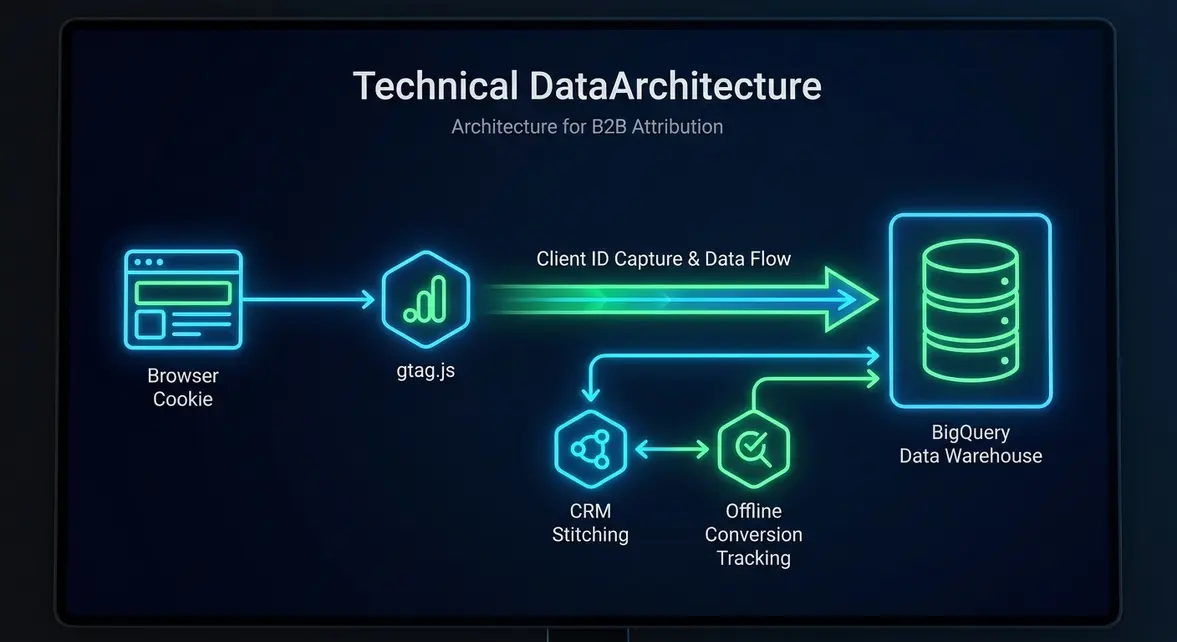
Architectural Shift: From analytics.js to Unified gtag.js Routing
The deprecation of analytics.js in favor of gtag.js represents a fundamental shift in how client-side telemetry is routed to Google's ecosystem. Historically, analytics.js relied on proprietary, isolated tracker objects that required explicit instantiation and configuration. This created data silos, forcing engineers to duplicate tracking logic across Google Analytics, Google Ads, and Floodlight tags. The introduction of gtag.js abstracts this complexity by utilizing a unified dataLayer routing mechanism, allowing a single semantic payload to be distributed across multiple endpoints simultaneously.
However, this abstraction initially obscured direct access to core tracking primitives, most notably the Google Analytics Client ID (the unique identifier stored in the _ga cookie). The Client ID is the foundational key for deterministic user stitching. Without it, bridging the gap between anonymous web behavioral data and known CRM entities is impossible. By leveraging the gtag.js API's asynchronous callback methods, growth engineers can extract this identifier at runtime and map it to a custom dimension or user property, effectively unlocking cross-device and offline attribution models.
Data Architecture: Bridging the Client-to-Warehouse Gap
Capturing the Client ID and passing it as a custom dimension fundamentally alters the downstream data architecture. When a user lands on a site, the gtag.js library generates or retrieves the _ga cookie. By explicitly extracting this value and appending it to the event payload, every subsequent hit sent to the Google Analytics collection endpoint contains this deterministic key. This ensures that when the raw event data is exported to a data warehouse like Google BigQuery, the user_pseudo_id (in GA4 terms) is explicitly available for SQL joins against backend CRM tables.
From a rendering and performance standpoint, this extraction must be handled asynchronously to prevent main-thread blocking. Executing the gtag('get', ...) method ensures that the browser's critical rendering path remains uninterrupted, maintaining a Largest Contentful Paint (LCP) of < 2.5s. The callback function only executes once the library has fully initialized and the cookie is available, ensuring data integrity without compromising Core Web Vitals.
This architecture solves several critical bottlenecks in B2B marketing operations:
- Deterministic CRM Stitching: Enables joining web session data with Salesforce or HubSpot lead records using the Client ID as the primary key.
- Offline Conversion Tracking (OCT): Facilitates server-to-server POST requests via the GA4 Measurement Protocol when a lead transitions to a closed-won state.
- Audience Suppression: Allows for precise exclusion of existing customers from top-of-funnel paid media campaigns by syncing CRM data back to Google Ads via Customer Match APIs.
Marketing Ops Implementation: Extracting and Routing the Client ID
To implement this tracking primitive, you must utilize the gtag.js API to retrieve the Client ID and subsequently set it as a user property (or custom dimension) for all subsequent events. This requires a precise sequence of JavaScript execution to ensure the value is captured before the primary pageview or conversion events are dispatched.
Below is the exact JavaScript implementation required to extract the Client ID and set it as a user property in a GA4 environment. This script should be executed immediately after the primary gtag.js initialization snippet.
// Extract Client ID and set as a GA4 User Property
gtag('get', 'G-XXXXXXXXXX', 'client_id', function(clientId) {
  // Push the extracted ID into the dataLayer for GTM consumption if needed
  window.dataLayer = window.dataLayer || [];
  window.dataLayer.push({
    'event': 'client_id_extracted',
    'ga_client_id': clientId
  });

  // Set the Client ID as a persistent user property in gtag.js
  gtag('set', 'user_properties', {
    'crm_client_id': clientId
  });
});
If you are utilizing Google Tag Manager alongside gtag.js, you can capture the ga_client_id from the dataLayer push above by creating a Data Layer Variable named {'{{ga_client_id}}'}. This variable can then be mapped to hidden fields in your lead generation forms (e.g., Marketo or HubSpot forms) before submission. Once the data flows into BigQuery, you can execute SQL queries to stitch the web behavior with CRM revenue data:
-- BigQuery SQL: Stitching GA4 Web Behavior with CRM Revenue
SELECT
  ga.user_pseudo_id,
  ga.traffic_source.source,
  ga.traffic_source.medium,
  crm.lead_status,
  crm.closed_won_revenue
FROM
  `your-project.analytics_123456789.events_*` AS ga
INNER JOIN
  `your-project.crm_data.leads` AS crm
ON
  ga.user_properties.crm_client_id.value.string_value = crm.ga_client_id
WHERE
  ga.event_name = 'generate_lead';
B2B Growth Leverage: Driving Down CAC via Offline Attribution
In high-ticket B2B SaaS environments, the sales cycle often spans 90 to 180 days, rendering standard cookie-based attribution windows obsolete. By capturing the Client ID via gtag.js and passing it into the CRM as a hidden form field, growth teams establish a persistent thread between the initial organic search click and the final closed-won revenue. When a $50,000 ACV deal closes in Salesforce, an automated webhook triggers a server-side payload via the GA4 Measurement Protocol, passing the exact Client ID back to Google Analytics along with the transaction value.
This deterministic feedback loop directly impacts operational marketing metrics. By feeding actual revenue data back into Google Ads and GA4, the bidding algorithms optimize for pipeline velocity and closed-won MRR rather than superficial lead volume. Implementations of this architecture typically yield a 15-20% reduction in blended Customer Acquisition Cost (CAC) and a +25% increase in Return on Ad Spend (ROAS), as budget is automatically reallocated away from keywords that generate junk leads and toward queries that drive qualified, high-intent pipeline.
System Telemetry Source: Original Engineering Report
Related Growth Blueprints
All Blueprints →Need this architecture deployed in your pipeline?
Skip the synchronous sales cycle and endless discovery calls. Submit your core acquisition or conversion bottleneck for a deep-dive asynchronous growth diagnostic.