n8n Agent Reliability: Open-Source Guardrails
The Signal
A silent SQLite failure in a production n8n stack recently caused 27 hours of dropped leads. The system's health endpoint returned a 200 status, while webhooks swallowed errors without logging or alerting. This incident exposed a critical gap in AI agent reliability: most workflows lack robust error handling, context management, and permission boundaries.
In response, the engineering team built and open-sourced AgentGuard. This MIT-licensed toolkit provides three zero-dependency sub-workflows designed to harden n8n agent deployments. It transforms fragile, optimistic agent loops into resilient, production-ready systems.
The Architecture Shift
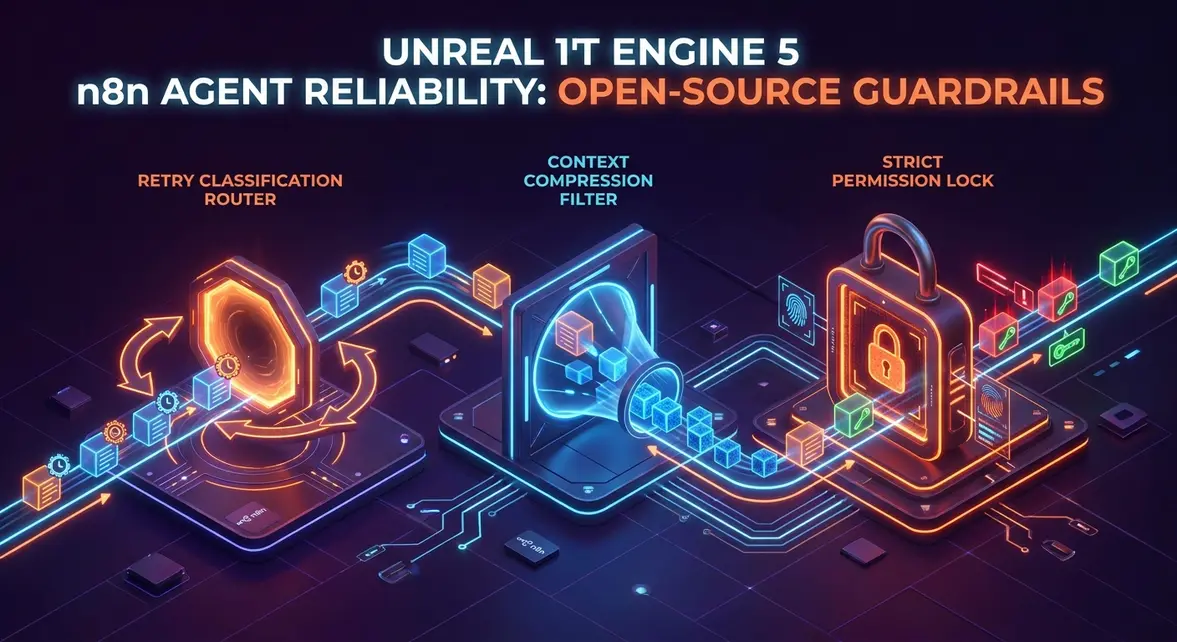
Moving from naive agent execution to a fault-tolerant architecture requires addressing three distinct failure domains. AgentGuard tackles these through specialized, decoupled sub-workflows.
- RetryClassifier: Replaces generic retries with a 10-class error taxonomy. It parses 429 Retry-After headers, cascades to local Ollama during API outages, and triggers context compaction on 400 errors.
- ContextBudget: Implements a two-tier compaction strategy to prevent silent context window exhaustion. It truncates oversized tool results instantly and uses a low-cost model to summarize historical turns when necessary.
- PermissionGate: Introduces a glob-pattern security layer for tool execution. It enforces allow, deny, or prompt-for-approval rules before any tool runs, logging all decisions to PostgreSQL or a webhook.
Implementation Pattern
Integrating these safeguards into existing n8n environments is designed to be a drop-in process. The modular nature allows teams to adopt components incrementally.
- Download the workflow JSON files from the AgentGuard GitHub repository.
- Import the sub-workflows directly into your n8n instance (requires version 1.70+).
- Insert an Execute Workflow node within your primary agent loop to route execution through the desired guardrails.
- Configure environment-specific parameters, such as fallback models, context thresholds, and security glob patterns.
Fractional CTO Perspective
Silent failures in revenue-generating workflows directly impact MRR. Relying on basic try/catch blocks or naive retry loops is engineering negligence when deploying autonomous agents. This open-source release provides enterprise-grade reliability primitives at zero software cost.
By implementing these patterns, engineering teams drastically reduce OPEX associated with manual incident recovery and API quota overruns. The PermissionGate component alone mitigates severe security risks associated with unrestricted LLM tool access. This is a mandatory architectural upgrade for any B2B platform running n8n agents in production.
System Telemetry Source: Original Engineering Report
Related Growth Blueprints
All Blueprints →Need this architecture deployed in your pipeline?
Skip the synchronous sales cycle and endless discovery calls. Submit your core acquisition or conversion bottleneck for a deep-dive asynchronous growth diagnostic.