n8n Architecture for Automated Insurance Claim Intake
The Signal
Manual insurance claim intake is a notorious operational bottleneck for scaling teams. Processing 40 to 60 claims daily can consume up to eight hours of manual data entry before any actual adjudication begins. By transitioning to an event-driven automation model, this workflow reduces intake time from eight minutes to just 12 seconds per claim.
The Architecture Shift
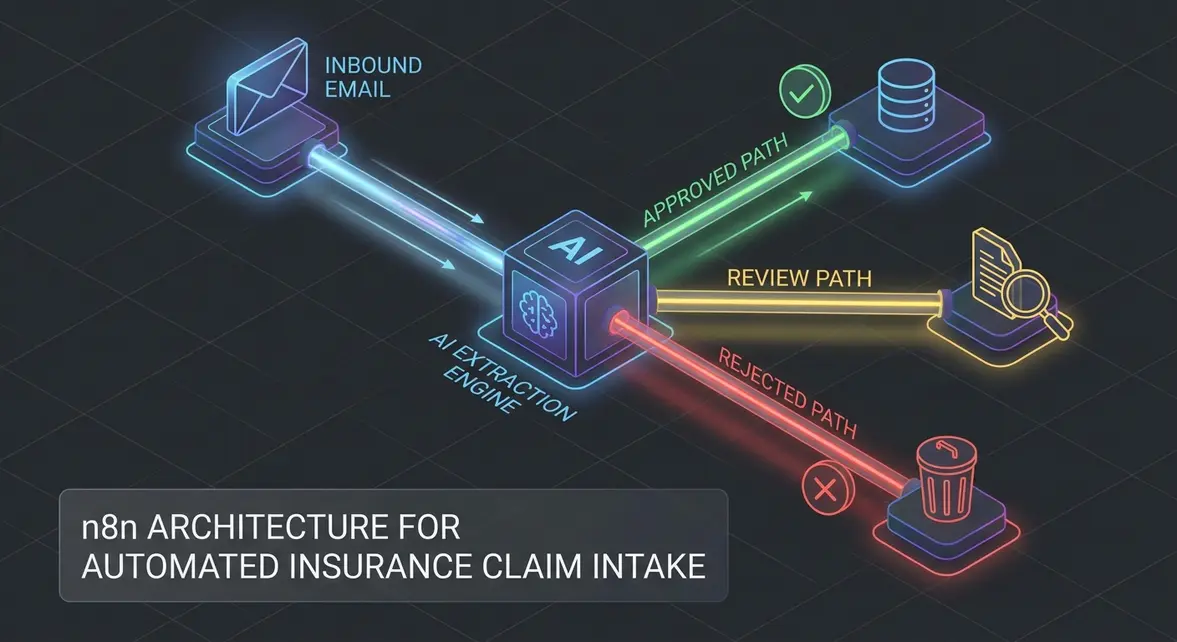
This system replaces human middleware with a deterministic, API-first pipeline. It leverages n8n for orchestration and PDF Vector for intelligent document extraction. The resulting architecture delivers immediate improvements across key operational vectors.
- Systems Impact: Replaces manual inbox monitoring with an OAuth2-authenticated Gmail trigger, ensuring zero-latency ingestion.
- Performance: Achieves 96% extraction accuracy on structured digital PDFs for critical fields like policy numbers and claimant data.
- Scalability: Decouples data extraction from human review, allowing the system to handle volume spikes without linear headcount scaling.
- Routing Logic: Automatically tiers claims based on financial thresholds, routing sub-$1,000 claims to auto-approval and escalating high-value claims.
Implementation Pattern
The pipeline operates on a strict, sequential ETL (Extract, Transform, Load) pattern. It utilizes conditional logic to flag anomalies before human intervention is required. Here is the step-by-step execution flow.
- Ingestion: A Gmail trigger detects incoming claims and downloads the PDF attachments.
- Extraction: The PDF Vector node parses the document, extracting clinical codes, financial data, and provider details.
- Transformation & Routing: A custom Code node calculates estimated reimbursements and applies routing thresholds.
- Validation: The system auto-flags claims missing pre-authorization numbers or supporting documents.
- Distribution: Structured data is loaded into Google Sheets for queue management, while real-time alerts are pushed to Slack.
Fractional CTO Perspective
From a strategic standpoint, this is a textbook example of high-leverage automation. By eliminating eight hours of daily manual data entry, you immediately reclaim a full-time equivalent (FTE) resource. This shifts OPEX away from low-value administrative tasks toward high-value claim adjudication.
Furthermore, the automated flagging mechanism acts as a proactive risk mitigation layer. Catching missing pre-authorizations before an adjuster opens the file drastically reduces cycle times. For B2B operations, deploying this architecture translates directly to improved SLA compliance and higher throughput without expanding payroll.
System Telemetry Source: Original Engineering Report
Related Growth Blueprints
All Blueprints →Need this architecture deployed in your pipeline?
Skip the synchronous sales cycle and endless discovery calls. Submit your core acquisition or conversion bottleneck for a deep-dive asynchronous growth diagnostic.