Securing n8n Workflows: Execution Boundary Proxy Pattern
The Signal
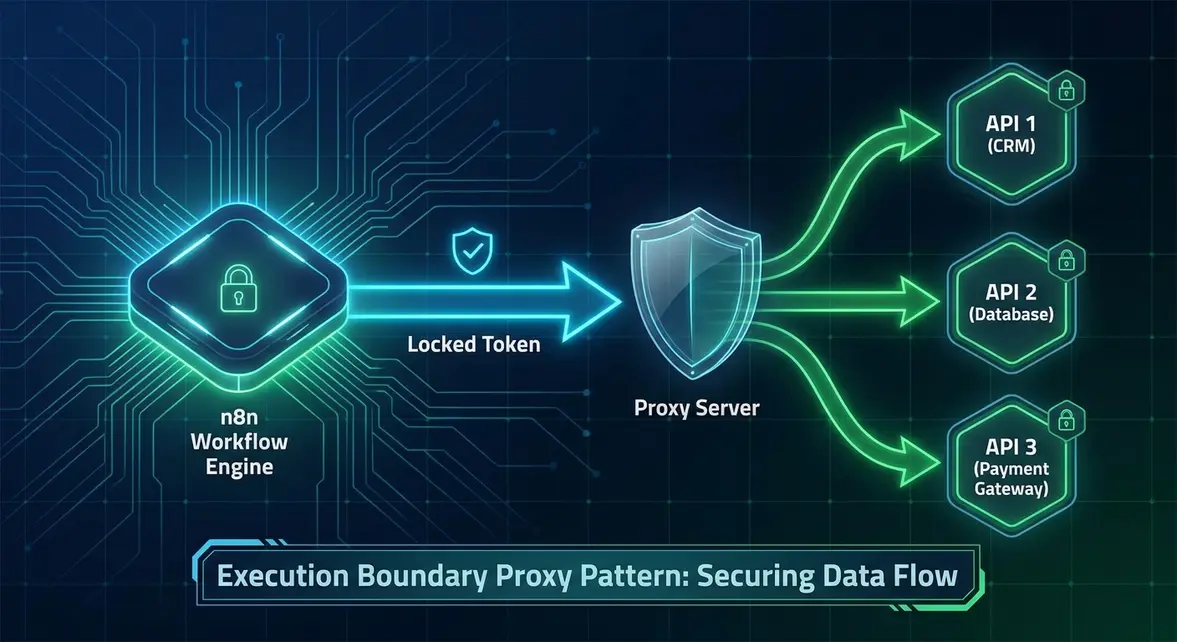
n8n workflows inherently treat credentials as data flowing through the execution graph. This architectural behavior leads to secret leakage in execution logs, exported JSON, and AI coding assistants. The definitive fix requires moving credentials behind a dedicated execution boundary.
The Architecture Shift
Relying solely on n8n's native credential store is insufficient when developers manually paste tokens into HTTP Request nodes. By introducing a proxy layer, n8n only requires a single rotating token to communicate with the proxy. The proxy then securely injects the actual API credentials on the wire.
- Systems Impact: Centralizes trust and auditing into a single proxy layer, drastically reducing the attack surface within the n8n environment.
- Performance: Introduces a minor network hop, which is negligible for asynchronous workflows but requires benchmarking for high-frequency pipelines.
- Scalability: Decouples token refresh, caching, and rotation from the workflow logic, allowing independent scaling of the credential management layer.
Implementation Pattern
To implement this execution boundary, follow a strict decoupling process. Never allow developers to paste raw tokens into HTTP nodes.
- Deploy a secure proxy service designed to hold and inject external API credentials.
- Configure n8n to authenticate with the proxy using a single, rotating proxy token.
- Store this proxy token strictly as an n8n Header Auth Credential to ensure only the credential ID is exported in the JSON.
- Route all outbound HTTP requests from n8n through the proxy.
- Implement robust monitoring on the proxy to distinguish between external API errors and proxy downtime.
Fractional CTO Perspective
Security incidents directly impact MRR through customer churn and reputational damage. Implementing an execution boundary for credentials shifts the security burden from workflow developers to a centralized infrastructure layer. This reduces OPEX related to security audits and incident response.
Furthermore, this architecture safely unlocks the use of AI coding assistants for workflow generation. By ensuring no live credentials exist in the workflow JSON, engineering teams can accelerate development without risking catastrophic secret exposure.
System Telemetry Source: Original Engineering Report
Related Growth Blueprints
All Blueprints →Need this architecture deployed in your pipeline?
Skip the synchronous sales cycle and endless discovery calls. Submit your core acquisition or conversion bottleneck for a deep-dive asynchronous growth diagnostic.