n8n Do-While Node: Native Polling & Async Workflows
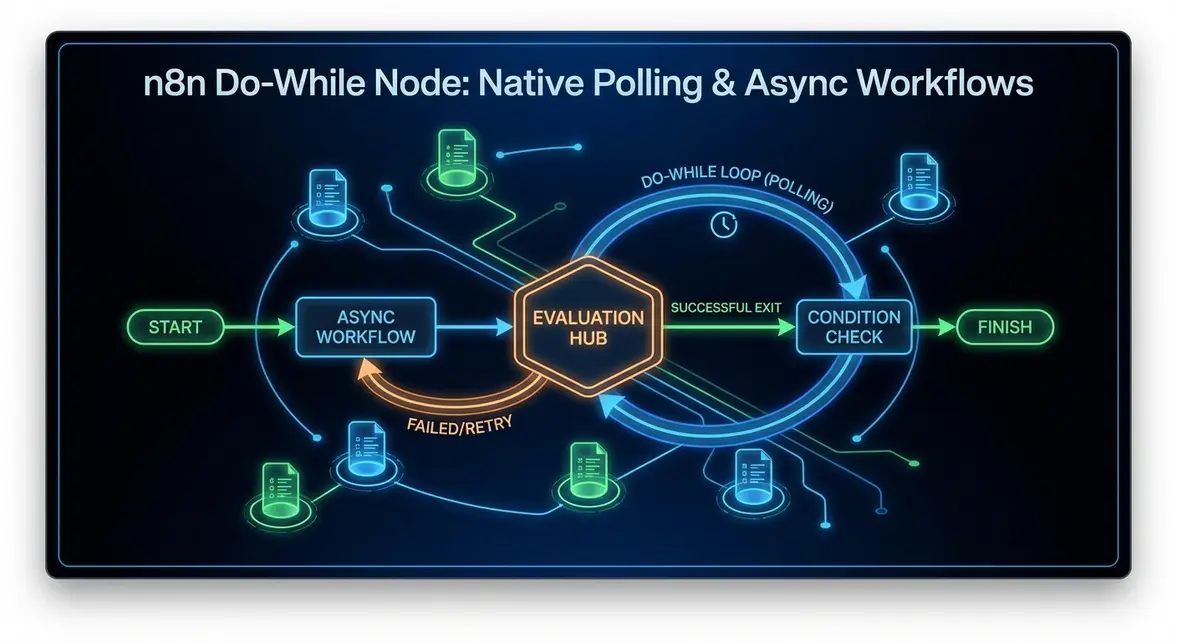
The Signal
The n8n ecosystem has historically lacked a native construct for indeterminate looping. Engineers often resorted to fragile recursive code nodes or rigid wait loops to handle asynchronous polling.
The release of the n8n-nodes-do-while community node fundamentally solves this architectural gap. It introduces a native do...while control flow pattern directly into the n8n visual canvas.
This enables robust polling mechanisms, API retries, and state-dependent workflow execution without relying on external dependencies or complex workarounds.
The Architecture Shift
Implementing this node shifts workflow design from deterministic list processing to dynamic state evaluation. This drastically reduces workflow complexity and failure rates.
- State Management: Automatically injects a
_loopmetadata object to track iterations, first runs, and timeout states. - Safety Mechanisms: Enforces a configurable maximum iteration cap to prevent infinite loops and runaway compute costs.
- Graceful Degradation: Routes timed-out executions through a standard exit pin with a boolean flag, allowing downstream IF nodes to handle failures cleanly.
- Resource Optimization: Replaces continuous recursive execution with configurable wait intervals, reducing load on both n8n and target APIs.
Implementation Pattern
Integrating the do...while node requires a specific routing topology to function correctly within your automation architecture.
- Initialize State: Use a Set node to define the initial variables or payload before entering the loop.
- Configure the Loop: Set the exit condition (e.g.,
$json.status === 'done'), the wait interval, and the maximum iteration limit. - Route the Action: Connect the "Loop" output pin to your action nodes, such as an HTTP Request or Database Query.
- Close the Circuit: Route the output of your action nodes back into the input of the Do...While node.
- Handle the Result: Connect the "Condition Met" output pin to your downstream logic, ensuring you check
$json._loop.timedOutto handle edge cases.
Fractional CTO Perspective
From an operational standpoint, asynchronous polling is a notorious source of silent failures and technical debt in automation platforms. This node standardizes how your engineering team handles eventual consistency.
By eliminating custom recursive scripts, you reduce maintenance overhead and lower the barrier to entry for developers building complex integrations. The built-in timeout handling directly protects your OPEX by preventing infinite API polling loops.
For B2B SaaS platforms relying on n8n for backend orchestration, this translates to higher reliability, fewer support tickets, and more predictable compute utilization.
System Telemetry Source: Original Engineering Report
Related Growth Blueprints
All Blueprints →Need this architecture deployed in your pipeline?
Skip the synchronous sales cycle and endless discovery calls. Submit your core acquisition or conversion bottleneck for a deep-dive asynchronous growth diagnostic.