Scaling n8n AI Agents with Progressive Disclosure
The Signal
Cramming instructions into an AI Agent's system prompt creates an unsustainable scaling curve. As tasks multiply, token counts explode, driving up latency and OPEX. This implementation solves context bloat by adapting Anthropic's Agent Skills pattern for self-hosted n8n environments.
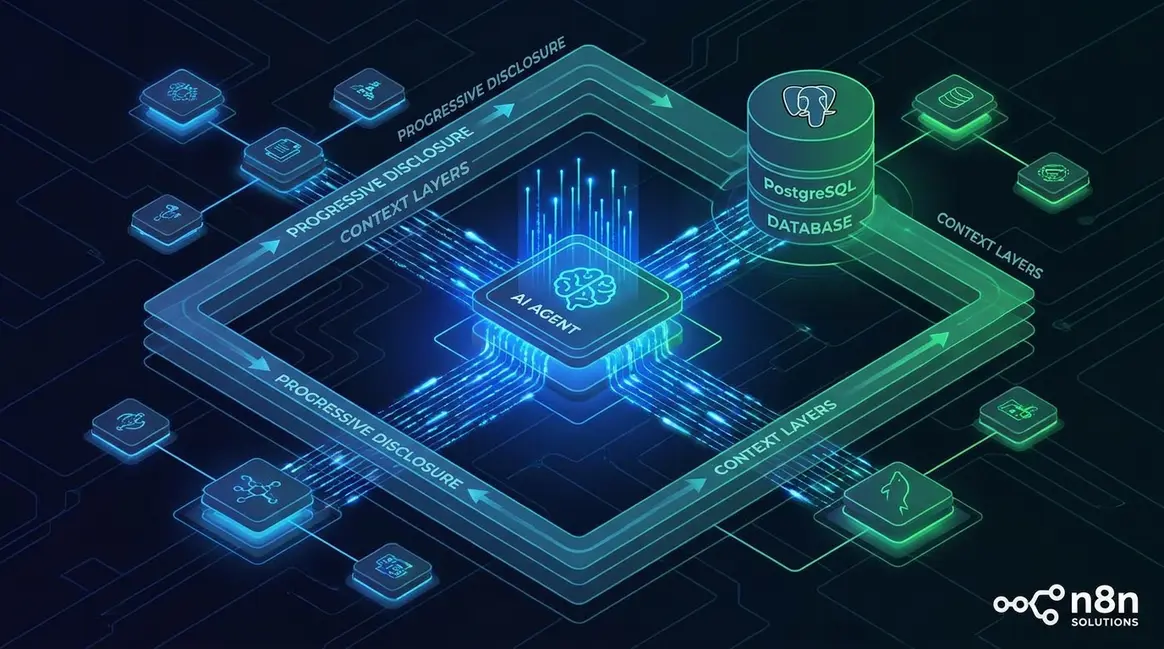
By utilizing progressive disclosure, the system loads context dynamically rather than statically. The agent only holds a lightweight manifest in its baseline memory. Full instructions and reference materials are fetched on-demand via tool calls.
The Architecture Shift
The core architectural decision involves bypassing n8n's native Data Tables in favor of a dedicated PostgreSQL container. While Data Tables offer zero-infrastructure prototyping, they introduce strict limitations for enterprise workloads. A dedicated database unlocks programmatic access and future-proofs the system.
- Systems Impact: Eliminates the 50MB native storage cap and enables direct programmatic access from Code nodes.
- Performance: Slashes baseline system prompt size from over 8,000 tokens to a minimal 30-50 token manifest per skill.
- Scalability: Utilizing the pgvector image pre-positions the architecture for seamless transition to RAG-based similarity search.
- Data Integrity: Enables robust audit logging through automated history triggers and cascade-on-delete behaviors.
Implementation Pattern
The solution relies on three distinct n8n workflows and a structured Postgres schema. The database utilizes three tables: a primary skills store, a child table for references, and an archival history table. This ensures clean state management and version control.
- Layer 1 (Manifest): The main agent workflow queries active skills and injects a lightweight JSON index into the system prompt.
- Layer 2 (Skill Body): The LLM triggers a sub-workflow tool to fetch the full markdown instructions only when a specific skill is matched.
- Layer 3 (References): A secondary tool workflow retrieves edge cases or long lists exclusively when the loaded skill demands them.
This decoupled approach ensures that tool call results are scoped strictly to the current run. Future conversational turns remain unpolluted by irrelevant context. The only custom code required is a six-line JavaScript snippet to build the manifest index.
Fractional CTO Perspective
From a B2B engineering standpoint, this pattern is a masterclass in OPEX optimization. Paying for 8,000 tokens on every trivial user query is a massive waste of capital. Progressive disclosure transforms LLM interactions from a fixed-cost model to a variable, usage-based model.
Furthermore, the choice of Postgres over native tooling demonstrates mature architectural foresight. It trades a minor increase in infrastructure complexity for absolute control over data scaling and vector search readiness. This is how you build production-grade AI middleware that won't buckle under enterprise demands.
System Telemetry Source: Original Engineering Report
Related Growth Blueprints
All Blueprints →Need this architecture deployed in your pipeline?
Skip the synchronous sales cycle and endless discovery calls. Submit your core acquisition or conversion bottleneck for a deep-dive asynchronous growth diagnostic.