Persist dataLayer State Across Navigation in GTM
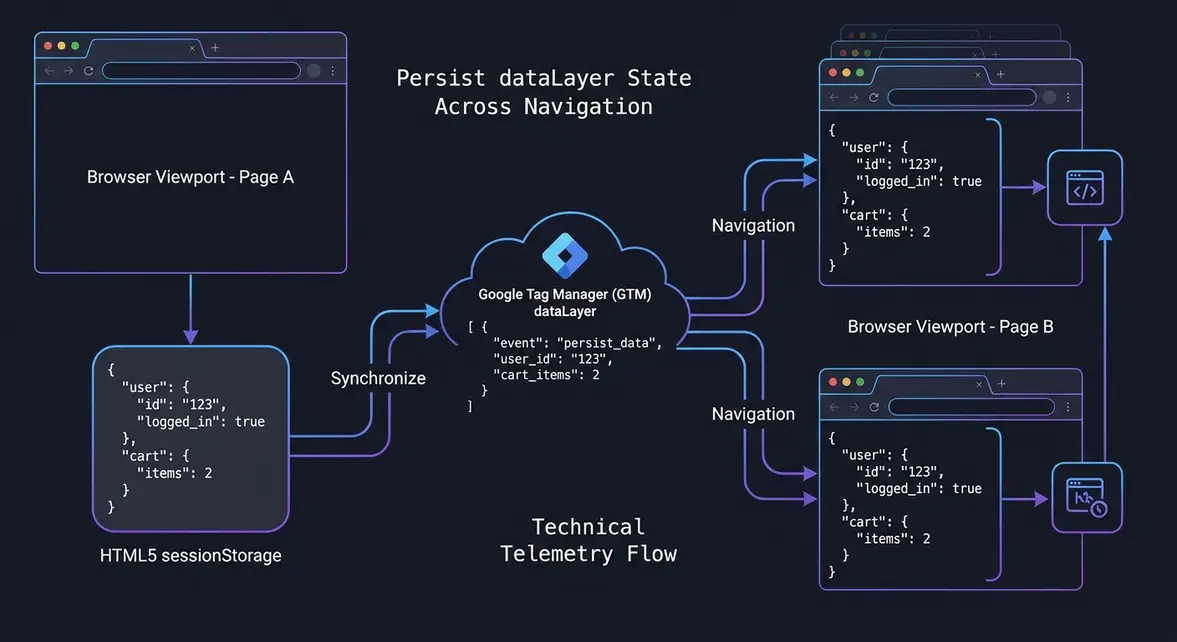
Session-Resilient Telemetry: Persisting Client-Side State
Executive Architectural Takeaway: The volatile nature of browser memory wipes JavaScript globals—including the Google Tag Manager dataLayer array—on every hard document reload. By decoupling session-scoped state from ephemeral window memory using the HTML5 Web Storage API (sessionStorage and localStorage), growth engineering teams can retain critical campaign identifiers, multi-step funnel metadata, and user classification parameters across page transitions without relying on bloated HTTP cookie headers.
Legacy analytics architectures treat every HTTP document refresh as a clean slate. When an anonymous lead navigates an enterprise marketing site, query parameters like gclid or custom demographic variables pushed via dataLayer.push() vanish the moment a standard link navigation triggers a teardown of the DOM. Historically, engineers mitigated this by stuffing state into document cookies. However, cookies impose an unacceptable performance penalty: every client-side cookie increases the byte payload of subsequent HTTP request headers, degrading Time to First Byte (TTFB) and consuming egress bandwidth across all static asset calls.
The modern telemetry primitive swaps cookie pollution for local browser storage. By abstracting the dataLayer queue into a localized persistence layer, custom parameters are written synchronously into sessionStorage or scoped localStorage. Upon execution of the GTM container on subsequent pageviews, an initialization script reads this key-value store and hydrates the window dataLayer before tags fire, eliminating session fragmentation.
Technical SEO Runtime Dynamics & Hydration Bottlenecks
Search engine crawlers like Googlebot execute single-pass renders with stateless, ephemeral sessions. Because headless renderers typically do not preserve local storage contexts across multiple crawled URLs, attempting to infer SEO data strictly from dynamic client-side storage can yield tracking disparities between bot indexing behavior and real-user runtime execution.
Architecting a robust persistence layer requires understanding the boundary between crawlable content and client-side attribution:
- Stateless Search Crawling: Googlebot parses URLs in sandboxed environments where
sessionStorageis expunged between discrete URL inspections. Consequently, metadata essential for technical SEO—such as canonical overrides, breadcrumb structures, and structured JSON-LD schemas—must remain statically rendered in the HTML markup or resolved via edge compute (e.g., Cloudflare Workers or Next.js App Router dynamic SSR), rather than relying on persisted client-side state. - Client Runtime Telemetry: Conversely, growth attribution requires persistent state across disparate landing pages, content hubs, and lead gen assets. Running client-side serialization preserves the visitor's multi-touch trajectory without mutating URL canonicals via ugly query parameter pollution (
?utm_source=...lingering on internal links). - Core Web Vitals Impact: Accessing the HTML5 Web Storage API is synchronous and executes on the browser's main thread. High-frequency reads or massive payload serializations (
JSON.stringify()) will block the main thread and trigger Long Animation Frames (LoAF), directly degrading Interaction to Next Paint (INP). The persistence layer must be lean, reading and writing strictly indexed, stringified JSON payloads under 10KB to maintain synchronous read latency under 2ms.
Marketing Ops Implementation: Engineering The Persistence Engine
Deploying a scalable cross-page persistence pipeline requires two foundational assets: a lightweight GTM custom tag executing at container initialization (Consent Initialization or Initialization trigger), and a downstream validation query in BigQuery to ensure attribution continuity.
Step 1: Client-Side Storage Serializer Tag
Create a Custom HTML Tag in GTM triggered on the All Pages or Initialization event. This script intercepts specified dataLayer keys, persists them into sessionStorage, and immediately pushes them back into the active runtime data model upon page load.
<script>
(function(window, storageKey) {
  'use strict';

  var storage = window.sessionStorage;
  if (!storage) return;

  // Retrieve current persisted state
  var getPersistedState = function() {
    try {
      var item = storage.getItem(storageKey);
      return item ? JSON.parse(item) : {};
    } catch (e) {
      return {};
    }
  };

  // Write state back to sessionStorage
  var setPersistedState = function(state) {
    try {
      storage.setItem(storageKey, JSON.stringify(state));
    } catch (e) {
      // Quota exceeded or private browsing restrictions
    }
  };

  // Hydrate dataLayer on initial page boot
  var currentState = getPersistedState();
  if (Object.keys(currentState).length > 0) {
    window.dataLayer = window.dataLayer || [];
    window.dataLayer.push(Object.assign({}, currentState, {
      event: 'dataLayerHydrated'
    }));
  }

  // Helper function to invoke from other tags: window.persistToDataLayer({ key: 'val' })
  window.persistToDataLayer = function(newPayload) {
    var activeState = getPersistedState();
    for (var key in newPayload) {
      if (newPayload.hasOwnProperty(key)) {
        activeState[key] = newPayload[key];
      }
    }
    setPersistedState(activeState);
    window.dataLayer.push(newPayload);
  };
})(window, '__gtm_persisted_state');
</script>
Step 2: Session Attribution Verification in BigQuery
Once persisted parameters (such as original touchpoint channels and entry click identifiers) flow into GA4, validate that attribution continuity is maintained over multi-page enterprise conversion journeys using Google BigQuery exports.
WITH session_events AS (
  SELECT
    user_pseudo_id,
    (SELECT value.int_value FROM UNNEST(event_params) WHERE key = 'ga_session_id') AS ga_session_id,
    event_timestamp,
    event_name,
    (SELECT value.string_value FROM UNNEST(event_params) WHERE key = 'persisted_initial_campaign') AS persisted_campaign,
    (SELECT value.string_value FROM UNNEST(event_params) WHERE key = 'persisted_lead_tier') AS persisted_lead_tier
  FROM
    `enterprise-analytics-prod.analytics_123456789.events_*`
  WHERE
    _TABLE_SUFFIX = FORMAT_DATE('%Y%m%d', DATE_SUB(CURRENT_DATE(), INTERVAL 1 DAY))
)
SELECT
  user_pseudo_id,
  ga_session_id,
  COUNTIF(event_name = 'page_view') AS total_pageviews,
  LOGICAL_OR(event_name = 'generate_lead') AS has_converted,
  MAX(persisted_campaign) AS attribution_campaign,
  MAX(persisted_lead_tier) AS enterprise_segment
FROM
  session_events
GROUP BY
  user_pseudo_id,
  ga_session_id
HAVING
  total_pageviews > 1
ORDER BY
  total_pageviews DESC
LIMIT 100;
Inside GTM, capture variables via a Custom JavaScript Variable referencing {{Persisted State}} or direct Data Layer Variables pointing to keys exposed by the dataLayerHydrated trigger.
Enterprise Pipeline Velocity: Eliminating Multi-Step Attribution Leakage
In enterprise B2B sales cycles, the journey from organic entry to demo booking spans multiple long-form pages, gated resource downloads, interactive pricing calculators, and third-party embedded widgets. When attribution depends on ephemeral URL parameters or in-memory variables, the moment a prospect clicks from a paid LinkedIn landing page to an ungated product tour, downstream conversion forms lose critical upstream attribution context.
Implementing storage-backed dataLayer persistence safeguards marketing pipeline fidelity:
- Zero Cookie Header Degradation: Shifting state handling from HTTP cookies to
sessionStoragecompletely removes attribution variables from HTTP request headers. For sites serving dozens of static micro-assets per page, saving 2KB to 4KB per network request lowers aggregate egress costs and prevents edge TTFB latency degradation. - Defending Pipeline CAC Accuracy: Missing first-touch attribution parameters in downstream CRM records (Salesforce/HubSpot) skews Customer Acquisition Cost (CAC) metrics. By holding UTM values, enterprise intent signals, and ad platform click IDs in localized storage, late-stage form fills consistently pull complete attribution payloads, directly reconciling paid ad spend with pipeline velocity and Annual Recurring Revenue (ARR).
System Telemetry Source: Original Engineering Report
Related Growth Blueprints
All Blueprints →Need this architecture deployed in your pipeline?
Skip the synchronous sales cycle and endless discovery calls. Submit your core acquisition or conversion bottleneck for a deep-dive asynchronous growth diagnostic.