Self-Hosted Supabase Architecture for Space Ops
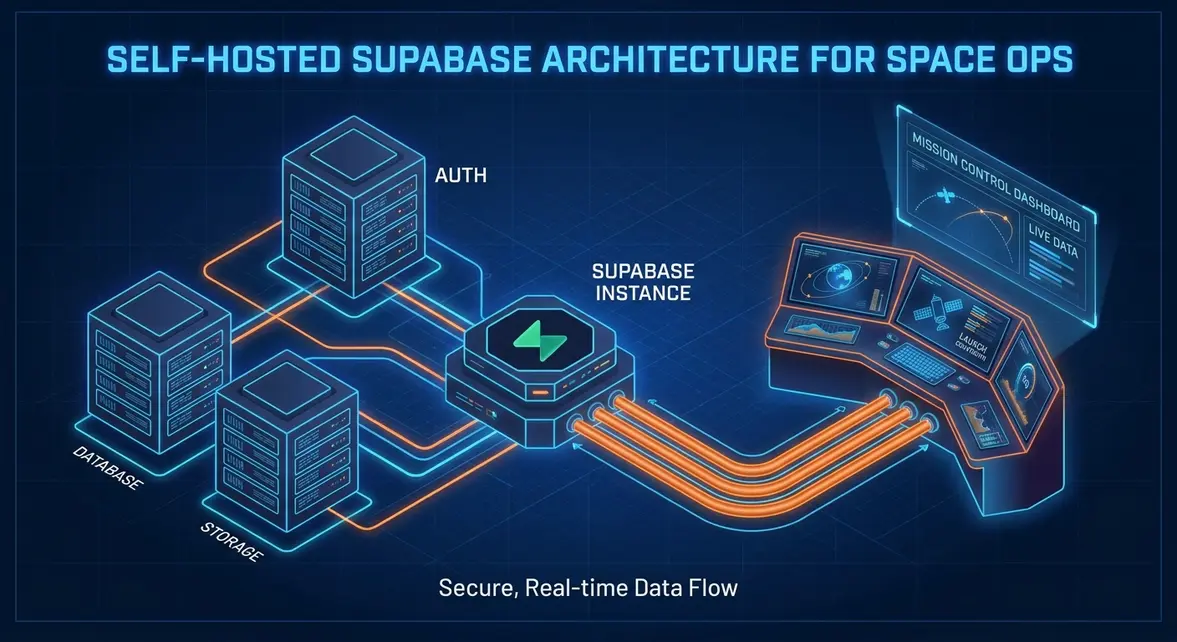
The Signal
Epsilon3 is revolutionizing the aerospace industry by providing an operating system for complex space missions. To manage billion-dollar project operations securely, they transitioned to a self-hosted Supabase architecture. This strategic move ensures absolute data sovereignty and operational reliability in zero-margin-for-error environments.
The Architecture Shift
Space operations demand strict compliance, air-gapped security potential, and real-time telemetry processing. Relying on multi-tenant cloud infrastructure introduces unacceptable risk profiles for mission-critical aerospace data. By self-hosting Supabase, Epsilon3 reclaims control over their entire data plane and authentication flow.
This architectural pivot fundamentally changes how they handle system impacts:
- Systems Impact: Complete isolation of the database and backend services eliminates noisy-neighbor problems.
- Performance: Localized deployment reduces network hops, ensuring real-time synchronization for mission control dashboards.
- Scalability: The underlying PostgreSQL database can be vertically and horizontally scaled independently of a managed service tier.
- Security: Self-hosting enables strict compliance with ITAR and other aerospace regulatory frameworks.
Implementation Pattern
Deploying a self-hosted Backend-as-a-Service (BaaS) requires a rigorous infrastructure-as-code approach. The engineering team must orchestrate multiple microservices while maintaining high availability. Here is the standard deployment logic for this pattern:
- Infrastructure Provisioning: Deploy dedicated compute instances and managed PostgreSQL clusters within a private VPC.
- Container Orchestration: Utilize Docker or Kubernetes to spin up Supabase microservices, including GoTrue, PostgREST, and Realtime.
- Network Isolation: Configure strict security groups, API gateways, and load balancers to restrict access to mission-control nodes.
- Telemetry & Monitoring: Implement custom observability stacks using Prometheus and Grafana to track database health and query latency.
Fractional CTO Perspective
From a strategic standpoint, self-hosting a BaaS like Supabase is a calculated trade-off between operational expenditure (OPEX) and engineering overhead. For B2B platforms handling highly sensitive data, the MRR gained by passing strict enterprise security audits far outweighs the infrastructure costs. It transforms compliance from a sales blocker into a distinct competitive advantage.
Furthermore, this architecture mitigates vendor lock-in and unpredictable pricing at scale. By owning the infrastructure, Epsilon3 stabilizes their unit economics while scaling to support billion-dollar space operations. This is a textbook example of aligning technical architecture with enterprise business objectives.
System Telemetry Source: Original Engineering Report
Related Growth Blueprints
All Blueprints →Need this architecture deployed in your pipeline?
Skip the synchronous sales cycle and endless discovery calls. Submit your core acquisition or conversion bottleneck for a deep-dive asynchronous growth diagnostic.