Proxying GTM Web Containers via Server-Side Tagging
First-Party Script Delivery: The sGTM Web Container Client
Legacy tracking implementations rely on direct client-side requests to third-party endpoints such as www.googletagmanager.com/gtm.js. This traditional architecture creates security vulnerabilities, exposes ingestion pipelines to aggressive browser ad-blocking heuristics, and introduces latency penalties via external DNS lookups and TLS negotiations. The Google Tag Manager Web Container Client within Server-Side GTM (sGTM) shifts this paradigm by serving the core tag management JavaScript directly from a custom first-party subdomain (e.g., metrics.domain.com).
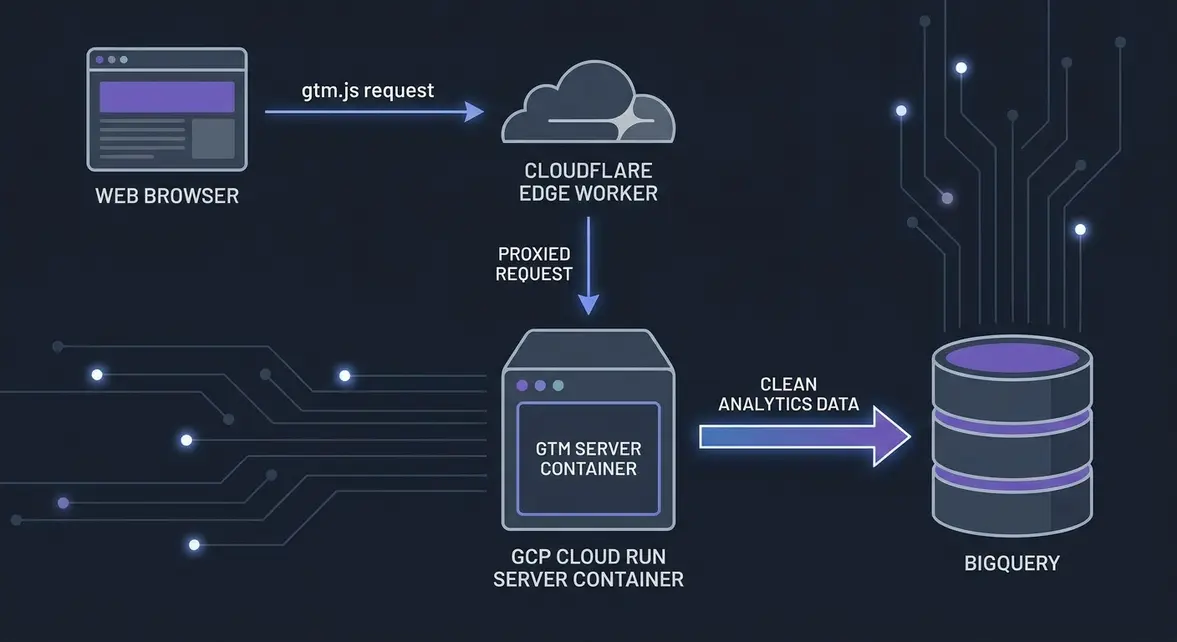
By deploying the Web Container Client inside an sGTM environment hosted on GCP Cloud Run or AWS Elastic Beanstalk, engineers proxy the delivery of the web container script. The server container intercepts the incoming HTTP request, fetches the upstream container definition from Google's infrastructure, caches the response, and streams it back to the client browser under a strict first-party domain context. This operational shift provides engineering teams with full programmatic control over HTTP headers, cache invalidation cycles, and data hygiene before execution happens in the DOM.
Core Web Vitals and First-Party Data Architecture
Routing GTM web container scripts through a server-side proxy directly impacts technical SEO and browser-level runtime execution. From a Core Web Vitals standpoint, standard third-party script injection often triggers connection overhead that increases Time to First Byte (TTFB) and degrades Largest Contentful Paint (LCP). By consolidating script retrieval through an existing first-party origin or an edge CDN proxy, browsers eliminate redundant TCP handshakes and DNS resolutions, accelerating script evaluation and minimizing main-thread blocking time.
Furthermore, Safari Intelligent Tracking Prevention (ITP) and Firefox Enhanced Tracking Protection (ETP) impose artificial expiration ceilings on cookies set via client-side JavaScript (often down to 24 hours or 7 days). Serving container code and telemetry ingestion endpoints via a first-party DNS record (with an identical apex domain) enables the generation of server-set Set-Cookie headers containing the HttpOnly and Secure flags. This preserves cross-session attribution longevity across long B2B enterprise sales cycles without violating browser privacy sandboxes.
- Content Security Policy (CSP) Consolidation: Eliminates the requirement to whitelist external origins like
www.googletagmanager.com, locking down script execution policies strictly to self-hosted or dedicated first-party CDNs. - Cache Control Optimization: Overrides default short TTLs by applying edge-level
stale-while-revalidateheaders, ensuring instant subsequent loads while maintaining background container freshness. - Ad-Blocker Resilience: Circumvents automated script-blocking rules that rely on static URL matching against third-party domain blocklists.
Marketing Ops Implementation: Edge Proxy Runbook
Executing this deployment requires configuring the sGTM Web Container Client, modifying the client-side injection snippet, and setting up an edge reverse-proxy via Cloudflare Workers to terminate TLS and forward requests to the GCP Cloud Run origin.
First, update the client-side GTM loader script on your application root to source the bundle directly from your sGTM edge endpoint instead of Google servers:
// Next.js / Custom Client-Side GTM Bootstrap Snippet
(function(w, d, s, l, i) {
  w[l] = w[l] || [];
  w[l].push({ 'gtm.start': new Date().getTime(), event: 'gtm.js' });
  var f = d.getElementsByTagName(s)[0],
      j = d.createElement(s),
      dl = l != 'dataLayer' ? '&l=' + l : '';
  j.async = true;
  // Route via first-party sGTM domain proxy instead of googletagmanager.com
  j.src = 'https://metrics.enterprise.com/gtm.js?id=' + i + dl;
  f.parentNode.insertBefore(j, f);
})(window, document, 'script', 'dataLayer', 'GTM-XXXXXXX');
Next, configure a Cloudflare Worker at the edge to route inbound /gtm.js and ingestion hits directly to your downstream sGTM Cloud Run instance while setting performance headers:
// Cloudflare Worker: Edge Reverse Proxy to sGTM Cloud Run Origin
export default {
  async fetch(request: Request, env: any): Promise<Response> {
    const url = new URL(request.url);
    const upstreamOrigin = 'https://sgtm-production-xyz-uc.a.run.app';

    // Preserve query parameters and pass through custom request headers
    const targetUrl = new URL(url.pathname + url.search, upstreamOrigin);
    const modifiedHeaders = new Headers(request.headers);
    modifiedHeaders.set('X-Forwarded-Host', url.hostname);
    modifiedHeaders.set('X-Real-IP', request.headers.get('cf-connecting-ip') || '');

    const upstreamResponse = await fetch(targetUrl.toString(), {
      method: request.method,
      headers: modifiedHeaders,
      body: request.body,
      redirect: 'manual'
    });

    // Clone response to mutate caching headers for gtm.js payloads
    const responseHeaders = new Headers(upstreamResponse.headers);
    if (url.pathname.endsWith('/gtm.js')) {
      responseHeaders.set('Cache-Control', 'public, max-age=3600, stale-while-revalidate=86400');
      responseHeaders.delete('pragma');
    }

    return new Response(upstreamResponse.body, {
      status: upstreamResponse.status,
      headers: responseHeaders
    });
  }
};
B2B Enterprise Growth & Data Pipeline Reliability
For B2B software companies marketing to technical personas (software engineers, security architects, DevOps managers), client-side tracking loss typically ranges between 20% and 40% due to aggressive ad-blockers, tracking protection extensions, and corporate network firewalls. This tracking drop-off cripples multi-touch attribution models and inflates observed Customer Acquisition Costs (CAC), because paid conversion events originating from LinkedIn Ads or Google Search are dropped prior to DOM ingestion.
By routing the GTM web container through a first-party sGTM client proxy, growth engineering teams recover lost event telemetry and guarantee payload delivery to backend warehouses like Snowflake or BigQuery. Furthermore, this architecture solves enterprise compliance mandates. Personal Identifiable Information (PII) such as unhashed emails, internal IP addresses, and user-agent fingerprints can be stripped or cryptographically hashed within the server container before data is routed to external downstream analytics vendors, mitigating SOC 2 and GDPR enforcement risks.
System Telemetry Source: Original Engineering Report
Blueprint di Crescita Correlati
Tutti gli Esperimenti →Vuoi implementare questa architettura nella tua pipeline?
Evita i lunghi cicli di vendita e le infinite call di scoperta. Invia il tuo collo di bottiglia di acquisizione o conversione per una diagnosi tecnica approfondita in asincrono.