Cloudflare Enables Autonomous Agent Infrastructure
The Signal
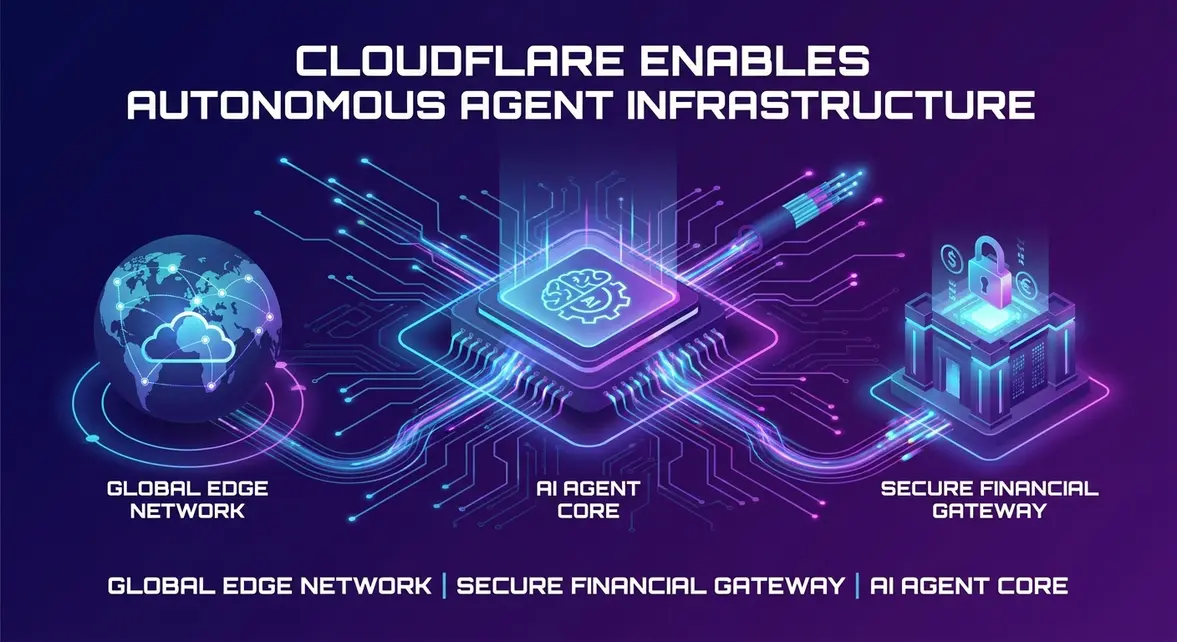
Cloudflare has fundamentally shifted the infrastructure provisioning paradigm. AI agents can now autonomously create accounts, purchase domains, and deploy code.
This eliminates the traditional human-in-the-loop bottlenecks for API token generation and billing setup. Systems can now scale horizontally, driven entirely by programmatic agent logic.
The Architecture Shift
This update transitions infrastructure management from declarative Infrastructure-as-Code (IaC) to autonomous Agentic Infrastructure. The integration seamlessly bridges Cloudflare's edge network with Stripe's financial APIs.
- Systems Impact: Decouples infrastructure provisioning from human identity and manual dashboard interactions.
- Performance: Reduces time-to-deployment from minutes or hours to milliseconds by automating token generation.
- Scalability: Enables infinite horizontal scaling where agents spin up isolated environments on demand.
Implementation Pattern
Integrating this capability requires a shift in how we handle authentication and billing workflows. The process relies on secure, programmatic handshakes between the agent, Stripe, and Cloudflare.
- Agent Initialization: The AI agent triggers a provisioning request via the Cloudflare API.
- Financial Handshake: The system interfaces with Stripe to authorize a paid subscription without manual credit card entry.
- Resource Allocation: Cloudflare registers the requested domain and provisions the edge environment.
- Token Issuance: An API token is returned directly to the agent for immediate code deployment.
Fractional CTO Perspective
For B2B SaaS platforms, this is a massive operational leverage point. By allowing agents to handle infrastructure provisioning, engineering teams can drastically reduce OPEX associated with DevOps overhead.
Furthermore, this accelerates time-to-value for end users, directly impacting MRR growth. Human oversight is relegated to permission granting rather than execution, optimizing resource allocation.
System Telemetry Source: Original Engineering Report
Related Growth Blueprints
All Blueprints →Need this architecture deployed in your pipeline?
Skip the synchronous sales cycle and endless discovery calls. Submit your core acquisition or conversion bottleneck for a deep-dive asynchronous growth diagnostic.