Reverse-IP Tracking: Collect ISP in GA4 & BigQuery
Reverse-IP Telemetry & Network Dimension Deprecation
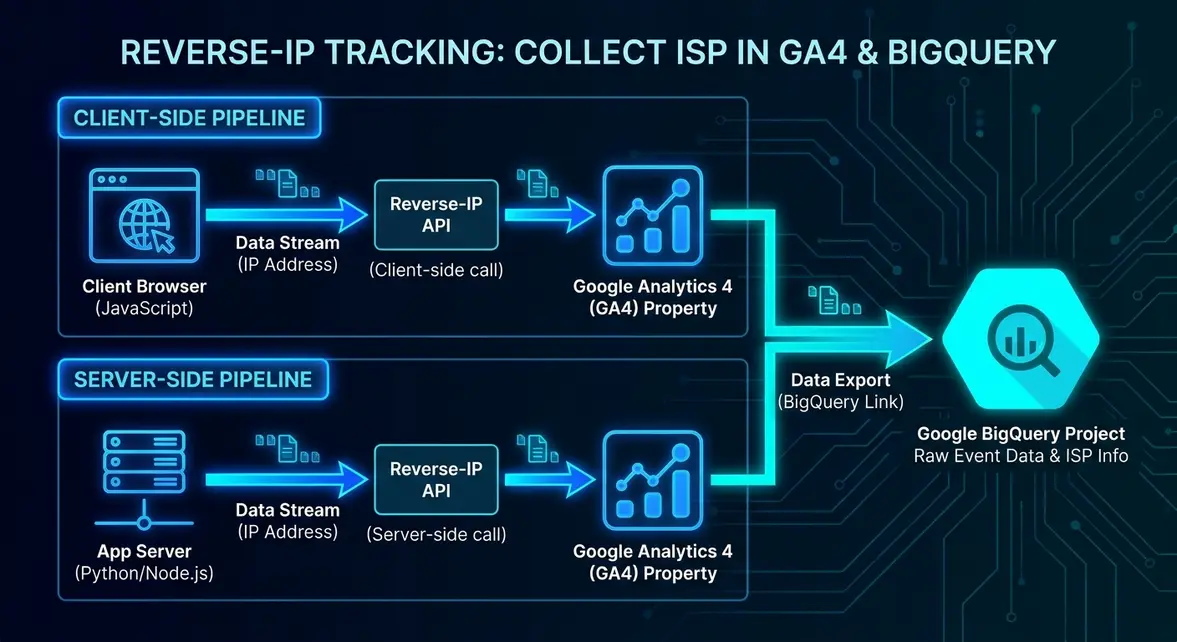
Executive Architectural Takeaway: The deprecation of native Service Provider and Network Domain dimensions in Google Analytics eliminated automated ISP and enterprise network tracking, degrading organic B2B attribution pipelines. Modern technical marketing teams reconstruct this telemetry by executing asynchronous reverse-IP lookups via edge workers or client-side SDKs, caching metadata in sessionStorage to maintain sub-50ms execution, and streaming autonomous system numbers (ASNs) directly into GA4 custom dimensions and BigQuery.
Historically, Universal Analytics automatically parsed the client IP address against a proprietary MaxMind database before anonymizing the last octet. This process exposed Network Domain and Service Provider directly in standard reporting interfaces. In February 2020, Google permanently deprecated both dimensions, forcing all incoming values to (not set). For B2B growth engineers, this eliminated native account-level identification, automated bot scrubbing (identifying AWS, DigitalOcean, and GCP crawlers), and organic company deanonymization at the edge.
Resolving this architectural deficit requires decoupling geo-intelligence extraction from Google Analytics' internal processing pipeline. Instead of relying on passive server-side parsing by Google, engineering teams deploy a client-side or server-side GTM (sGTM) reverse lookup against an IP intelligence endpoint (such as IP Geolocation API or MaxMind GeoIP2 Precision). The response payloads are parsed for Autonomous System Numbers (ASN), Internet Service Provider (ISP) names, and company domain associations before being committed to persistent storage and forwarded via GA4 event parameters.
Technical SEO & Data Architecture: Edge Telemetry vs Client Overhead
Executing network lookups client-side presents distinct performance trade-offs that directly affect Core Web Vitals (CWV). A blocking HTTP request to an external geolocation API prior to firing the primary GA4 configuration tag introduces variable latency (often 150ms to 450ms), degrading Time to First Byte (TTFB) and Largest Contentful Paint (LCP) if executed synchronously in the critical rendering path.
To preserve CWV benchmarks (LCP < 2.5s and zero Interaction to Next Paint degradation), the architecture must isolate reverse-IP lookup operations asynchronously outside the initial render cycle. The lookup is executed once per session, persisted into browser sessionStorage, and propagated to subsequent page views without issuing redundant network requests.
From a technical SEO and crawl budget perspective, server-side resolution at the CDN or sGTM layer offers three decisive architectural advantages:
- Crawler Disqualification: Search engine bots and headless scrapers (Googlebot, Bingbot, headless Chromium clusters) can be fingerprinted via ASN classification at the edge, preventing synthetic traffic from contaminating organic conversion funnels.
- Zero Main-Thread Contention: Moving resolution from client-side JavaScript execution to a Cloud Run sGTM instance reduces client-side CPU consumption, eliminating third-party script bloat.
- Data Sanitation Before GA4 Ingestion: Raw IP addresses are stripped at the sGTM proxy layer, ensuring strict adherence to GDPR Article 4(1) and SOC 2 Type II compliance standards before downstream transmission to BigQuery.
Marketing Ops Implementation: Asynchronous Reverse-IP Runbook
The implementation pipeline leverages client-side session caching paired with asynchronous dataLayer event dispatching, followed by BigQuery aggregation to isolate enterprise ISPs from commercial data centers.
First, deploy an asynchronous JavaScript snippet via GTM or directly in the document <body> that queries the reverse-IP endpoint, verifies existing sessionStorage states, and pushes validated ISP attributes into the data layer:
(function() {
  var storageKey = 'geo_telemetry_isp';
  var cachedISP = sessionStorage.getItem(storageKey);

  if (cachedISP) {
    window.dataLayer = window.dataLayer || [];
    window.dataLayer.push({
      event: 'telemetry_isp_ready',
      isp_name: cachedISP
    });
    return;
  }

  fetch('https://api.ipgeolocation.io/ipgeo?apiKey=YOUR_API_KEY&fields=isp')
    .then(function(response) {
      if (!response.ok) throw new Error('Network response failure');
      return response.json();
    })
    .then(function(data) {
      if (data && data.isp) {
        sessionStorage.setItem(storageKey, data.isp);
        window.dataLayer = window.dataLayer || [];
        window.dataLayer.push({
          event: 'telemetry_isp_ready',
          isp_name: data.isp
        });
      }
    })
    .catch(function(err) {
      console.warn('ISP Telemetry bypass:', err.message);
    });
})();
In Google Tag Manager, configure a Custom Event Trigger listening for telemetry_isp_ready. Map the Data Layer Variable {{isp_name}} to the GA4 Event parameter dimension_isp on all transactional and engagement hits.
Once GA4 streams raw telemetry into Google BigQuery via the continuous export pipeline, run the following SQL query to clean data center traffic (AWS, Google Cloud, Azure, DigitalOcean) and isolate commercial enterprise accounts driving organic traffic:
WITH enriched_sessions AS (
  SELECT
    user_pseudo_id,
    (SELECT value.int_value FROM UNNEST(event_params) WHERE key = 'ga_session_id') AS session_id,
    traffic_source.source AS traffic_source,
    traffic_source.medium AS traffic_medium,
    (SELECT value.string_value FROM UNNEST(event_params) WHERE key = 'dimension_isp') AS isp_name,
    event_timestamp
  FROM
    `gcp-project-id.analytics_123456789.events_*`
  WHERE
    _TABLE_SUFFIX = FORMAT_DATE('%Y%m%d', DATE_SUB(CURRENT_DATE(), INTERVAL 1 DAY))
)
SELECT
  isp_name,
  COUNT(DISTINCT CONCAT(user_pseudo_id, '-', CAST(session_id AS STRING))) AS total_sessions,
  COUNT(DISTINCT user_pseudo_id) AS unique_visitors
FROM
  enriched_sessions
WHERE
  isp_name IS NOT NULL
  AND NOT REGEXP_CONTAINS(LOWER(isp_name), r'(amazon|google|microsoft|digitalocean|ovh|linode|hetzner|cloudflare|akamai)')
GROUP BY
  isp_name
ORDER BY
  total_sessions DESC
LIMIT 100;
B2B Growth Engineering: Pipeline Deanonymization & MRR Leverage
Extracting verified ISP and ASN telemetry directly resolves the B2B pipeline black hole where 95% of organic traffic visits high-intent pages (e.g., pricing, API documentation, integration specs) without completing a lead capture form. By streaming clean network metadata into BigQuery and syncing matched corporate entities to CRM platforms (HubSpot, Salesforce) via reverse-ETL (Census, Hightouch), Growth Engineering teams identify enterprise accounts actively evaluating their solutions in real time.
This pipeline hygiene directly drives Customer Acquisition Cost (CAC) reduction. SDR teams trigger targeted outbound sequences to known domain accounts within 30 minutes of pricing page interactions, compressing sales cycles and driving higher pipeline velocity. Furthermore, isolating data center ASNs removes automated crawler noise from attribution models, eliminating phantom organic sessions, sharpening conversion rate metrics, and protecting marketing spend from non-human traffic anomalies.
System Telemetry Source: Original Engineering Report
Related Growth Blueprints
All Playbooks →Want this working inside your business?
Whether you're a founder fixing tracking leaks or a team scaling SEO and AI workflows, share your site and bottleneck for a clear diagnostic within 48 hours.