Custom GA4 Endpoints: First-Party Telemetry Architecture
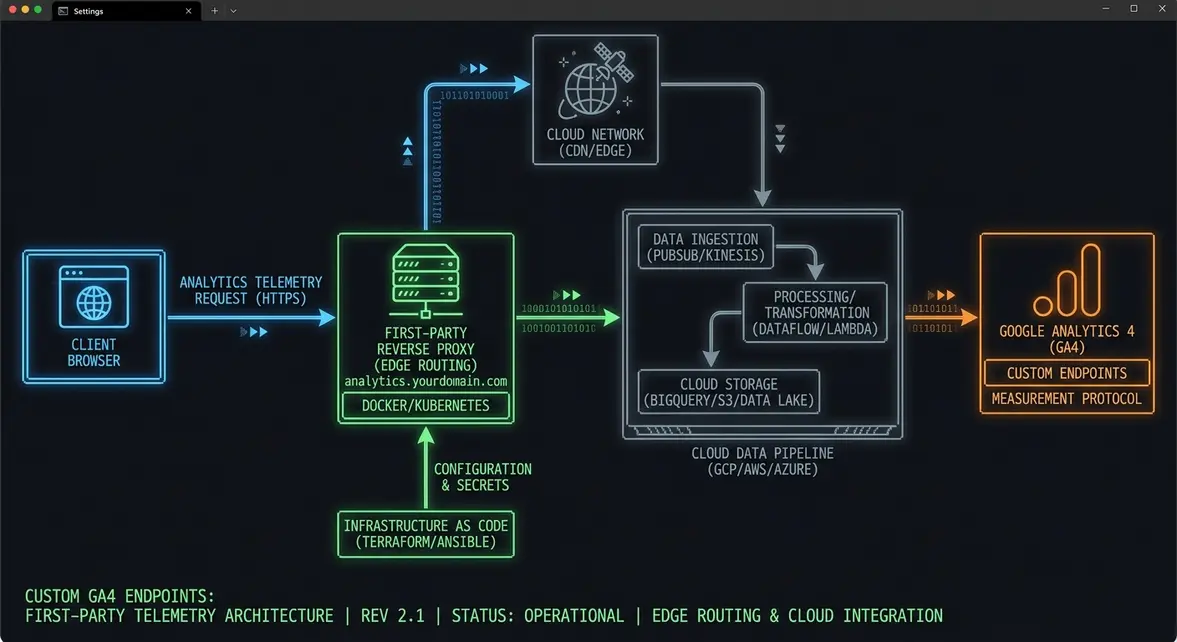
Bypassing Third-Party Transport Vulnerabilities via Custom GA4 Endpoints
Traditional client-side analytics rely entirely on browser-initiated network requests routed directly to vendor endpoints such as https://www.google-analytics.com. While functional in legacy tracking paradigms, this operational pattern introduces systemic data degradation in modern tracking environments. Client-side ad-blockers, privacy-focused browsers (such as Brave), and DNS-level network filters (like Pi-hole) routinely block or abort requests directed toward recognized tracking domains. For technical acquisition teams, this causes substantial gaps in attribution models, frequently omitting 15% to 30% of baseline event volume.
By overriding the transport destination inside your tag configuration, telemetry requests are routed through a first-party reverse proxy or custom ingress layer. Rather than sending hits directly to public analytics infrastructure, the client runtime transmits serialized protocol buffers or HTTP POST payloads to a designated sub-path on your apex domain (e.g., metrics.domain.com/collect or /api/telemetry). This architectural decoupling transforms a fragile third-party network interaction into a resilient first-party data stream, ensuring client integrity while preserving raw telemetry.
Edge Routing Architecture and Technical SEO Performance Gains
From an infrastructural and technical SEO standpoint, routing analytics hits through a custom first-party reverse proxy mitigates browser-level network penalties. When a browser initiates cross-origin requests to third-party endpoints, it incurs mandatory transport latency: additional DNS resolutions, TLS handshakes, and TCP connection setups. In resource-constrained mobile environments, this overhead competes directly with critical visual elements, negatively impacting Core Web Vitals metrics such as Largest Contentful Paint (LCP) and Cumulative Layout Shift (CLS).
Consolidating your measurement pipeline under your apex domain establishes HTTP/2 or HTTP/3 connection multiplexing. The client reuses the existing socket connection already established with your origin, removing the network waterfall penalties typically associated with external monitoring tools. Furthermore, this topology insulates telemetry from WebKit Intelligent Tracking Prevention (ITP) constraints, which aggressively throttle the lifespan of client-set document.cookie values to between 24 hours and 7 days. Setting the analytics client ID via an HTTP-only, secure first-party Set-Cookie header on your proxy response preserves attribution persistence across 30-, 60-, and 90-day B2B sales cycles without violating data boundary requirements.
- Connection Multiplexing: Eliminates distinct DNS resolutions and SSL negotiations for third-party trackers, reducing overall main-thread contention and keeping LCP consistently below 2.0 seconds.
- ITP Mitigation: Server-issued
HttpOnlycookies bypass client-side storage truncation, preventing enterprise buyer attribution degradation. - Edge Schema Validation: Proxies validate event schemas and strip accidental Personally Identifiable Information (PII) before hitting destination data warehouses or Google BigQuery.
Step-by-Step Implementation: Overriding Client Transport and Edge Ingestion
Deploying a custom endpoint requires reconfiguring the client-side tag runtime while provisioning an edge proxy to forward validated payloads to Google Analytics servers or your private data warehouse. Within Google Tag Manager or hardcoded Global Site Tags (gtag.js), override the internal transport_url parameter to target your reverse proxy domain.
The following client-side configuration intercepts outbound events and directs them toward a dedicated first-party edge router:
// Configure GA4 to route telemetry through a first-party endpoint
gtag('config', 'G-XXXXXXXXXX', {
  transport_url: 'https://metrics.yourdomain.com',
  first_party_collection: true,
  send_page_view: true
});
At the edge layer, deploy an ingestion worker (e.g., using Cloudflare Workers or an AWS API Gateway integration) that receives the HTTP POST or GET request, extracts the measurement payload, and routes it downstream via the GA4 Measurement Protocol or an internal Apache Kafka / Google Cloud PubSub ingestion queue:
export default {
  async fetch(request: Request, env: Env): Promise<Response> {
    const url = new URL(request.url);

    // Validate first-party telemetry path
    if (url.pathname.startsWith('/g/collect')) {
      const forwardUrl = new URL(request.url);
      forwardUrl.hostname = 'www.google-analytics.com';

      const modifiedHeaders = new Headers(request.headers);
      modifiedHeaders.set('X-Forwarded-For', request.headers.get('cf-connecting-ip') || '');
      modifiedHeaders.set('X-Custom-Auth-Token', env.INGESTION_SECRET);

      // Dispatch hit to upstream Google Analytics ingress
      const upstreamResponse = await fetch(forwardUrl.toString(), {
        method: request.method,
        headers: modifiedHeaders,
        body: request.body
      });

      return new Response(upstreamResponse.body, {
        status: upstreamResponse.status,
        headers: upstreamResponse.headers
      });
    }

    return new Response('Endpoint Not Found', { status: 404 });
  }
};
When implementing inside GTM web containers, ensure custom parameters like {'{{Custom Endpoint URL}}'} match your provisioned edge environment variables to prevent payload dropping in staging and production branches.
B2B Growth Engineering: Pipeline Attribution and CAC Optimization
For B2B organizations marketing to enterprise prospects, tracking data loss directly inflates Customer Acquisition Cost (CAC). Technical enterprise buyers—particularly developers, DevOps engineers, and security executives—disproportionately utilize tracking prevention and ad-blocking extensions. When high-intent decision-makers research your product, standard client-side analytics fail to record the touchpoints, misclassifying multi-touch attribution conversions as "Direct" or untracked conversions rather than properly crediting targeted LinkedIn or programmatic search campaigns.
Implementing custom endpoint proxying guarantees pipeline visibility across these high-value cohorts. By recapturing an estimated 18% to 24% of previously unobserved telemetry, growth teams eliminate attribution blind spots in their BigQuery data modeling. When paid acquisition algorithms receive fully reconciled offline conversion signals through reverse-proxied measurement, ad platform bid optimization stabilizes. The result is more aggressive and accurate programmatic bidding on high-performing intent keywords, cutting blended customer acquisition costs by up to 15% and establishing an uncorrupted data layer for cohort-based lifetime value (LTV) calculations.
System Telemetry Source: Original Engineering Report
Related Growth Blueprints
All Blueprints →Need this architecture deployed in your pipeline?
Skip the synchronous sales cycle and endless discovery calls. Submit your core acquisition or conversion bottleneck for a deep-dive asynchronous growth diagnostic.