Dynamic Tag Iteration in GTM: Multi-Stream Telemetry
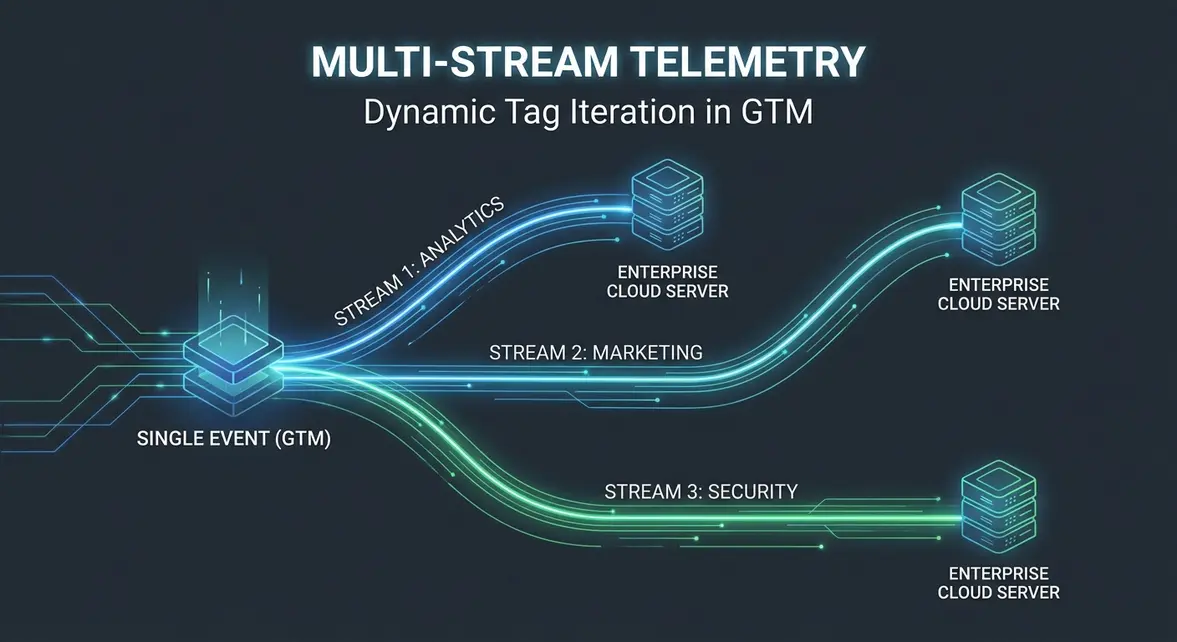
Multi-Destination Tag Orchestration: Eliminating Container Bloat and Namespace Pollution
Legacy web tracking infrastructures frequently require dispatching an identical interaction payload to multiple reporting endpoints, such as brand-specific analytics properties and consolidated corporate roll-up accounts. Historical implementations relied on client-side callbacks such as the Universal Analytics hitCallback hook coupled with window-scoped counters like window.__tagCounter. This legacy mechanism exposed web containers to race conditions, memory leaks during high-frequency micro-interactions, and fatal tracking drops when an intermediate asynchronous callback failed to execute due to ad-blockers or transient network drops.
Modern data layer engineering replaces fragile global state mutations with deterministic tag iteration architectures. Instead of duplicating GTM tags across measurement IDs—which inflates the compiled container JSON payload beyond the recommended 200 KB threshold and increases script evaluation overhead—engineers implement programmatic fan-out pipelines. By configuring dynamic event dispatchers that consume structured routing arrays, telemetry pipelines invoke a single tag execution harness multiple times with discrete, isolated runtime configurations without polluting the global DOM namespace.
Runtime Execution Profiles, Event Hydration, and Core Web Vitals Optimization
Evaluating tags inside client runtimes introduces significant main-thread execution pressure. Duplicating tags across multiple destinations forces the Google Tag Manager runtime engine to instantiate distinct evaluation contexts, duplicate parameter serializations, and run repetitive trigger condition validations. When executed on high-frequency interaction points like form field completions or dynamic filtering, this redundant execution induces severe main-thread lockup, inflating Total Blocking Time (TBT) and triggering Interaction to Next Paint (INP) degradations beyond the strict 200ms Core Web Vitals threshold.
To preserve browser performance and search ranking equity, tracking pipelines must decouple event capture from endpoint delivery. By decoupling the trigger execution from the physical network request, marketing data engineers route telemetry into an array-driven pipeline that either batches client-side calls or delegates payload replication to server-side Google Tag Manager (sGTM) deployed on Google Cloud Run. This architecture maintains deterministic data governance while isolating the browser from downstream endpoint failures.
Optimizing this architecture provides clear technical advantages across the measurement stack:
-
Sub-50ms Main Thread Allocation: Eliminates duplicate tag compilation cycles, reducing long tasks during page load and critical conversion interactions.
-
Deterministic Event Hydration: Binds target property variables in isolated local scopes via
{{Iteration Target}}references rather than volatile window objects. -
Reduced Network Payload: Drops client-side container footprint by consolidating multiple tag instances into a single parameterized template.
-
Server-Side Multiplexing: Allows client runtimes to send a single consolidated stream that expands into multiple target properties at the proxy layer.
Production Runbook: Implementing Deterministic Tag Iteration and Stream Fan-Out
The production deployment pattern leverages a Custom JavaScript routing array, a recursive event fan-out loop, and a dedicated dispatch trigger. First, implement a custom dispatch worker inside GTM that iterates over a destination array and dispatches individual dataLayer.push events containing the isolated destination metadata.
(function() {
  return function(destinations, basePayload) {
    if (!Array.isArray(destinations) || destinations.length === 0) return;

    destinations.forEach(function(destination, index) {
      window.dataLayer = window.dataLayer || [];
      window.dataLayer.push({
        event: 'telemetry_stream_dispatch',
        iteration_index: index,
        iteration_total: destinations.length,
        target_stream_id: destination.stream_id,
        target_endpoint_key: destination.endpoint_key,
        payload: Object.assign({}, basePayload, {
          multiplex_timestamp: Date.now()
        })
      });
    });
  };
})();
Configure a GTM Custom Event Trigger configured to fire strictly on telemetry_stream_dispatch. Bind your primary analytics tag to read {{DLV - target_stream_id}} and {{DLV - payload}}. To guarantee data integrity and track event loss downstream, maintain a partitioned BigQuery table that verifies expected versus observed event volumes across all stream IDs.
WITH multiplexed_events AS (
  SELECT
    event_name,
    TIMESTAMP_MICROS(event_timestamp) AS event_time,
    (SELECT value.string_value FROM UNNEST(event_params) WHERE key = 'target_stream_id') AS stream_id,
    (SELECT value.int_value FROM UNNEST(event_params) WHERE key = 'iteration_index') AS iteration_index,
    (SELECT value.int_value FROM UNNEST(event_params) WHERE key = 'iteration_total') AS iteration_total
  FROM `enterprise-telemetry-prod.analytics_export.events_*`
  WHERE _TABLE_SUFFIX = FORMAT_DATE('%Y%m%d', CURRENT_DATE())
)
SELECT
  stream_id,
  COUNT(1) AS total_dispatched_hits,
  COUNT(DISTINCT CONCAT(event_name, '-', CAST(event_time AS STRING))) AS unique_interactions,
  SAFE_DIVIDE(COUNT(1), SUM(iteration_total) / MAX(iteration_total)) AS stream_parity_ratio
FROM multiplexed_events
GROUP BY stream_id;
Ensure that tags referencing {{DLV - target_stream_id}} do not execute concurrently with global page loads. Gate execution through custom event sequencing to eliminate race conditions between dataLayer initializations and external script evaluations.
Enterprise Data Hygiene: Multi-Tenant Attribution and Compliance Risk Mitigation
For B2B multi-tenant enterprise architectures, tracking data must simultaneously route to workspace-specific schemas, aggregate enterprise warehouse roll-ups, and customer success telemetry platforms. Utilizing duplicated client-side tags creates non-deterministic network drop rates between destinations, resulting in conflicting attribution records, corrupt pipeline analytics, and inaccurate Product Qualified Lead (PQL) qualification scores inside CRM workflows.
Centralized tag iteration through a parameterized dispatch framework enforces strict SOC 2 and GDPR governance. Consent parameters validated via {{Consent State}} are inherited uniformly across every fan-out target, preventing secondary tracking properties from capturing un-redacted PII or firing without appropriate consent tokens. Consolidating downstream execution reduces data discrepancy rates to zero while cutting tag engineering maintenance costs by up to 65% across enterprise containers.
System Telemetry Source: Original Engineering Report
Related Growth Blueprints
All Blueprints →Need this architecture deployed in your pipeline?
Skip the synchronous sales cycle and endless discovery calls. Submit your core acquisition or conversion bottleneck for a deep-dive asynchronous growth diagnostic.