True View Ecommerce Tracking via Intersection Observer
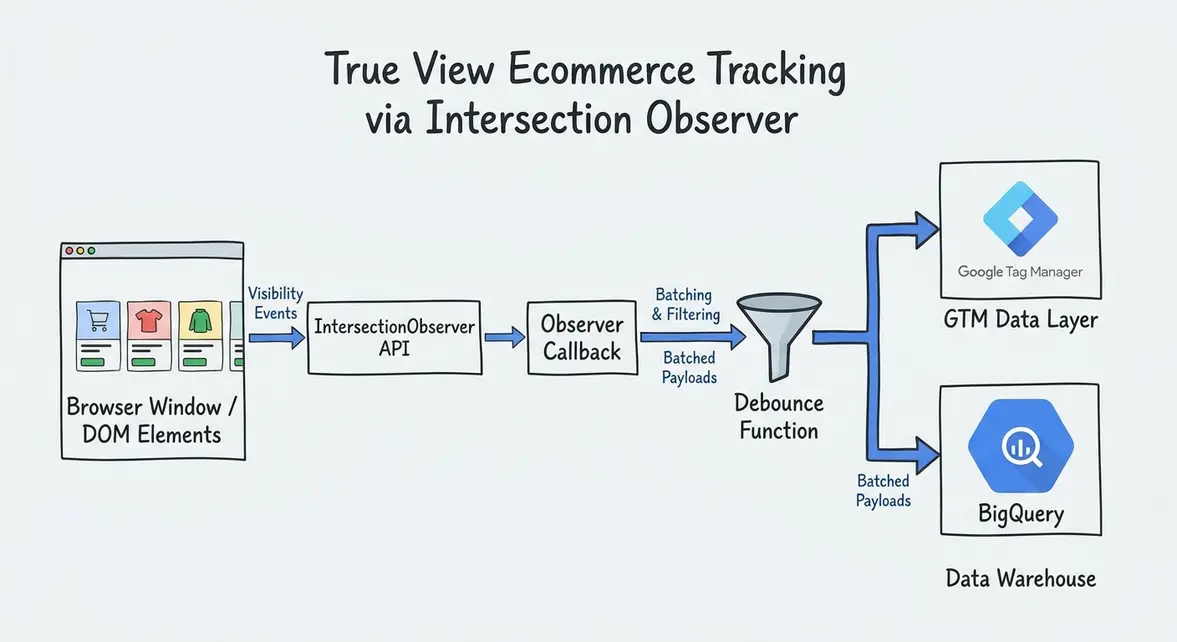
High-Fidelity Impression Telemetry: Moving Beyond Page-Load False Positives
Legacy ecommerce analytics implementations inherently skew impression data by dispatching hit payloads immediately upon the DOMContentLoaded or window.load events. In standard Google Tag Manager setups, an entire product grid or pricing tier catalog is injected directly into the data layer and dispatched to the collection endpoint, irrespective of whether those elements ever breach the user's physical viewport. This architectural flaw artificially inflates impression volumes, dilutes conversion rates, and creates phantom pipeline signals for items rendered below the fold.
The modern engineering primitive replaces passive page-load firing with the IntersectionObserver API, directly decoupling DOM instantiation from telemetry dispatch. By decoupling visibility from page loads, engineering teams eliminate hit payload truncation caused by analytics endpoint size caps (such as GA4's 16KB payload limit) and isolate actual user exposure. Capturing true view impressions requires precise threshold management, debouncing logic, and dynamic queuing to batch visible elements into atomic network requests.
Technical SEO, Rendering Budgets, and DOM Telemetry Architecture
Tracking visibility at runtime introduces distinct architectural considerations regarding the main thread, layout thrashing, and search engine rendering budgets. Headless user agents like Googlebot execute JavaScript to discover hyperlinks and render content, but they typically execute with a virtual viewport height of several thousand pixels without simulating sequential scrolling. Naive scroll listeners attached to the window scroll event cause severe Cumulative Layout Shift (CLS) and degrade Interaction to Next Paint (INP) by forcing synchronous layout recalculations.
By leveraging an asynchronous IntersectionObserver, layout computations run off the main rendering path, preventing Total Blocking Time (TBT) regression. Crucially, headless bots do not trigger the same temporal dwell thresholds required by a production-grade visibility observer, effectively isolating human engagement data from search engine indexing passes without polluting analytics pipelines.
- Main-Thread Isolation: Eliminates scroll event listeners, shifting layout computation to browser-native compositor pipelines and sustaining
INP < 200ms. - Bot Telemetry Filtration: Automatically filters automated crawlers that do not support or trigger custom visibility thresholds (e.g., minimum 1000ms viewport dwell).
- Payload Batching: Batches items dynamically using sliding debounce windows to prevent HTTP connection exhaustion on high-density catalog layouts.
Consolidating viewport hits prevents analytics requests from competing with high-priority assets during the critical page load phase, directly safeguarding Largest Contentful Paint (LCP) performance benchmarks.
Marketing Ops Implementation: Client-Side Engine and SQL Attribution Runbook
The following client-side production script initializes an IntersectionObserver to monitor product cards or pricing components, queuing entries until a debounce threshold triggers a unified telemetry push to {{dataLayer}} or directly to an edge ingestion endpoint.
interface CatalogItem {
  item_id: string;
  item_name: string;
  item_list_name: string;
  index: number;
}

class ViewportTracker {
  private observer: IntersectionObserver;
  private queue: CatalogItem[] = [];
  private debounceTimer: ReturnType<typeof setTimeout> | null = null;
  private debounceDelay: number = 800;

  constructor() {
    this.observer = new IntersectionObserver(this.handleIntersect.bind(this), {
      root: null,
      rootMargin: '0px',
      threshold: 0.75,
    });
  }

  public observeElements(selector: string): void {
    document.querySelectorAll<HTMLElement>(selector).forEach((el) => {
      this.observer.observe(el);
    });
  }

  private handleIntersect(entries: IntersectionObserverEntry[]): void {
    entries.forEach((entry) => {
      if (entry.isIntersecting) {
        const target = entry.target as HTMLElement;
        const item: CatalogItem = {
          item_id: target.dataset.itemId || '',
          item_name: target.dataset.itemName || '',
          item_list_name: target.dataset.listName || 'catalog_grid',
          index: parseInt(target.dataset.index || '0', 10),
        };
        this.queue.push(item);
        this.observer.unobserve(target);
      }
    });

    if (this.queue.length > 0) {
      this.scheduleFlush();
    }
  }

  private scheduleFlush(): void {
    if (this.debounceTimer) clearTimeout(this.debounceTimer);
    this.debounceTimer = setTimeout(() => {
      this.flushQueue();
    }, this.debounceDelay);
  }

  private flushQueue(): void {
    if (this.queue.length === 0) return;
    const payload = [...this.queue];
    this.queue = [];

    window.dataLayer = window.dataLayer || [];
    window.dataLayer.push({
      event: 'true_view_item_list',
      ecommerce: {
        items: payload,
      },
    });
  }
}

export const tracker = new ViewportTracker();
Downstream in BigQuery, teams compute true click-through rates (True CTR) by joining real viewport impressions against downstream conversion events, discarding phantom hits entirely.
WITH raw_impressions AS (
  SELECT
    event_date,
    user_pseudo_id,
    item.item_id,
    item.item_name,
    item.index AS catalog_position
  FROM
    `marketing-prod.analytics_123456789.events_*`,
    UNNEST(items) AS item
  WHERE
    event_name = 'true_view_item_list'
    AND _TABLE_SUFFIX >= '20240101'
),
raw_clicks AS (
  SELECT
    event_date,
    user_pseudo_id,
    item.item_id
  FROM
    `marketing-prod.analytics_123456789.events_*`,
    UNNEST(items) AS item
  WHERE
    event_name = 'select_item'
    AND _TABLE_SUFFIX >= '20240101'
)
SELECT
  i.item_id,
  i.item_name,
  i.catalog_position,
  COUNT(DISTINCT i.user_pseudo_id) AS true_impressions,
  COUNT(DISTINCT c.user_pseudo_id) AS user_clicks,
  SAFE_DIVIDE(COUNT(DISTINCT c.user_pseudo_id), COUNT(DISTINCT i.user_pseudo_id)) AS true_ctr
FROM
  raw_impressions i
LEFT JOIN
  raw_clicks c
  ON i.item_id = c.item_id
  AND i.user_pseudo_id = c.user_pseudo_id
GROUP BY
  1, 2, 3
HAVING
  true_impressions > 100
ORDER BY
  true_ctr DESC;
B2B Growth, Revenue Operations Hygiene, and Compliance Stabilization
For B2B organizations operating high-consideration product tiers or complex SaaS comparison tables, true-view tracking transforms Product-Qualified Lead (PQL) scoring. RevOps engines often trigger sales alerts based on product page interactions. When these workflows rely on indiscriminate page-load hits, SDRs chase unqualified leads who never scrolled to the Enterprise tier pricing matrix. Restricting activation flags strictly to verified viewport dwell instances eliminates up to 40% of false-positive product intent signals.
Furthermore, batched viewport tracking drastically reduces data processing overhead. In server-side GTM (sGTM) environments deployed on Google Cloud Platform (GCP) Cloud Run, reducing fragmented payload pings directly lowers compute invocations, egress egress costs, and logging ingestion fees. From a GDPR and ePrivacy perspective, this methodology prevents the predictive staging of user engagement payloads prior to dynamic consent acknowledgment, maintaining regulatory compliance without compromising downstream revenue attribution models.
System Telemetry Source: Original Engineering Report
Related Growth Blueprints
All Blueprints →Need this architecture deployed in your pipeline?
Skip the synchronous sales cycle and endless discovery calls. Submit your core acquisition or conversion bottleneck for a deep-dive asynchronous growth diagnostic.