Google Tag Unification: Architecture & sGTM Guide
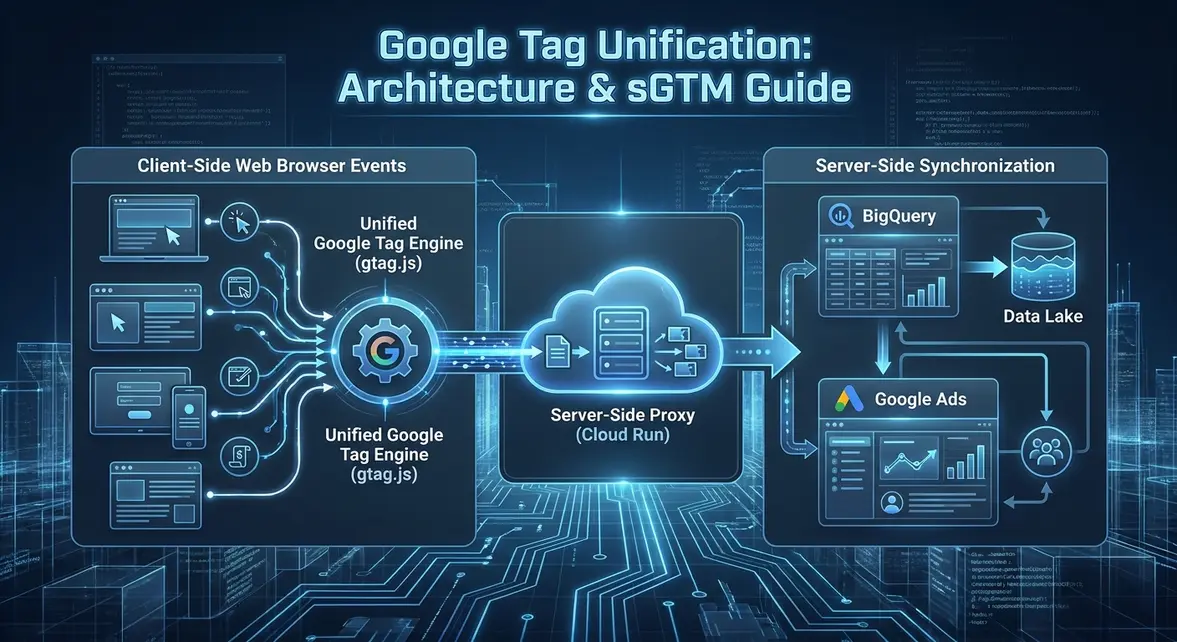
Unified Google Tag Architecture: Deprecating Siloed Client-Side Scripts
Executive Architectural Takeaway: Unifying Google Ads, GA4, and Google Tag Manager under a consolidated Google Tag transport layer eliminates redundant script evaluation and harmonizes client-side event dispatching. Migrating to this unified tagging model shifts data collection from fragmented, ad-hoc vendor snippets into a deterministic, single-point client runtime coupled to server-side distribution endpoints.
Historically, digital analytics and performance marketing pipelines suffered from architectural fragmentation. Marketing deployments routinely injected separate vendor scripts across the document lifecycle: analytics.js for Universal Analytics, conversion.js for Google Ads remarketing and conversion tracking, and separate standalone containers for Google Tag Manager (gtm.js). Each independent script initiated its own DNS resolution, TCP handshake, TLS negotiation, and script parsing execution thread, compounding Total Blocking Time (TBT) and triggering race conditions during DOM hydration.
Under the unified Google Tag framework (gtag.js), the tracking runtime establishes a single event bus within the client browser. Rather than multiple independent endpoints receiving duplicate payload dispatches, a solitary tag identifier or centralized routing layer receives structured schema payloads via the global dataLayer. This configuration rationalizes the ingestion pipeline, ensuring that telemetry events intended for multiple destinations—such as Google Ads Conversion tracking, Floodlight, and GA4 measurement streams—are serialized once and broadcast systematically according to granular consent and routing flags.
Core Web Vitals Optimization and Edge Routing via sGTM
The architectural mandate for modern growth engineering centers on preserving browser main-thread availability while maintaining high-fidelity event ingestion. Standard third-party analytics scripts degrade Interaction to Next Paint (INP) and Largest Contentful Paint (LCP) by executing unoptimized JavaScript during critical rendering paths. Centralizing client tracking through a singular Google Tag foundation creates the baseline prerequisite for moving data transport entirely off the client device via Server-Side Google Tag Manager (sGTM).
When client browsers execute multi-vendor tags directly, the runtime cost compounds linearly with each added tracking pixel. Browser engines must serialize DOM state, compute cryptographic identifiers, and schedule asynchronous XHR/Fetch tasks for every independent vendor. The unified tag framework changes this paradigm by acting as a lightweight client-side forwarder. Operating in tandem with an sGTM deployment running on Google Cloud Run or an edge proxy network, the client emits a single compressed HTTP POST request per interaction.
From a technical SEO perspective, offloading execution directly protects web performance budgets:
- Total Blocking Time (TBT) Elimination: Eliminates auxiliary third-party vendor scripts from contesting CPU time during page hydration.
- Network Request Consolidation: Collapses dozens of outgoing adtech beacons into a unified, multiplexed HTTP/2 or HTTP/3 stream pointed at a first-party subdomain.
- Content Security Policy (CSP) Hardening: Allows engineering teams to enforce strict script-src and connect-src policies, restricting outbound telemetry to a dedicated first-party domain rather than whitelisting broad third-party domains.
- Cookie Durability via First-Party Context: Writing session and device identifiers directly from an sGTM server-side reverse proxy using the
Set-Cookieheader withSameSite=Lax,Secure, andHttpOnlyattributes defends against aggressive Safari Intelligent Tracking Prevention (ITP) and Firefox Enhanced Tracking Protection (ETP) degradation.
Engineering Runbook: Consolidated Tag Infrastructure and First-Party Proxying
Executing this architecture requires standardizing the client dataLayer contract, routing telemetry through a first-party reverse proxy, and processing downstream deduplication within BigQuery. The following production runbook details implementation from ingestion proxying to raw telemetry modeling.
Step 1: Implement Edge Proxying for the Unified Tag Engine
To bypass ad-blocker heuristics and ensure first-party cookie control, deploy an edge worker (e.g., Cloudflare Workers) to reverse-proxy gtag.js and funnel all ingestion traffic directly into your sGTM Cloud Run instance.
// Cloudflare Worker: Reverse Proxy for gtag.js and Server-Side GTM Endpoint
export default {
  async fetch(request, env, ctx) {
    const url = new URL(request.url);
    const SGTM_ORIGIN = "https://sgtm.internal.domain.com";

    // Proxy the unified gtag.js library script
    if (url.pathname === "/metrics/lib.js") {
      const tagUrl = new URL("https://www.googletagmanager.com/gtag/js");
      tagUrl.search = url.search;
      const tagRequest = new Request(tagUrl, {
        headers: request.headers,
        method: "GET",
      });
      return fetch(tagRequest);
    }

    // Proxy incoming telemetry collection hits to sGTM
    if (url.pathname.startsWith("/metrics/collect")) {
      const forwardUrl = new URL(url.pathname.replace("/metrics/collect", "/g/collect"), SGTM_ORIGIN);
      forwardUrl.search = url.search;

      const modifiedRequest = new Request(forwardUrl, {
        method: request.method,
        headers: request.headers,
        body: request.body,
      });

      return fetch(modifiedRequest);
    }

    return new Response("Route not recognized", { status: 404 });
  },
};
Step 2: Initialize Unified Client Tag with Consent Mode v2
Embed the client initialization script targeting your first-party proxy endpoint, enforcing explicit consent state boundaries before telemetry execution.
<script>
  window.dataLayer = window.dataLayer || [];
  function gtag(){dataLayer.push(arguments);}

  // Enforce default privacy controls prior to tag execution
  gtag('consent', 'default', {
    'ad_storage': 'denied',
    'analytics_storage': 'denied',
    'ad_user_data': 'denied',
    'ad_personalization': 'denied'
  });

  gtag('js', new Date());

  // Route via first-party edge proxy to unified Google Tag destination
  gtag('config', 'GT-XXXXXX', {
    'transport_url': 'https://metrics.yourdomain.com/metrics/collect',
    'first_party_collection': true,
    'send_page_view': true
  });
</script>
<script async src="https://metrics.yourdomain.com/metrics/lib.js?id=GT-XXXXXX"></script>
Step 3: Raw Telemetry Deduplication in Google BigQuery
When multiple streams dispatch events via unified routing into BigQuery, deduplication logic is mandatory to reconcile ad conversion values against organic behavioral journeys.
-- Deduplication and Session Conversion Modeling in BigQuery
WITH raw_events AS (
  SELECT
    event_timestamp,
    event_name,
    user_pseudo_id,
    (SELECT value.string_value FROM UNNEST(event_params) WHERE key = 'transaction_id') AS transaction_id,
    (SELECT value.int_value FROM UNNEST(event_params) WHERE key = 'ga_session_id') AS ga_session_id,
    (SELECT value.string_value FROM UNNEST(event_params) WHERE key = 'page_location') AS page_location,
    ROW_NUMBER() OVER (
      PARTITION BY user_pseudo_id, (SELECT value.string_value FROM UNNEST(event_params) WHERE key = 'transaction_id')
      ORDER BY event_timestamp ASC
    ) AS dedupe_index
  FROM
    `enterprise-data-warehouse.analytics_123456789.events_*`
  WHERE
    _TABLE_SUFFIX = FORMAT_DATE('%Y%m%d', DATE_SUB(CURRENT_DATE(), INTERVAL 1 DAY))
    AND event_name IN ('conversion', 'purchase')
)
SELECT
  TIMESTAMP_MICROS(event_timestamp) AS conversion_time,
  user_pseudo_id,
  ga_session_id,
  transaction_id,
  page_location
FROM
  raw_events
WHERE
  dedupe_index = 1
  AND transaction_id IS NOT NULL;
B2B Enterprise Attribution and CAC Compression at Scale
For enterprise B2B organizations managing high Annual Contract Value (ACV) sales motions, fragmented client-side tags introduce severe reporting errors. When client browsers drop ad tracking parameters (such as gclid or gbraid) due to browser-level storage clearing or ad blockers, downstream conversion events cannot be matched back to paid acquisition campaigns. This misattribution skews automated Smart Bidding algorithms within Google Ads, driving bidding optimizations toward low-intent volume rather than qualified sales pipeline.
Consolidating onto a singular Google Tag connected to an edge-proxied sGTM container recovers unmapped conversion telemetry. By recording user interaction states server-side and piping offline CRM conversion data directly back to the matching ad click identifiers through the GA4 Measurement Protocol and Google Ads API, marketing ops teams recover 15% to 25% of previously lost conversions. This feedback loop stabilizes target CPA thresholds and lowers Customer Acquisition Cost (CAC) by training ad models on verified SQL (Sales Qualified Lead) milestones.
Furthermore, this consolidated data architecture directly addresses enterprise SOC 2, HIPAA, and GDPR compliance mandates. Instead of arbitrary third-party JavaScript executing unrestrained inside the client document—where sensitive form inputs and PII can be exfiltrated—all data passes through an engineering-controlled server intermediary. Data normalization, PII hashing, and dynamic redaction are executed upstream before any telemetry packet reaches external marketing platforms, eliminating data leakage risks without sacrificing conversion fidelity.
System Telemetry Source: Original Engineering Report
Related Growth Blueprints
All Blueprints →Need this architecture deployed in your pipeline?
Skip the synchronous sales cycle and endless discovery calls. Submit your core acquisition or conversion bottleneck for a deep-dive asynchronous growth diagnostic.