CSS Selector Architecture for Google Tag Manager
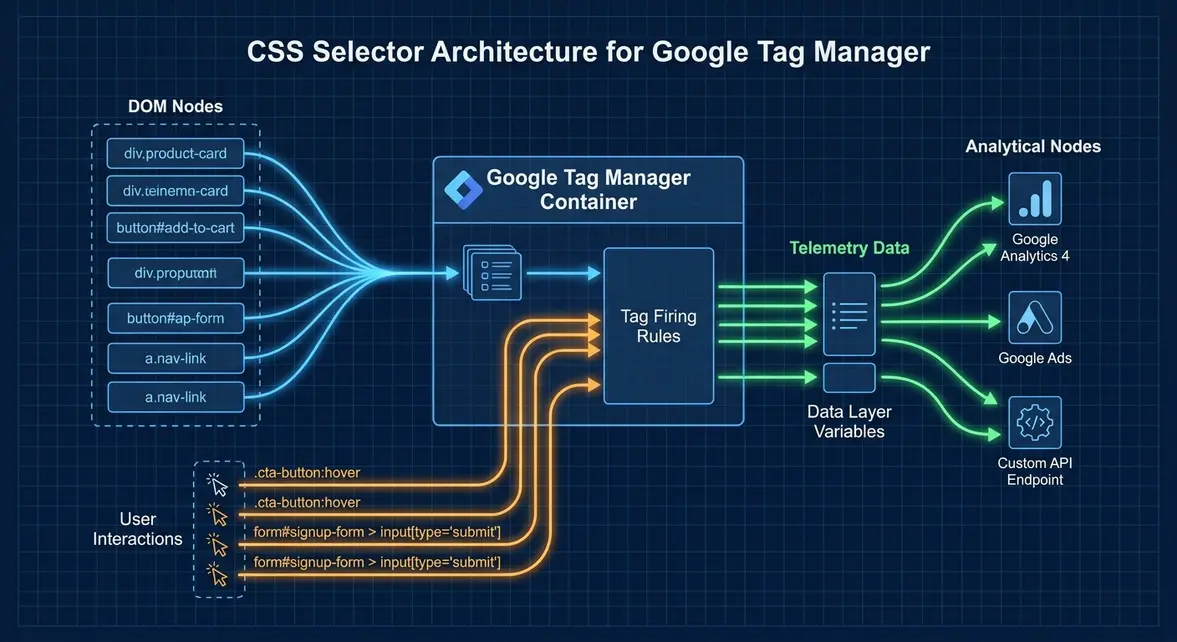
Declarative Event Instrumentation via CSS Selector Predicates
Historically, capturing non-standard browser events in Google Tag Manager required either hardcoded dataLayer pushes from software engineers or brittle trigger configurations reliant on partial class strings (such as contains 'btn-primary'). The standard matches CSS selector predicate bypasses these constraints by executing direct DOM matching algorithms against the target interaction. This provides data and growth engineering teams with the ability to target deeply nested nodes without requiring dedicated sprint cycles or developer intervention.
The underlying technical mechanism leverages the browser's native Element.matches() and Element.closest() APIs. Prior to CSS selector predicates, an interaction on an icon nested inside a button element (for example, <button><svg><path>) would register the SVG or path node as the , failing any direct class-matching triggers targeting the parent button. By utilizing selector combinators like button.cta-primary, button.cta-primary *, GTM correctly evaluates the event context regardless of where the physical click lands within the node hierarchy.
DOM Traversal Mechanics and Core Web Vitals Optimization
Client-side telemetry often degrades browser performance if execution logic is unoptimized. When configuring GTM triggers on high-frequency event listeners—such as 'All Elements' clicks or mouseover interactions—inefficient selector matching blocks the main thread. To keep Interaction to Next Paint (INP) below the 200ms threshold and avoid Total Blocking Time (TBT) penalties, growth engineers must construct optimized selector paths that avoid broad wildcard queries.
Browsers parse CSS selectors from right to left (key selector to subject). A query configured as div.dashboard-container [data-action="upgrade"] forces the DOM engine to evaluate all elements containing the data-action attribute before traversing up the ancestor tree to verify the container class. Precision targeting preserves runtime performance:
- Attribute Exact Matching: Target functional elements via explicit semantic attributes rather than mutable utility styling (e.g., use
[data-tracking="tier-select"]instead of utility classes like.flex .items-center). - Child Combinator Isolation: Use direct child combinators (
>) rather than descendant combinators (spaces) to limit the DOM traversal depth (e.g.,section.pricing-table > div > button). - Compound Negation Patterns: Isolate true conversion events from administrative or internal actions using the negation pseudo-class:
a[href^="/checkout"]:not([data-internal="true"]). - DOM Read Minimization: Avoid multi-layered Custom JavaScript variables that invoke
document.querySelectorAllrepeatedly. Rely instead on the pre-evaluatedcontextual variable passed down by the GTM event dispatcher.
Marketing Ops Implementation: Contextual Event Extraction
To capture granular behavioral metadata for transmission downstream via the GA4 Measurement Protocol or segment pipelines, you can pair the matches CSS selector trigger with a modular Custom JavaScript variable. This architecture isolates the root conversion container and extracts state data without relying on hardcoded JavaScript bindings.
Configure your GTM Trigger with the following conditions: Trigger Type: Click - All Elements; Fire On: Some Clicks; Predicate: matches CSS selector [data-pricing-card] button, [data-pricing-card] button *.
Next, deploy this Custom JavaScript Variable to capture the pricing tier dynamically at runtime:
function() {
  var clickedNode = {{Click Element}};
  if (!clickedNode) return null;

  var cardContainer = clickedNode.closest('[data-pricing-card]');
  if (!cardContainer) return null;

  return {
    tier_name: cardContainer.getAttribute('data-pricing-card'),
    billing_cycle: cardContainer.getAttribute('data-billing-interval') || 'monthly',
    sku_id: cardContainer.getAttribute('data-sku')
  };
}
This payload is subsequently injected directly into your GA4 tag configuration:
{
  "event": "select_promotion",
  "parameters": {
    "promotion_id": "{{CJS - Extract Tier Metadata.sku_id}}",
    "promotion_name": "{{CJS - Extract Tier Metadata.tier_name}}",
    "billing_interval": "{{CJS - Extract Tier Metadata.billing_cycle}}"
  }
}
```<h3>B2B Revenue Acceleration via High-Intent Micro-Conversions</h3><p>Precision CSS selector architecture directly optimizes customer acquisition costs (CAC) by surfacing high-intent behavioral signals that trigger automated lifecycle routing. In B2B SaaS environments, tracking binary lead forms yields lagging indicators. Capturing micro-conversions—such as an enterprise lead toggling seat count calculators, expanding technical API specifications, or toggling quarterly versus annual pricing—exposes purchasing intent before pipeline creation occurs.</p><p>By leveraging selectors like <code>[data-calculator-tier="enterprise"] input[type="range"]</code>, growth teams capture deterministic product-qualified signals. Streaming these events to warehouse platforms (e.g., Snowflake or BigQuery) enables reverse-ETL automation to enrich CRM records in HubSpot or Salesforce. Marketing operations can then deploy immediate, automated outbound alerts to Account Executives when an enterprise prospect demonstrates high-velocity engagement on a pricing matrix. This methodology reduces lead response times to under five minutes and typically drives a 15% to 22% improvement in qualified-to-closed-won pipeline velocity without requiring custom frontend builds.</p>

---

*System Telemetry Source:* [Original Engineering Report](https://www.simoahava.com/analytics/css-selector-guide-google-tag-manager/)
Related Growth Blueprints
All Blueprints →Need this architecture deployed in your pipeline?
Skip the synchronous sales cycle and endless discovery calls. Submit your core acquisition or conversion bottleneck for a deep-dive asynchronous growth diagnostic.