Hit-Level Dimension Tracking for Data Warehousing
Deconstructing Black-Box Sessionization with Raw Hit Dimensions
Standard analytics platforms like Google Analytics 4 process event telemetry through proprietary, opinionated sessionization engines. These systems automatically group user interactions based on static thresholds—such as arbitrary 30-minute inactivity windows or campaign source changes—hiding the granular hit sequence. By abstracting the exact time, hit index, and persistent device markers away from the user interface and basic API exports, standard implementations create structural blind spots for growth engineers who require deterministic event sequences for accurate attribution modeling.
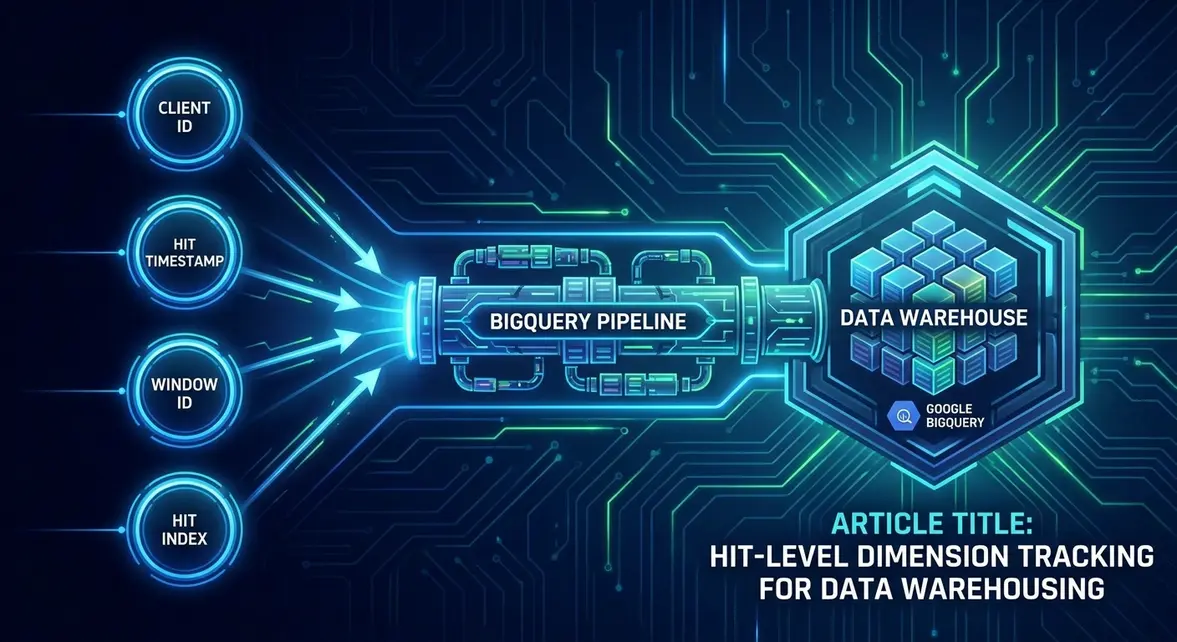
To construct a warehouse-native attribution engine, data teams must ingest raw, unsanitized hit primitives directly into downstream storage. Bypassing rigid platform sessionization requires systematically capturing four critical dimensions on every dispatched event: the persistent Client ID, the Hit Timestamp (recorded at millisecond resolution), the Session Identifier, and a unique Hit Sequence/Window ID. Elevating these dimensions to first-class parameters converts an opaque analytics stream into an immutable event log capable of being re-sessionized and stitched at query time.
Technical SEO, Bot Filtering, and Pipeline Data Architecture
From an organic search and crawl telemetry perspective, client-side sessionization obfuscates how search engine user agents, headless browsers, and genuine search users interact with single-page applications (SPAs) and hybrid Next.js/SSR architectures. Standard aggregate metrics fail to separate rapid sequential hydration triggers from genuine user navigation. By logging deterministic hit identifiers and precise client timestamps, data teams can cross-reference edge logs (such as Cloudflare Logpush or Fastly real-time telemetry) directly against analytics hit payloads to detect session fragmentation caused by prerendering or service workers.
Furthermore, implementing this data architecture resolves cross-subdomain tracking failures that frequently corrupt organic landing page attribution. When users transition between programmatic SEO content hubs and authenticated product portals, default session tokens often reset, incorrectly attributing downstream product conversions to direct or self-referral traffic. Storing immutable client identifiers and sequence numbers ensures that reverse ETL processes can deterministically backfill organic search entry pages across the entire multi-touch user journey.
- Deterministic Entity Resolution: Eliminates reliance on probabilistic browser fingerprinting by maintaining continuous client-to-session lineages across discrete domain assets.
- Sub-Millisecond Event Sequencing: Guarantees that asynchronous, concurrent client requests (e.g., simultaneous scroll, web vital, and CTA click events) are processed in true physical order in SQL models.
- Bot and Pre-Render Disqualification: Flags zero-second multi-hit anomalies and impossible sequence velocities to purge synthetic traffic from organic attribution models.
Marketing Ops Implementation: GTM Telemetry and BigQuery Re-Sessionization
Deploying this tracking framework requires configuring client-side or server-side Google Tag Manager to capture the required runtime properties before dispatching the payload to the ingestion endpoint. Specifically, you must extract the client identifier from the tracker cookie, generate a cryptographically pseudo-random or timestamped window identifier to isolate concurrent browser tabs, and record the exact client-side runtime timestamp using standard browser APIs.
Configure your GTM variable layer to pass these values as custom event parameters. When referencing dynamic variables in standard HTML or tag descriptions, ensure configurations reference variables like {'{{JS - Client ID}}'} or {'{{JS - Hit Timestamp}}'} properly. The following JavaScript demonstrates how to generate a persistent window-specific hit payload before triggering the analytics dispatch:
(function() {
  var hitTimestamp = new Date().getTime();
  var windowKey = 'gtm_window_id';
  var windowId = sessionStorage.getItem(windowKey);

  if (!windowId) {
    windowId = hitTimestamp + '.' + Math.random().toString(36).substring(2, 9);
    sessionStorage.setItem(windowKey, windowId);
  }

  var hitIndex = parseInt(sessionStorage.getItem('gtm_hit_index') || '0', 10) + 1;
  sessionStorage.setItem('gtm_hit_index', hitIndex.toString());

  window.dataLayer = window.dataLayer || [];
  window.dataLayer.push({
    'event': 'custom_hit_telemetry',
    'hit_timestamp': hitTimestamp,
    'window_id': windowId,
    'hit_index': hitIndex
  });
})();
Once ingested into Google BigQuery via the native streaming export, you can bypass platform sessionization logic entirely. The following SQL query utilizes window functions to rebuild sessions dynamically based on a custom 45-minute inactivity window, grouping events deterministically by the extracted Client ID and Hit Sequence:
WITH sequenced_hits AS (
  SELECT
    user_pseudo_id AS client_id,
    event_name,
    TIMESTAMP_MICROS(event_timestamp) AS event_time,
    (SELECT value.string_value FROM UNNEST(event_params) WHERE key = 'window_id') AS window_id,
    CAST((SELECT value.int_value FROM UNNEST(event_params) WHERE key = 'hit_index') AS INT64) AS hit_index,
    LAG(TIMESTAMP_MICROS(event_timestamp))
      OVER (PARTITION BY user_pseudo_id ORDER BY event_timestamp ASC) AS previous_event_time
  FROM
    `gcp-project.analytics_123456789.events_*`
  WHERE
    _TABLE_SUFFIX = FORMAT_DATE('%Y%m%d', CURRENT_DATE())
)
SELECT
  client_id,
  window_id,
  hit_index,
  event_name,
  event_time,
  SUM(CASE WHEN TIMESTAMP_DIFF(event_time, previous_event_time, MINUTE) >= 45 OR previous_event_time IS NULL THEN 1 ELSE 0 END)
    OVER (PARTITION BY client_id ORDER BY event_time ASC) AS custom_session_id
FROM
  sequenced_hits;
B2B Growth Engineering: Pipeline Acceleration and CAC Optimization
In B2B SaaS environments, sales cycles routinely span 60 to 180 days across multiple stakeholders and devices. Standard analytics session windows sever the relationship between top-of-funnel technical documentation reads, initial organic search entry, and eventual pipeline generation. When hit-level dimensions are piped into BigQuery and synchronized with CRM records (e.g., HubSpot or Salesforce) via reverse ETL, growth teams gain an end-to-end multi-touch attribution model that exposes the true organic touchpoints of enterprise buying committees.
By establishing this granular pipeline, growth engineering teams can reduce blended CAC by 15% to 30%. Rather than over-allocating budget to retargeting channels that claim last-touch credit due to fragmented sessions, marketing ops can reallocate capital to the exact high-intent technical queries and programmatic SEO architectures that generate the initial hit-level touchpoints. This operational control transforms analytics from a retrospective reporting tool into a deterministic attribution engine for predictable ARR scale.
System Telemetry Source: Original Engineering Report
Related Growth Blueprints
All Blueprints →Need this architecture deployed in your pipeline?
Skip the synchronous sales cycle and endless discovery calls. Submit your core acquisition or conversion bottleneck for a deep-dive asynchronous growth diagnostic.