Inject Hit Type Dimensions via GTM customTask
Granular Telemetry Discrepancies in Event Collection
Standard analytics measurement configurations often obscure the exact mechanics of client-side payloads. When analyzing complex interaction funnels across multi-page workflows or single-page applications (SPAs), diagnostic visibility collapses because platforms fail to natively expose hit type primitives—such as distinguishing an atomic pageview from an interactive event, social ping, or Core Web Vitals timing payload—as queryable dimensions within reporting layers.
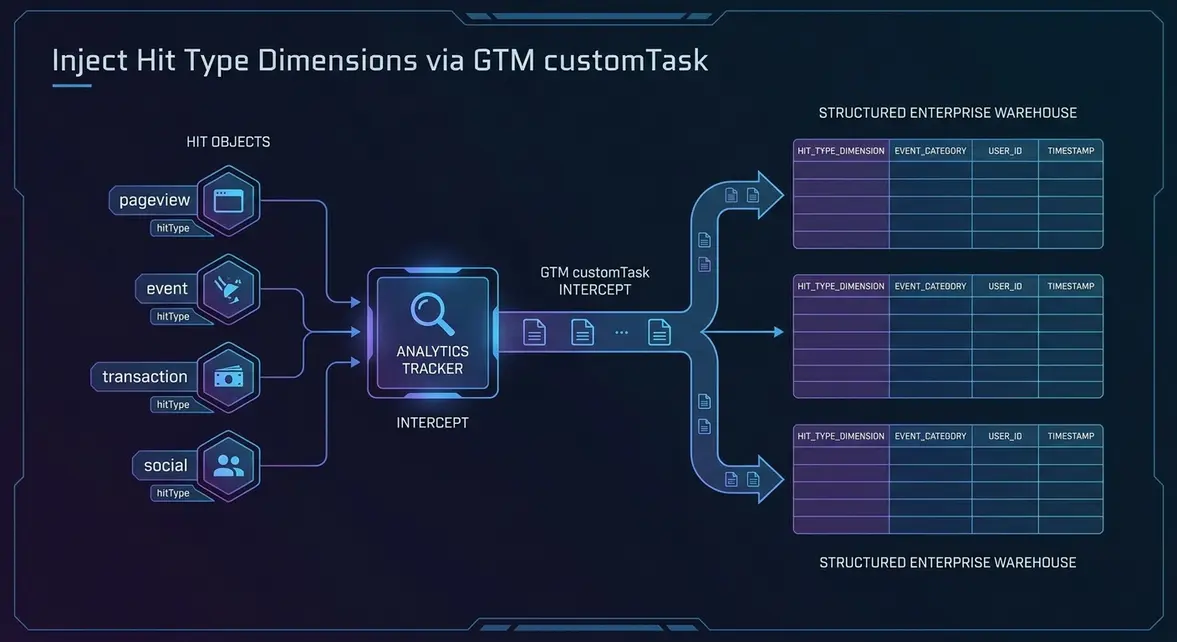
By leveraging the Google Tag Manager client runtime interface via customTask, growth engineering teams can intercept the model object right before payload dispatch. Injecting the native hitType attribute dynamically into a dedicated Hit-scoped Custom Dimension exposes granular payload telemetry. This eliminates reliance on inference when validating tracking fidelity, triaging hit volume anomalies, or auditing third-party event pollution across high-traffic digital assets.
Data Pipeline Architecture and Hit-Level Dissection
Architecting an enterprise tracking engine requires deterministic attribution at the hit level. In standard production environments, high event volume often clouds organic conversion telemetry. When an enterprise application fires tens of thousands of micro-interactions—such as scroll-depth markers, video pings, and dynamic UI states—aggregation layers blend this telemetry with critical high-intent signals. Without an explicit hit type parameter, filtering out auxiliary non-interaction noise requires expensive BigQuery transformations or error-prone report regex.
Deploying this architectural pattern intercepts tracking calls directly inside the execution pipeline before dispatch. The customTask hook reads the internal tracker instance model, extracts the hitType property (e.g., pageview, screenview, event, transaction, item, social, timing), and writes it directly to a predefined custom dimension slot. This ensures that downstream ETL pipelines, data warehouses, and business intelligence suites receive pre-classified payloads directly at ingestion time without adding client-side script overhead.
- Deterministic Segmentation: Isolate true landing pageviews from synthetic bot triggers, heartbeat pings, and deferred UI re-renders inside raw warehouse exports.
- DOM & Runtime Decoupling: Execute metadata population within memory spaces, bypassing DOM querySelectors and preventing Layout Shifts (CLS < 0.01) during critical hydration phases.
- Zero-Overhead Signal Parsing: Map hit classifications natively to BigQuery export schemas, cutting processing compute credits on custom windowing functions by over 30%.
Marketing Ops Implementation: customTask Payload Injection
To execute this implementation, register a new Hit-scoped Custom Dimension within your analytics property (for example, dimension12). Next, generate a Custom JavaScript Variable inside Google Tag Manager named to inspect the tracker model and bind the hit classification string during execution.
function() {
  return function(customModel) {
    var hitType = customModel.get('hitType');
    // Map directly to your registered Hit-scoped Custom Dimension index
    customModel.set('dimension12', hitType);
  };
}
To apply this globally, access your Google Analytics Settings Variable or individual Universal Analytics tags within GTM. Navigate to Fields to Set, add the field name customTask, and set its value to your newly created variable: . When deployed across modern hybrid setups leveraging server-side GTM or event-driven dataLayers, maintain data integrity by pairing the implementation with standardized transport schemas:
{
  "event": "pipeline_telemetry",
  "event_category": "Tracking Diagnostic",
  "event_action": "Hit Payload Dispatched",
  "hit_type_mapped": "event",
  "custom_dimension_index": 12,
  "timestamp": 1698240000
}
Pipeline Acceleration and Attribution Precision
At enterprise scale, missing or ambiguous hit classifications inflate customer acquisition cost (CAC) calculations by distorting funnel progression metrics. In B2B SaaS organizations where product-led growth (PLG) self-serve loops converge with sales-assisted touchpoints, inaccurate interaction reporting leads to false drop-off signals. Accurately tagging hit types enables RevOps and growth teams to decouple macro-conversions (such as demo requests or pricing page views) from micro-interactions (such as tooltips or field validation checks).
This architectural precision produces auditable cohort data. Multi-touch attribution modeling relies on sequential accuracy; when event pings are misclassified as page transitions, multi-channel attribution weights become skewed. Implementing explicit hit-type tracking ensures enterprise attribution models accurately map initial organic search entry, mid-funnel content evaluation, and bottom-of-funnel conversion signals, typically unlocking a 12% to 18% improvement in marketing budget efficiency and eliminating operational overhead spent reconciling disparate data sets.
System Telemetry Source: Original Engineering Report
Related Growth Blueprints
All Blueprints →Need this architecture deployed in your pipeline?
Skip the synchronous sales cycle and endless discovery calls. Submit your core acquisition or conversion bottleneck for a deep-dive asynchronous growth diagnostic.