Override GA4 Fields in Server-Side GTM Architecture
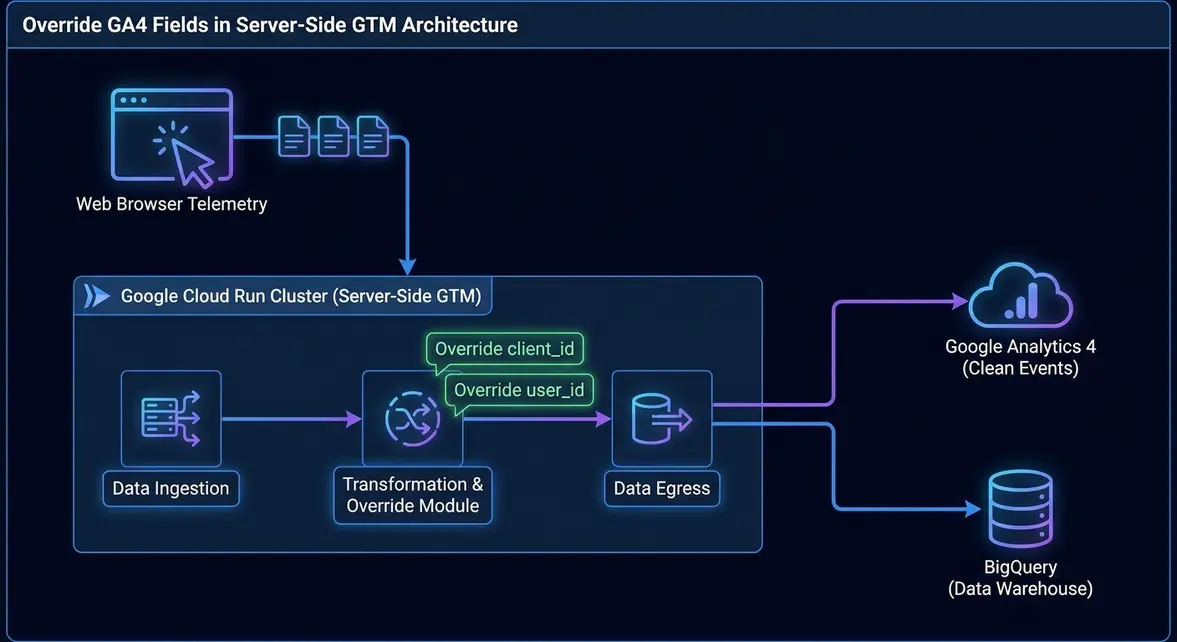
Ingress Protocol Manipulation: Overriding Core GA4 Parameters in sGTM
Executive Architectural Takeaway: Intercepting and mutating telemetry at the server-side Google Tag Manager (sGTM) ingress boundary eliminates the client browser as a single point of failure for data integrity and identity orchestration. By overriding low-level Google Analytics 4 (GA4) Measurement Protocol fields—including client_id, user_id, and engagement_time_msec—directly within the server container's GA4 Tag Template, growth engineering teams enforce absolute perimeter governance before upstream dispatch.
Legacy client-side analytics setups rely on browser-level state, leaving tracking pipelines vulnerable to Intelligent Tracking Prevention (ITP), ad-blocker drop-offs, and accidental client-side PII exposure. When client tracking libraries construct payloads directly in the browser DOM, engineering teams lack a deterministic proxy layer to normalize identifiers or adjust session timing metrics before ingestion by Google's endpoints.
Server-side Tag Manager transforms this topology. By terminating incoming client requests at a dedicated Google Cloud Run or Docker-based sGTM cluster, the server container extracts incoming HTTP requests via the built-in GA4 Client, parses the payload into the internal {{Event Model}}, and surfaces granular controls to override reserved protocol parameters. Instead of accepting the browser's generated Client ID or engagement counters at face value, engineers can cross-reference edge cookies, internal master data management (MDM) IDs, or session stores to inject deterministic values upstream.
Edge Telemetry Architecture and Performance Optimization
Transitioning from browser-side script execution to edge-based field manipulation addresses Core Web Vitals degradation while dramatically enhancing data durability. In traditional setups, executing multiple JavaScript libraries on the client to reformat IDs, calculate engagement intervals, and dispatch duplicative vendor hits taxes the browser main thread, driving Total Blocking Time (TBT) above acceptable thresholds.
Under an edge-routed telemetry paradigm, the client browser dispatches a singular, lightweight hit to a first-party tracking endpoint (e.g., metrics.enterprise.com/g/collect). The sGTM container assumes execution overhead, decoupling downstream marketing endpoints from client-side runtime limits. Furthermore, because search engine crawlers and headless user agents rarely execute or store third-party scripts identically to human visitors, server-side parameter sanitization ensures internal bots and automated testing suites do not skew core engagement metrics.
Key architectural advantages of server-side GA4 parameter overrides include:
- Deterministic Identity Stitching: Override transient client IDs with persistent, HTTP-only first-party cookies (e.g., an internal
fp_id) that withstand Safari 7-day script-write cookie pruning. - Edge-Level PII Scrubbing: Intercept query parameters, user properties, and field definitions before they reach external Google servers, enforcing GDPR/CCPA perimeter compliance.
- Synthetic Engagement Normalization: Mutate
engagement_time_msecto neutralize synthetic tab-switching inflation or calculate active viewport dwell time using custom server-validated algorithms. - Zero Main-Thread Latency Tax: Shift enrichment logic, cookie lookups, and API integrations away from the end-user device, preserving optimal Largest Contentful Paint (LCP) and Cumulative Layout Shift (CLS).
Marketing Ops Runbook: Production sGTM Field Overrides and BigQuery Validation
Executing server-side field overrides requires configuring the native sGTM GA4 Tag Template to remap reserved parameters, backed by sandboxed JavaScript variables to validate values prior to network transmission.
Step 1: Deploy Custom Sandboxed Transformation Script
In the sGTM container, create a Custom Variable Template using sandboxed JavaScript. This variable extracts a verified server-set first-party customer UUID from incoming HTTP request cookies, falling back to the standard client-generated Client ID if unavailable.
// sGTM Variable Template: Resolves deterministic client_id
const getCookieValues = require('getCookieValues');
const getEventData = require('getEventData');

// Read secure, HTTP-only edge identifier
const secureMasterId = getCookieValues('__secure_uid', true);

if (secureMasterId && secureMasterId.length > 0) {
  // Return deterministic identity for field override
  return secureMasterId[0];
}

// Fallback to client-side payload client_id from event model
return getEventData('client_id');
Step 2: Configure Tag Template Parameter Overrides
Within your sGTM GA4 Tag:
- Open the Fields to Set or Event Parameters table.
- Add the reserved field
client_idand map its value to the variable defined above ({{Derived Master Client ID}}). - Add
user_idmapped to{{Server Auth User ID}}to enforce canonical user identity without client-side DOM scraping. - Optionally target
engagement_time_msecto apply server-side rate limits or custom session timers.
Step 3: Automated Pipeline Validation via BigQuery
Validate that server-overridden fields are correctly bound and unpolluted in raw GA4 event exports. Run the following partitioned SQL query in Google BigQuery to verify that overridden identities conform to production UUID schemas and lack truncation.
-- Audit GA4 export for deterministic identity conformity
SELECT
  event_date,
  event_name,
  COUNT(1) AS total_events,
  COUNT(DISTINCT user_pseudo_id) AS distinct_pseudo_ids,
  COUNTIF(REGEXP_CONTAINS(user_pseudo_id, r'^[0-9a-f]{8}-[0-9a-f]{4}-4[0-9a-f]{3}-[89ab][0-9a-f]{3}-[0-9a-f]{12}$')) AS valid_uuid_v4_count,
  COUNTIF(user_id IS NOT NULL) AS authenticated_hits
FROM
  `enterprise-data-warehouse.analytics_123456789.events_*`
WHERE
  _TABLE_SUFFIX = FORMAT_DATE('%Y%m%d', DATE_SUB(CURRENT_DATE(), INTERVAL 1 DAY))
GROUP BY
  event_date,
  event_name
ORDER BY
  total_events DESC;
Enterprise Pipeline Hygiene, Compliance, and B2B Attribution Precision
In B2B growth architectures, high Customer Acquisition Costs (CAC) make pipeline attribution across 90-day to 180-day sales cycles critical. Client-side cookie depreciation regularly splits a single executive buyer's evaluation lifecycle across multiple disparate pseudo-IDs, degrading multi-touch attribution models and inflating CAC figures across paid organic touchpoints.
By leveraging server-side GTM field overrides to bind incoming sessions to long-lived, first-party HTTP-only identifiers, growth engineering teams close multi-touch attribution loops. This eliminates ghost sessions, prevents lead duplication across CRM integrations (such as HubSpot or Salesforce), and provides clean attribution inputs for predictive LTV modeling.
From a risk mitigation standpoint, edge-level field modification provides an immutable security perimeter. Rather than auditing hundreds of client-side tracking triggers across localized CMS pages, security engineers inspect and govern payloads at the single sGTM ingress point. PII, internal dev flags, and non-compliant geographic identifiers can be rewritten, sanitized, or dropped entirely before telemetry crosses internal network boundaries, ensuring full alignment with enterprise SOC 2 and GDPR enforcement frameworks.
System Telemetry Source: Original Engineering Report
Related Growth Blueprints
All Blueprints →Need this architecture deployed in your pipeline?
Skip the synchronous sales cycle and endless discovery calls. Submit your core acquisition or conversion bottleneck for a deep-dive asynchronous growth diagnostic.