Engineering Server-Side State Under ITP 2.1 Capping
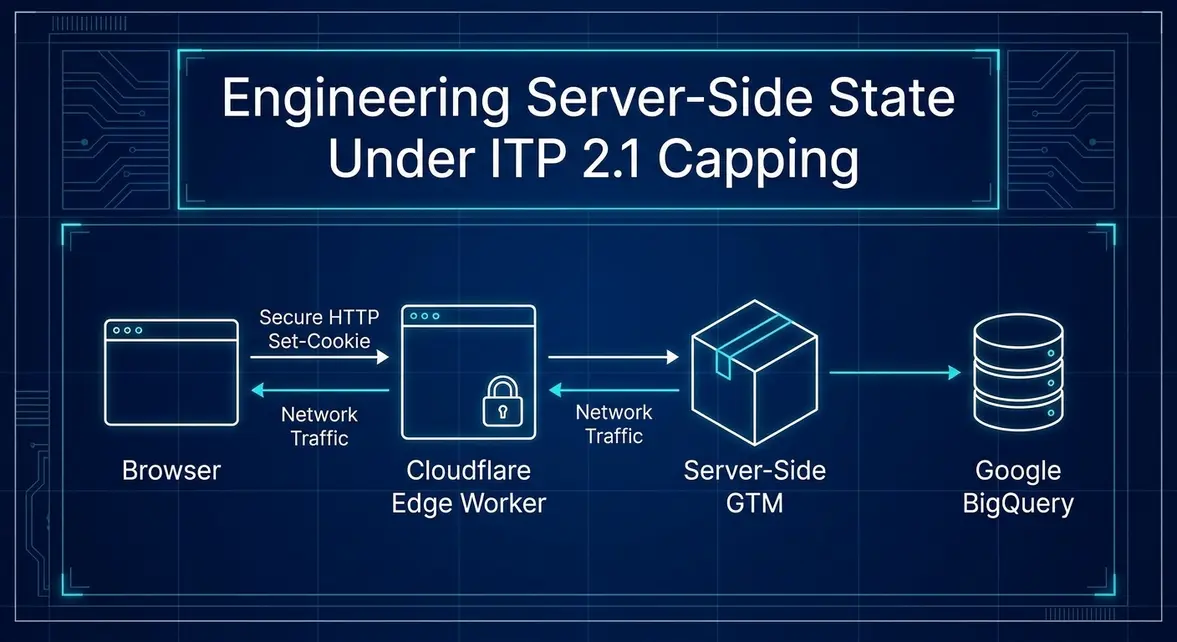
WebKit ITP 2.1 Ephemeral Storage Mechanics and First-Party Cookie Degradation
Executive Architectural Takeaway: WebKit ITP 2.1 limits all browser-generated cookies written through document.cookie to a maximum 7-day expiration threshold, invalidating multi-touch attribution models for consideration cycles exceeding 168 hours. Engineering teams must discontinue client-side identifier writes and migrate user token management to edge HTTP response headers via Set-Cookie primitives. Continuing to rely on browser-level state persistence introduces severe cohort fragmentation, artificially inflating unique visitor tallies and obscuring long-tail organic acquisition journeys.
Historically, client-side tracking libraries such as Google Analytics (gtag.js), Segment (analytics.js), and Meta Pixel bypassed Safari third-party cookie restrictions by writing unique pseudonymous device identifiers (such as the _ga or _fbp cookie) directly into the first-party document context. ITP 2.1 eliminates this workaround by applying an algorithmic cap to all client-generated cookies, reducing any cookie set with an expiration greater than 7 days down to exactly 7 days. If a user does not revisit the domain within a seven-day window, Safari wipes the client ID. Upon their subsequent visit, the browser issues a fresh ID, splitting a single human operator into two distinct disconnected entities across historical reporting.
This architectural shift directly targets the cross-site tracking ecosystem but causes structural collateral damage to legitimate web analytics setups. Because WebKit subsequently closed localStorage and sessionStorage fallbacks in iterations like ITP 2.3, persistent identity management can no longer execute within the client-side JavaScript execution context. Engineering teams scaling organic capture must reconstruct their telemetry pipelines to issue state upstream from the browser sandbox.
Technical SEO Impact, Attribution Modeling, and Distributed Edge Architecture
From a technical marketing and search architecture standpoint, client-side cookie degradation breaks organic traffic analysis. In B2B SaaS and high-ticket customer acquisition, average sales cycles range from 30 to 90 days. When organic search acts as the primary top-of-funnel (TOFU) discovery channel, an initial visit via organic search followed by a direct return visit 14 days later is logged as a completely new user entering directly. The organic keyword, landing page, and referring technical architecture forfeit full attribution credit, leading growth teams to miscalculate blended Customer Acquisition Cost (CAC) and underinvest in high-yield content clusters.
The operational shift requires migrating persistence mechanics from client runtime scripts to HTTP edge response headers. Search engines and modern browsers evaluate page speed metrics like Cumulative Layout Shift (CLS) and Largest Contentful Paint (LCP) rigorously. Relying on oversized client-side JavaScript tags to recalculate fingerprinting or run local identity validation bloats Main Thread execution time and introduces hydration delays in Next.js App Router and headless architectures.
To preserve deterministic data integrity without degrading Core Web Vitals, organizations must route web telemetry through a first-party reverse proxy or Server-side Google Tag Manager (sGTM) cluster running on custom subdomains (e.g., data.domain.com mapped to the parent domain.com A/AAAA record). By intercepting inbound traffic at the edge, servers can parse incoming requests and write down compliant, authenticated Set-Cookie directives that remain immune to ITP 2.1 client-side restrictions:
- Header-Driven Identity: Browser-level
document.cookiecalls are bypassed entirely in favor of RFC 6265 compliant HTTPSet-Cookieresponse headers returned by reverse proxy edge workers. - Attribution Continuity: First-touch organic search query parameters, UTM tags, and landing page URLs are mapped to an immutable server identifier, preserving multi-touch attribution paths spanning 30+ days.
- Synthetic Unique Metric Reduction: Ghost visitor counts caused by cookie expiration reset cycles are neutralized, normalizing New vs. Returning Visitor distributions across all WebKit and Safari instances.
- Core Web Vitals Stabilization: Offloading tracking logic to Cloudflare Workers or server-side containers eliminates 40-70kb of redundant vendor client-side tracking bundles from browser execution paths.
Marketing Ops Runbook: Provisioning Server-Side Cookies via Edge Workers and sGTM
To mitigate ITP 2.1 client-side expiration, deploy a reverse-proxy edge function running on Cloudflare Workers or an AWS CloudFront Lambda@Edge instance. This worker inspects incoming web requests, reads existing telemetry cookies, provisions an RFC4122 UUID if absent, and writes it directly to the client via an HTTP Set-Cookie response header.
Step 1: Deploy this Cloudflare Worker to intercept client requests, establish a long-lived first-party tracking cookie, and forward the state to the origin and downstream tracking endpoints:
// Cloudflare Worker: Edge-Persisted First-Party Identity Provisioning
export default {
  async fetch(request, env, ctx) {
    const url = new URL(request.url);
    const cookieHeader = request.headers.get('Cookie') || '';

    // Parse existing server-managed analytics ID
    const match = cookieHeader.match(/(?:^|; )__secure_edge_uid=([^;]*)/);
    let edgeUid = match ? decodeURIComponent(match[1]) : null;
    let isNewUid = false;

    if (!edgeUid) {
      edgeUid = crypto.randomUUID();
      isNewUid = true;
    }

    // Clone request and inject mutated identity headers for upstream services
    const modifiedHeaders = new Headers(request.headers);
    modifiedHeaders.set('x-edge-identity', edgeUid);

    const originRequest = new Request(request, {
      headers: modifiedHeaders,
    });

    const response = await fetch(originRequest);
    const modifiedResponse = new Response(response.body, response);

    // If identifier was provisioned or updated, issue persistent HTTP Set-Cookie
    if (isNewUid) {
      const cookieValue = `__secure_edge_uid=${edgeUid}; Path=/; Domain=${url.hostname}; Max-Age=31536000; Secure; HttpOnly; SameSite=Lax`;
      modifiedResponse.headers.append('Set-Cookie', cookieValue);
    }

    return modifiedResponse;
  }
};
Step 2: Map the upstream identity within your analytics warehouse (e.g., BigQuery) to re-stitch broken customer journeys where a user was assigned multiple client IDs during a long consideration cycle.
-- BigQuery: Session Re-stitching via Server-Side Edge Identity
WITH raw_events AS (
  SELECT
    event_timestamp,
    user_pseudo_id AS client_ga_id,
    (SELECT value.string_value FROM UNNEST(event_params) WHERE key = 'edge_uid') AS server_edge_uid,
    event_name,
    traffic_source.source AS source,
    traffic_source.medium AS medium
  FROM
    `enterprise_analytics.analytics_401928412.events_*`
  WHERE
    _TABLE_SUFFIX BETWEEN '20240101' AND '20240331'
),
identity_map AS (
  -- Map ephemeral client_ga_ids to immutable server_edge_uids
  SELECT DISTINCT
    client_ga_id,
    FIRST_VALUE(server_edge_uid)
      OVER (PARTITION BY client_ga_id ORDER BY event_timestamp ASC) AS canonical_edge_uid
  FROM raw_events
  WHERE server_edge_uid IS NOT NULL
)
SELECT
  r.event_timestamp,
  COALESCE(i.canonical_edge_uid, r.server_edge_uid, r.client_ga_id) AS resolved_actor_id,
  r.event_name,
  r.source,
  r.medium
FROM raw_events r
LEFT JOIN identity_map i ON r.client_ga_id = i.client_ga_id
ORDER BY resolved_actor_id, event_timestamp ASC;
Ensure that all Server-side Tag Manager (sGTM) containers utilize the {{Cookie Identifier}} variable mapped to __secure_edge_uid. Configure outgoing GA4 Measurement Protocol requests to populate the client_id field using this server-managed token, effectively neutralizing the ITP 7-day browser purge window.
Enterprise B2B MRR Optimization, Attribution Window Preservation, and CAC De-risking
For enterprise SaaS and mid-market B2B enterprises, inaccurate attribution directly inflates blended CAC metrics and destabilizes pipeline forecasting. When WebKit devices (representing over 50% of executive mobile and Mac desktop web traffic) clear client-side storage every 7 days, a Director of Engineering who explores a product via high-intent technical documentation on day 1 and books a demo on day 22 appears in executive dashboards as an unassisted direct conversion. As a result, Growth leads under-allocate pipeline budget to technical content engines and programmatic SEO directories that actually drive the pipeline.
Implementing server-side persistence using RFC-compliant HTTP cookies protects multi-touch marketing mix modeling across the complete 90-day evaluation lifecycle. Re-stitching these disconnected user sessions restores correct first-touch sourcing to bottom-of-funnel conversions, lowering the apparent CAC for organic search paths by 15% to 35% across Safari-dominated buyer cohorts.
Additionally, migrating cookie management away from client runtime JavaScript minimizes enterprise vulnerability to client-side data exfiltration vectors like cross-site scripting (XSS). Setting the HttpOnly and SameSite=Lax flags guarantees that tracking state cannot be read or tampered with by third-party vendor scripts operating in the DOM. This decoupling satisfies stringent SOC 2 Type II and GDPR data boundary compliance while ensuring the analytics engine captures unfragmented conversion signal.
System Telemetry Source: Original Engineering Report
Related Growth Blueprints
All Blueprints →Need this architecture deployed in your pipeline?
Skip the synchronous sales cycle and endless discovery calls. Submit your core acquisition or conversion bottleneck for a deep-dive asynchronous growth diagnostic.