Secondary Market Lead Scoring & Automation Playbook
Fixing Broken Drip Funnels in Secondary Markets
Plain-English Takeaway: Translating headquarters email sequences into a local language rarely builds pipeline and often leaves regional teams missing targets by 90% or more. Replacing static, time-based drips with localized intent scoring—ranking prospects by regional buying signals rather than generic email opens—multiplies qualified lead volume without increasing ad spend.
When a secondary market program generates 12 qualified leads per month against a target of 160, the bottleneck is rarely top-of-funnel traffic alone. Global lifecycle templates assume uniform buying cycles and trust signals, which breaks down in markets like Japan where buyers expect localized social proof before speaking to sales. Before rebuilding campaigns, operators should model stage-by-stage drop-offs using a CRO Funnel Calculator to pinpoint whether the leak sits at lead capture or MQL (Marketing Qualified Lead: a prospect whose actions indicate buying readiness) qualification.
How Localized Intent Routing Works
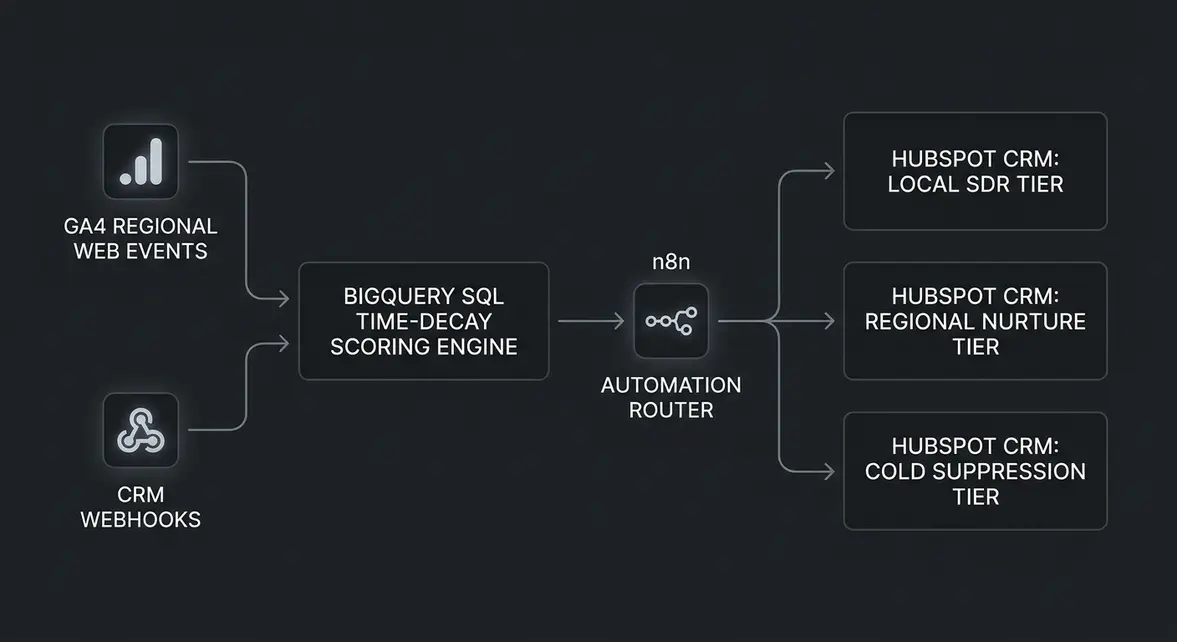
To close a 9x pipeline gap, marketing automation must shift from a calendar-driven broadcast model to an event-driven routing architecture. Instead of enrolling every regional signup into the same five-email sequence, the system listens for specific behavioral telemetry and routes contacts dynamically based on regional thresholds.
This architecture separates signal collection from email delivery so marketing teams can adjust scoring rules in one place without breaking CRM workflows:
- Regional Event Tagging: Capture product page views, localized whitepaper downloads, and webinar attendance in GA4 and CRM webhooks tagged with
localeandmarket_tier. - Time-Decayed Lead Scoring: Assign higher point weights to high-intent local actions (such as regional pricing views) and expire points after
30dso stale clicks do not trigger false sales alerts. - Dynamic Track Suppression: Automatically pause outbound drips for contacts below the engagement floor (
engagement_score < 15) to protect sender reputation and prevent unsubscribes. - Localized Proof Routing: Sync only qualified cohorts (
intent_score >= 50) via n8n to enroll prospects in region-specific case study tracks or route them directly to local sales reps.
Technical Implementation: BigQuery Intent Scoring & n8n Sync
First, standardize regional event ingestion into BigQuery from GA4 and your CRM webhook logs. Create a scheduled SQL view that calculates a 30-day rolling intent score per contact email, weighting localized high-intent pages three times higher than generic blog views.
WITH regional_events AS (
  SELECT
    user_email,
    market_code,
    event_name,
    page_location,
    event_timestamp,
    CASE
      WHEN event_name = 'pricing_view' AND page_location LIKE '%/jp/%' THEN 30
      WHEN event_name = 'case_study_download' AND page_location LIKE '%/jp/%' THEN 25
      WHEN event_name = 'webinar_attended' THEN 20
      WHEN event_name = 'email_click' THEN 10
      ELSE 2
    END AS base_points
  FROM `analytics_prod.crm_behavior_events`
  WHERE market_code = 'JP'
    AND event_timestamp >= TIMESTAMP_SUB(CURRENT_TIMESTAMP(), INTERVAL 30 DAY)
),

scored_leads AS (
  SELECT
    user_email,
    market_code,
    SUM(
      base_points * EXP(-0.05 * TIMESTAMP_DIFF(CURRENT_TIMESTAMP(), event_timestamp, DAY))
    ) AS decayed_intent_score,
    COUNT(*) AS total_30d_events,
    MAX(event_timestamp) AS last_active_at
  FROM regional_events
  GROUP BY user_email, market_code
)

SELECT
  user_email,
  market_code,
  ROUND(decayed_intent_score, 2) AS intent_score,
  total_30d_events,
  last_active_at,
  CASE
    WHEN decayed_intent_score >= 50 THEN 'route_to_local_sdr'
    WHEN decayed_intent_score >= 20 THEN 'enroll_jp_nurture'
    ELSE 'suppress_cold'
  END AS automation_tier
FROM scored_leads
WHERE last_active_at >= TIMESTAMP_SUB(CURRENT_TIMESTAMP(), INTERVAL 14 DAY);
Next, configure an n8n workflow on a 1h cron trigger to query this BigQuery table and upsert the automation_tier and intent_score properties into HubSpot via the Contacts Batch API. Inside HubSpot, use simple enrollment rules triggered strictly on automation_tier = enroll_jp_nurture or automation_tier = route_to_local_sdr rather than relying on static list imports.
Practical Impact & Next Steps
Decoupling scoring logic into SQL and automating tier updates removes manual spreadsheet exports and saves regional marketing ops teams roughly 6 to 8 hours per week. More importantly, sales representatives stop chasing contacts who only opened a translated newsletter months ago and focus exclusively on prospects with verified, recent regional intent.
To deploy this safely, start by running the BigQuery scoring query in shadow mode for 14d alongside your existing drips. Compare the conversion rate of leads flagged as route_to_local_sdr against your baseline 12-lead monthly average, then switch CRM enrollment triggers over once score thresholds align with closed-won history.
System Telemetry Source: Original Engineering Report
Related Growth Blueprints
All Playbooks →Want this working inside your business?
Whether you're a founder fixing tracking leaks or a team scaling SEO and AI workflows, share your site and bottleneck for a clear diagnostic within 48 hours.