Server-Side Meta Conversions API via GA4 and GTM Server
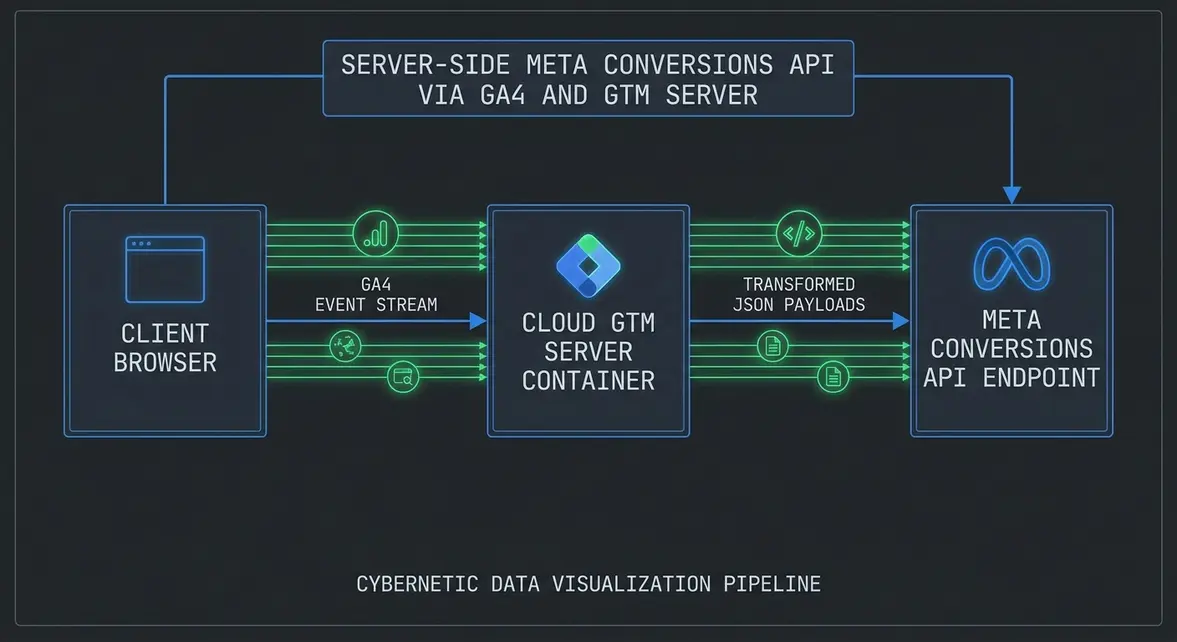
Server-Side Meta Conversions API via GA4 Event Model Pipeline
Client-side telemetry has degraded across modern browser environments due to Safari Intelligent Tracking Prevention (ITP), Firefox Enhanced Tracking Protection (ETP), content blockers, and restrictive mobile operating system privacy frameworks like iOS App Tracking Transparency (ATT). Relying solely on client-side Meta Pixel scripts (fbevents.js) routinely drops 15% to 30% of conversion data before it ever reaches Meta Ads Manager. This signal degradation blinds optimization algorithms, impairs lookalike generation, and artificially inflates reported Customer Acquisition Cost (CAC).
The release of Meta's official Conversions API (CAPI) tag template for Server-Side Google Tag Manager (sGTM) restructures tracking topology. Instead of requiring redundant client-side vendor libraries, this setup routes telemetry through a single first-party GA4 web stream (gtag.js) directly into a private sGTM instance hosted on Google Cloud Run or AWS. The built-in GA4 Client within the sGTM container parses incoming HTTP request payloads into a unified, server-side event data model, which downstream server tags—such as the Meta CAPI tag—consume and forward via server-to-server HTTP POST requests.
Technical SEO Data Architecture: Core Web Vitals and First-Party Proxying
Executing multiple third-party marketing tags directly in the browser damages Document Object Model (DOM) performance, bloating Total Blocking Time (TBT) and delaying Interaction to Next Paint (INP). By offloading Meta telemetry execution from the browser's main thread to a server-side proxy, sites eliminate the overhead of downloading, parsing, and executing fbevents.js on mobile devices. This architectural transition strips out 35KB to 60KB of blocking JavaScript, directly supporting the technical SEO objective of keeping Largest Contentful Paint (LCP) under 2.5 seconds and TBT under 200 milliseconds.
Beyond frontend performance optimization, routing events through an sGTM custom tracking domain (e.g., metrics.domain.com) transitions data collection to a genuine first-party context. When DNS A or AAAA records route to the container cluster, HTTP responses include first-party Set-Cookie headers. This prevents Safari ITP from truncating the Meta click ID (_fbc) and browser ID (_fbp) cookies to 24-hour or 7-day windows, preserving an attribution lifespan of up to 90 days for extended B2B sales cycles.
Server-side data transformation functions as an operational security and data hygiene layer before payload egress. Engineering teams can programmatically inspect incoming payloads, hash customer information (e.g., business emails and phone numbers) using SHA-256 before transmission to Meta Graph API endpoints, and strip sensitive parameters from query strings to prevent unintended compliance violations.
- Reduced Main-Thread Congestion: Consolidating multiple tracking libraries into a single GA4 HTTP transport request reduces thread contention and minimizes layout shifts.
- First-Party Attribution Integrity: Custom domain proxying protects
_fbpand_fbccookie lifetimes against browser-based storage partition rules. - Event Deduplication: Shared
event_idparameters passed in both client and server payloads allow Meta to deduplicate matching hits without skewing conversion counts.
Marketing Ops Implementation: Web DataLayer to sGTM Conversions API Configuration
The deployment process requires a coordinated pipeline between the frontend data layer, the web GTM container, and the sGTM container. On the website, developers push conversion data containing hashed or unhashed user parameters and a deterministic event_id into the data layer. The web GTM configuration then passes these fields within a standard GA4 event to the sGTM endpoint.
Implement the frontend tracking call during an acquisition event, such as a high-intent enterprise demo request:
window.dataLayer = window.dataLayer || [];
window.dataLayer.push({
  event: 'lead_form_submitted',
  event_id: 'lead_' + Date.now() + '_' + Math.floor(Math.random() * 1000),
  user_data: {
    email_address: 'growth.lead@enterprise.com',
    phone_number: '+15550192834',
    external_id: 'usr_84920492'
  },
  conversion_value: 1200.00,
  currency: 'USD'
});
Within the Web GTM container, configure a GA4 Event Tag triggered by the lead_form_submitted custom event. In the tag configuration, set the transport URL to your server container domain (e.g., https://metrics.domain.com) and pass the {{event_id}} variable under Event Parameters. The Server GTM container then executes the extraction and forwarding workflow:
{
  "event_name": "Lead",
  "event_time": 1711929600,
  "event_id": "lead_1711929600_482",
  "user_data": {
    "em": ["a6c761b0a7fb3c9b7e9b048d0847f9f3efb250523e0050882e36b856b3e6c38d"],
    "ph": ["8b1a9953c4611296a827abf8c47804d7e828d584347713d2f9b174cb2e6af26f"],
    "client_ip_address": "198.51.100.42",
    "client_user_agent": "Mozilla/5.0 (Macintosh; Intel Mac OS X 10_15_7)",
    "fbp": "fb.1.1711920000.1092840291",
    "fbc": "fb.1.1711920000.IwAR0exampleClickID"
  },
  "custom_data": {
    "value": 1200.00,
    "currency": "USD"
  },
  "action_source": "website"
}
In the Server GTM container, create a tag using the Meta Conversions API template. Set the trigger to match when the GA4 Client identifies the incoming path, map the {{Event Data}} properties to Meta's expected parameters, and provide your Meta Pixel ID and API Access Token via environment-level constants.
B2B Growth Engine: Downfunnel Conversion Recovery and CAC Compression
In B2B customer journeys spanning 30 to 90 days, client-side attribution breaks down before pipeline value converts to closed-won revenue. By deploying the Meta Conversions API via sGTM and GA4 event mapping, growth marketing engineering teams can match downstream stages—such as Product Qualified Leads (PQLs) and sales opportunities—back to the original ad interaction using the retained _fbc and external_id parameters.
Enriching conversion signals directly at the server level routinely pushes Meta Event Match Quality (EMQ) scores from sub-5.0 ratings up into the 8.2 to 9.4 range. Feeding high-fidelity first-party data (normalized email addresses, phone numbers, and deterministic IDs) into Meta's Value-Based Bidding (VBB) system enables campaign algorithms to optimize delivery toward high-LTV accounts. This setup typically yields an 18% to 24% reduction in blended Cost Per Acquisition (CAC) across target B2B segments while eliminating reporting blind spots across internal BigQuery attribution models.
System Telemetry Source: Original Engineering Report
Related Growth Blueprints
All Blueprints →Need this architecture deployed in your pipeline?
Skip the synchronous sales cycle and endless discovery calls. Submit your core acquisition or conversion bottleneck for a deep-dive asynchronous growth diagnostic.