sGTM Consent Mode v2: Auto Pageview Redispatch
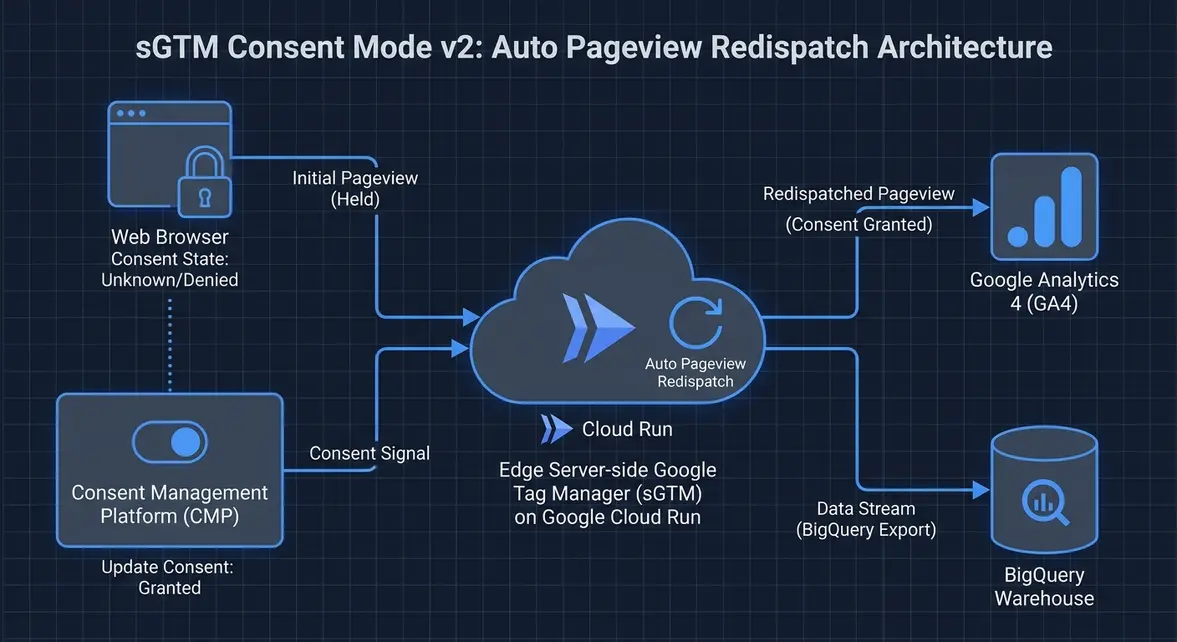
Consent-Driven Event Redispatch in Server-Side Google Tag Manager
Executive Architectural Takeaway: The native Google tag (gtag.js) client runtime now automatically re-dispatches key interaction events—specifically page_view and configured key events—to server-side Google Tag Manager (sGTM) when consent transitions from denied to granted. This architectural evolution removes the need for brittle client-side custom event listeners previously built to re-trigger tags post-consent. When combined with server-side ingestion, it restores first-touch attribution while maintaining compliance boundaries under GDPR and ePrivacy directives.
Historically, implementing Advanced Consent Mode required engineering teams to build complex client-side workarounds. When a visitor landed on a site, the Google tag fired an anonymized cookieless ping (gcs=G100). If the user subsequently granted consent via a Consent Management Platform (CMP) banner, teams had to choose between two failure states: drop initial landing page parameters (destroying organic and paid attribution) or manually fire a secondary page_view event on a custom consent update trigger. The latter routinely caused duplicate page views in Google Analytics 4 (GA4) unless governed by custom JavaScript flags that checked runtime state.
Under the updated gtag.js runtime implementation, the client engine maintains an internal queue of unconsented pings. As soon as a valid gtag('consent', 'update', ...) call executes with analytics_storage: 'granted', the script automatically re-evaluates the active hit state. It synthesizes and dispatches an updated HTTP request directly to the configured sGTM transport URL (server_container_url), attaching the newly minted client identifier (_ga), session identifier (_s), and consent parameter (gcs=G111).
Technical SEO & Data Architecture: Handling Cookieless Ingestion at the Edge
This automatic redispatch mechanism shifts the point of attribution reconciliation from client-side DOM scripting directly to your server-side proxy layer. For high-traffic marketing sites, this optimization eliminates main-thread script evaluation overhead during the critical Largest Contentful Paint (LCP) and Interaction to Next Paint (INP) execution windows. Rather than executing custom tag-sequencing loops in the browser, the browser issues an asynchronous POST request to your Cloud Run or AWS ECS sGTM cluster.
From a technical SEO and crawl budget standpoint, search engine bots (which do not interact with CMP modals and evaluate pages under default consent) exclusively emit the cookieless ping or no ping at all if tag firing rules exclude automated agents. Because legitimate user consent transitions do not trigger a full document reload or DOM hydration cycle, Core Web Vitals remain completely isolated from tag firing logic. The browser execution cost is strictly bound to a single XHR/Fetch payload dispatched off-thread.
Key architectural mechanics of this payload lifecycle include:
- Payload Delta Evaluation: The initial ping sends
ep.gcs=G100(orG102depending on ad storage states) lacking_gacookies. Upon consent update, the browser automatically dispatches an identical event schema wheregcsincrements toG111, injecting the client-generated or server-mintedclient_id. - Session Stitching at sGTM: The GA4 Client in sGTM parses the incoming query string or body payload. When the consented hit arrives with the same
ga_session_id, BigQuery export tables stitch the landing page hit to the active session without creating orphan interaction records. - Header and Parameter Stripping: In legacy client-side containers, third-party marketing tags had direct access to document state. Running this pipeline through sGTM allows edge-level redaction of PII (query parameters, IP addresses, user agents) prior to forwarding data to upstream vendor endpoints (Google Analytics 4, Meta Conversions API, or BigQuery).
Marketing Ops Implementation: CMP Configuration and Edge Audit Runbook
To safely deploy this automated behavior without generating duplicate conversion records downstream, engineering teams must configure the client-side Google Tag initialization correctly and enforce downstream deduplication inside BigQuery.
Step 1: Client-Side Consent Mode Initialization and CMP Bridge
Deploy the following script in the document <head> prior to loading gtag.js or the Google Tag Manager web container. Ensure the default state sets analytics_storage and ad_storage to denied.
// Initialize dataLayer and default consent state
window.dataLayer = window.dataLayer || [];
function gtag(){dataLayer.push(arguments);}

gtag('consent', 'default', {
  'ad_storage': 'denied',
  'ad_user_data': 'denied',
  'ad_personalization': 'denied',
  'analytics_storage': 'denied',
  'wait_for_update': 500
});

// Configure transport URL pointing to your sGTM Cloud Run custom domain
gtag('config', 'G-XXXXXXXXXX', {
  'server_container_url': 'https://collect.yourdomain.com',
  'send_page_view': true
});

// CMP Resolution Handler: Invoked when the user clicks 'Accept All'
function handleUserConsentGranted() {
  gtag('consent', 'update', {
    'ad_storage': 'granted',
    'ad_user_data': 'granted',
    'ad_personalization': 'granted',
    'analytics_storage': 'granted'
  });
  // Note: Do NOT execute an explicit gtag('event', 'page_view') here.
  // The runtime automatically re-dispatches the page_view hit to sGTM.
}
Step 2: BigQuery Session Reconciliation and Deduplication Query
Because both the initial cookieless ping (if Advanced Consent Mode is active) and the subsequent consented hit land in your raw telemetry logs, use this SQL model to reconcile events and prevent duplicate attribution in growth reporting pipelines.
WITH raw_events AS (
  SELECT
    event_date,
    event_timestamp,
    event_name,
    user_pseudo_id,
    (SELECT value.int_value FROM UNNEST(event_params) WHERE key = 'ga_session_id') AS ga_session_id,
    (SELECT value.string_value FROM UNNEST(event_params) WHERE key = 'gcs') AS gcs_consent_state,
    (SELECT value.string_value FROM UNNEST(event_params) WHERE key = 'page_location') AS page_location,
    ROW_NUMBER() OVER(
      PARTITION BY
        (SELECT value.int_value FROM UNNEST(event_params) WHERE key = 'ga_session_id'),
        event_name,
        (SELECT value.string_value FROM UNNEST(event_params) WHERE key = 'page_location')
      ORDER BY
        event_timestamp DESC
    ) AS hit_rank
  FROM `your-gcp-project.analytics_XXXXXXXX.events_*`
  WHERE _TABLE_SUFFIX = FORMAT_DATE('%Y%m%d', DATE_SUB(CURRENT_DATE(), INTERVAL 1 DAY))
    AND event_name IN ('page_view', 'purchase', 'sign_up')
)
-- Select the most-consented event state (deduplicating cookieless pings if updated)
SELECT
  event_date,
  event_timestamp,
  event_name,
  user_pseudo_id,
  ga_session_id,
  gcs_consent_state,
  page_location
FROM raw_events
WHERE hit_rank = 1;
B2B Enterprise Growth & Pipeline Velocity: Impact on CAC and Data Hygiene
For enterprise B2B organizations running high-ACV campaigns across paid search and display, attribution models are hypersensitive to missing first-touch conversion data. When a prospective enterprise buyer navigates to a landing page from a paid campaign (e.g., Google Ads or LinkedIn Ads) and hesitates for 20 seconds before accepting cookie banners, legacy tracking setups frequently lost the gclid or UTM campaign parameters associated with the initial entry document. By the time consent was granted, the original click metadata was disconnected from the session, misattributing closed-won enterprise pipeline to (direct) or (none).
The automated redispatch behavior inside sGTM guarantees that the full initial payload context—including page_location, query parameters, and edge-derived IP metadata—is re-evaluated and ingested under the consented state. This mechanics directly recovers paid search CAC calculations by preventing multi-touch attribution degradation across high-intent conversion pathways.
From a risk and governance perspective, this pipeline secures SOC 2 and GDPR compliance. Data engineering teams gain precise control over client signals: cookieless pings that were fired prior to consent are updated deterministically, ensuring that unconsented user identities are never written to long-term storage or exposed downstream. By offloading these reconciliation flows to sGTM and BigQuery, growth marketing teams eliminate the data inflation and skewed conversion rates that previously distorted pipeline forecasting.
System Telemetry Source: Original Engineering Report
Related Growth Blueprints
All Playbooks →Want this working inside your business?
Whether you're a founder fixing tracking leaks or a team scaling SEO and AI workflows, share your site and bottleneck for a clear diagnostic within 48 hours.