GA4 Measurement Protocol Session Attribution Architecture
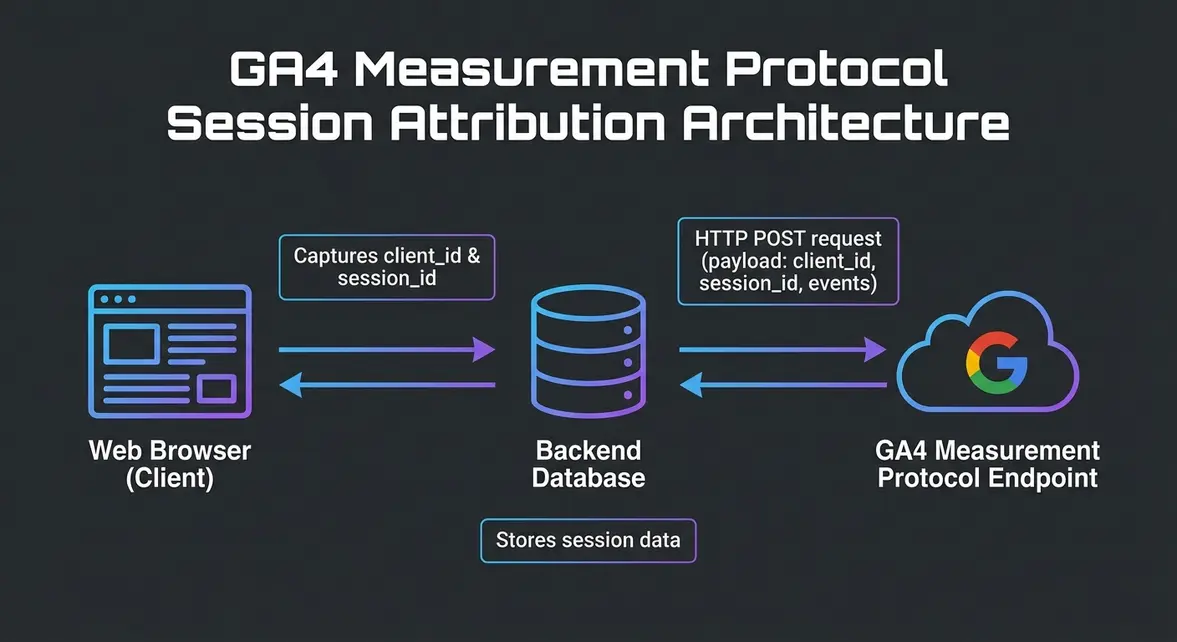
Architectural Mechanics of GA4 Measurement Protocol Session Ingestion
In Universal Analytics, the Measurement Protocol served as the unified transport layer for both client-side libraries and server-side tracking, creating sessions implicitly whenever an incoming hit hit the collection endpoint. Google Analytics 4 fundamentally inverts this relationship. The GA4 Measurement Protocol is an asynchronous data-enrichment pipeline rather than a real-time session generation engine. When an HTTP POST request hits the GA4 collection endpoint, Google does not automatically derive session dimensions, acquisition channels, or campaign parameters from HTTP headers or user agents unless explicit session parameters are appended directly to the payload.
To successfully stitch server-side telemetry to an existing user journey, developers must explicitly bind the event to a pre-existing client context using two mandatory identifiers: client_id (or app_instance_id for Firebase) and the session_id (passed as ga_session_id within the event parameters). If an event is dispatched to the Measurement Protocol without an active, matching session_id, GA4 defaults to attributing the event to a direct visit or creates an orphan interaction that lacks source, medium, and campaign attribution in standard exploration reports. Furthermore, historical backfilling is strictly bound by a 72-hour processing window using timestamp_micros, meaning any pipeline delays exceeding this boundary result in permanent attribution drift.
Technical SEO & Server-Side Telemetry Infrastructure
Executing client-side conversion tracking introduces substantial rendering overhead and exposes attribution pipelines to aggressive browser tracking preventions, such as Safari's Intelligent Tracking Prevention (ITP) and Firefox's Enhanced Tracking Protection (ETP). In high-performance web applications built on Next.js, Nuxt, or Remix, running multiple third-party conversion tags on critical user paths degrades Core Web Vitals, specifically inflating Total Blocking Time (TBT) and delaying Interaction to Next Paint (INP). Migrating conversion events to an asynchronous, server-side GA4 Measurement Protocol architecture eliminates client-side execution drag while bypassing ad-blockers that drop an estimated 15% to 30% of standard telemetry.
The technical implementation requires your application data layer to harvest tracking state during the user's initial organic session. When a user lands via organic search, the Google Tag (gtag.js) writes the _ga cookie containing the client_id and a session cookie formatted as ga<CONTAINER_ID> containing the session_id and session_number. Your application backend must extract these values at key interaction checkpoints (such as demo requests, trial signups, or lead captures) and persist them alongside the user record in your primary database or data warehouse.
- Client-Side Extraction: Use JavaScript access patterns to isolate the
client_idviagtag('get')or direct parsing of document cookies, extracting the timestamp and counter from thega*session cookie. - Database Persistence: Store the
client_id,ga_session_id, and originatingsession_numberin PostgreSQL, MongoDB, or your CRM schema alongside the user profile. - Asynchronous Dispatch: Execute server-side HTTP POST dispatches from background workers to GA4 when offline business milestones trigger (e.g., Stripe subscription creation, contract execution, or CRM stage changes).
Marketing Operations Implementation Guide
To wire up server-side conversion ingestion with intact session attribution, first configure your frontend to expose the necessary session metadata. Do not rely on brittle regex parsing of document cookies if the Google Tag API is accessible. Instead, use the native Promise-based extraction pattern provided by gtag.js to pass the runtime values directly into your form handler or application state.
When sending variables in Google Tag Manager containers, ensure your Data Layer macros capture these identifiers safely. When referencing variables like or in your server container, pass them through as top-level parameters. Below is a production-ready Node.js controller showing how to ingest the parameters on the server and forward an offline conversion directly to the GA4 Measurement Protocol endpoint:
import axios from 'axios';

export async function trackOfflineConversion({
  clientId,
  sessionId,
  conversionValue,
  transactionId,
}) {
  const apiSecret = process.env.GA4_API_SECRET;
  const measurementId = process.env.GA4_MEASUREMENT_ID;
  const endpoint = `https://www.google-analytics.com/mp/collect?measurement_id=${measurementId}&api_secret=${apiSecret}`;

  const payload = {
    client_id: clientId,
    timestamp_micros: (Date.now() * 1000).toString(),
    events: [
      {
        name: 'purchase',
        params: {
          session_id: sessionId,
          currency: 'USD',
          value: conversionValue,
          transaction_id: transactionId,
          engagement_time_msec: 100,
        },
      },
    ],
  };

  try {
    const response = await axios.post(endpoint, payload, {
      headers: { 'Content-Type': 'application/json' },
    });
    return response.status === 204;
  } catch (error) {
    console.error('GA4 MP Dispatch Failed:', error.response?.data || error.message);
    throw error;
  }
}
Notice the inclusion of engagement_time_msec set to an integer value greater than zero. Without this parameter, GA4 frequently discards session duration telemetry, which can prevent the session from qualifying as an engaged session in downstream reporting views. Validate your payloads against the GA4 debug endpoint (https://www.google-analytics.com/debug/mp/collect) before routing to production.
B2B Growth & Multi-Touch Pipeline Leverage
For high-ACV B2B SaaS organizations, the typical sales cycle spans weeks or months from initial organic content consumption to contract completion. Standard client-side attribution collapses entirely across this timeline: by the time an enterprise prospect signs an order form inside a sales-led CRM pipeline, their original organic search landing page session has expired, and standard web analytics default to attributing the resulting revenue to direct traffic or offline sales.
By capturing the client_id and session_id during the initial self-serve signup or MQL gated-content download and propagating those primitives through Salesforce or HubSpot to Stripe, growth teams can programmatically send closed_won events back to GA4 via the Measurement Protocol. This matches down-funnel enterprise contract values ($20,000 to $100,000+ ARR) directly back to specific technical documentation, long-tail programmatic SEO pages, or high-intent comparison queries.
In practice, closing this telemetry loop eliminates attribution black holes. Marketing teams deploying this architecture routinely reduce unassigned direct traffic shares by 35% to 45%, reallocating capital toward organic search paths that drive bottom-line net revenue rather than top-of-funnel vanity traffic. It provides the exact financial justification needed to scale technical SEO operations by proving direct correlation with closed ARR.
System Telemetry Source: Original Engineering Report
Blueprint di Crescita Correlati
Tutti gli Esperimenti →Vuoi implementare questa architettura nella tua pipeline?
Evita i lunghi cicli di vendita e le infinite call di scoperta. Invia il tuo collo di bottiglia di acquisizione o conversione per una diagnosi tecnica approfondita in asincrono.