Join Google Ads & GA4 in BigQuery
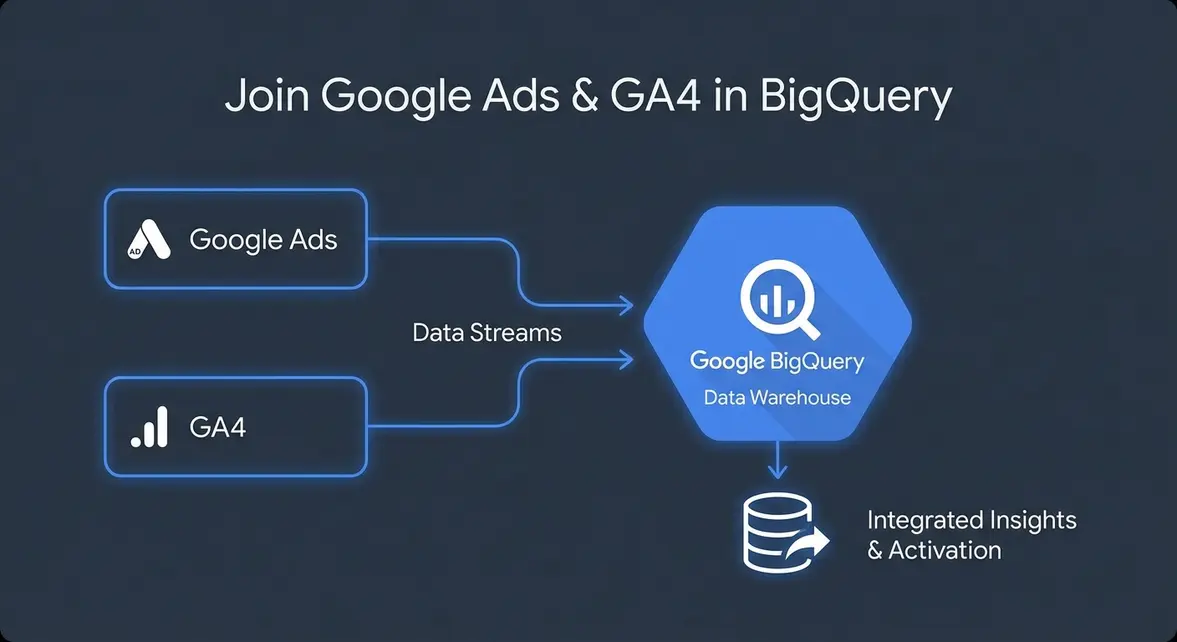
Eliminating Native Attribution Silos with BigQuery Integration
Native Google Analytics 4 reporting interfaces and the standard Google Ads conversion tracking UI operate as isolated attribution black boxes. In standard client-side deployments, Google Ads relies on gclid-driven attribution models, while the GA4 front-end applies algorithmic data-driven attribution (DDA) subject to thresholding, modeling windows, and aggregation latency. These discrepancies obscure performance metrics, forcing B2B growth teams to reconcile disparate spend and downstream conversion signals manually across disconnected dashboards.
Unifying the raw Google Ads export and the GA4 raw event stream inside Google BigQuery removes black-box transformations. Instead of relying on pre-aggregated API pulls or fragmented session stitches, growth engineers can access unaggregated hit-level primitives. This data pipeline exposes the full lifecycle of an acquisition event—from ad network impressions and cost per click (CPC) to precise post-click interactions like session initiation, feature engagement, and product qualified lead (PQL) signups.
Technical Data Architecture & Identity Resolution
Executing an end-to-end join across Google Ads and GA4 requires a deterministic schema contract. The raw GA4 export streams each interaction as a discrete record under the events_* partitioned table. To tie these events back to paid ad interactions, growth engineers must stitch the collected click identifier (gclid or fallback session parameters) to the Google Ads BigQuery Data Transfer Service (DTS) tables, specifically targeting p_ads_ClickStats_* and p_ads_Campaign_*.
A primary bottleneck in client-side attribution is cross-domain navigation, Safari's Intelligent Tracking Prevention (ITP) capping cookies at 1 to 7 days, and ad-blockers intercepting tracking scripts. Transitioning to a server-side tagging environment (Server-Side GTM deployed on Cloud Run or App Engine) mitigates this by issuing first-party Set-Cookie headers via your core domain. This retains tracking integrity, preserves query parameters across redirect paths, and consistently stores the gclid in a secure, first-party cookie for ingestion into GA4 custom dimensions.
- Granular Impression & Cost Ingestion: Ingesting Google Ads click and cost schemas into BigQuery exposes campaign IDs, ad group IDs, creative IDs, and exact spend at micro-dollar fidelity.
- Event-Level Correlation: Extracting the
gclidfromevent_paramsunifies anonymous session records with exact ad placement vectors without third-party cookie reliance. - Deterministic Identity Graphing: Combining server-side
client_id, first-party CRM identifiers (such as a hashed user ID), and the click identifier creates a complete audit trail from initial ad impression to downstream pipeline stages.
Marketing Ops Implementation: Data Pipeline & Query Logic
To execute this join, activate the BigQuery Data Transfer Service for Google Ads alongside the native GA4 BigQuery export within your Google Cloud Platform project. Ensure your Server-Side GTM tag or client-side configuration extracts the gclid from landing page URLs and writes it into a GA4 user property or event-scoped custom parameter, typically tracked via {'{{Page URL}}'} or dedicated JavaScript variables.
Once data transfers populate the target dataset, run an automated data modeling query (via dbt, scheduled queries, or Cloud Functions) to match GA4 session-start events with Google Ads click records. Below is a production-ready SQL script illustrating how to join raw session starts to Google Ads campaign data using the gclid primitive:
WITH ga4_clicks AS (
  SELECT
    user_pseudo_id,
    (SELECT value.int_value FROM UNNEST(event_params) WHERE key = 'ga_session_id') AS ga_session_id,
    TIMESTAMP_MICROS(event_timestamp) AS event_timestamp,
    (SELECT value.string_value FROM UNNEST(event_params) WHERE key = 'gclid') AS gclid
  FROM
    `your-gcp-project.analytics_123456789.events_*`
  WHERE
    event_name = 'session_start'
    AND _TABLE_SUFFIX = FORMAT_DATE('%Y%m%d', DATE_SUB(CURRENT_DATE(), INTERVAL 1 DAY))
    AND EXISTS (SELECT 1 FROM UNNEST(event_params) WHERE key = 'gclid' AND value.string_value IS NOT NULL)
),
ads_performance AS (
  SELECT
    c.campaign_id,
    c.campaign_name,
    cs.gclid,
    cs.click_date,
    cs.cost / 1000000.0 AS cost_usd
  FROM
    `your-gcp-project.google_ads.p_ads_ClickStats_123456789` cs
  JOIN
    `your-gcp-project.google_ads.p_ads_Campaign_123456789` c
  ON
    cs.campaign_id = c.campaign_id
  WHERE
    cs._PARTITIONDATE = DATE_SUB(CURRENT_DATE(), INTERVAL 1 DAY)
)
SELECT
  ga.event_timestamp,
  ga.user_pseudo_id,
  ga.ga_session_id,
  ads.campaign_id,
  ads.campaign_name,
  ads.gclid,
  ads.cost_usd
FROM
  ga4_clicks ga
INNER JOIN
  ads_performance ads
ON
  ga.gclid = ads.gclid;
This joined data layer serves as the foundation for custom multi-touch attribution models. Instead of accepting fixed 30-day lookback windows, analytics teams can now measure exact latency between the initial ad spend and downstream conversion events such as product activation or contract initiation.
B2B Growth & CAC Optimization Engine
For B2B software companies operating with sales-assisted funnels and 60-to-180 day sales cycles, this warehouse-native pipeline resolves a critical operational challenge: calculating true Customer Acquisition Cost (CAC) and Payback Period across long sales velocity horizons. Native platforms stop tracking performance after short conversion windows, causing high-intent search campaigns that yield enterprise SQLs months down the line to appear inefficient.
By connecting Google Ads click-level cost data to downstream CRM opportunities (e.g., Salesforce or HubSpot) via GA4 identifiers, revenue teams unlock Closed-Loop Attribution. This pipeline exposes which specific ad creatives, keywords, and landing page variations produce high-velocity ARR versus those that drive low-intent signups. In practice, growth engineering teams leveraging this architecture systematically reallocate 20% to 35% of underperforming ad spend into high-LTV pipeline vectors, reducing blended customer acquisition costs while accelerating enterprise pipeline velocity.
System Telemetry Source: Original Engineering Report
Blueprint di Crescita Correlati
Tutti gli Esperimenti →Vuoi implementare questa architettura nella tua pipeline?
Evita i lunghi cicli di vendita e le infinite call di scoperta. Invia il tuo collo di bottiglia di acquisizione o conversione per una diagnosi tecnica approfondita in asincrono.