Universal Link Click Categorization in GA4
Automating Link Taxonomy: Beyond GA4 Enhanced Measurement
Google Analytics 4 Enhanced Measurement natively automates outbound click tracking and select file download triggers, yet it remains fundamentally blind to internal link topologies and semantic context. Default implementations rely heavily on disparate triggers for navigation bars, sidebar widgets, inline editorial links, and conversion buttons. This distributed tagging strategy introduces severe technical debt, inflates Google Tag Manager (GTM) container sizes, and fragments downstream behavioral analytics. Growth engineering teams frequently face an operational bottleneck: marketing stakeholders request bespoke event configurations for every micro-conversion element across evolving web applications.
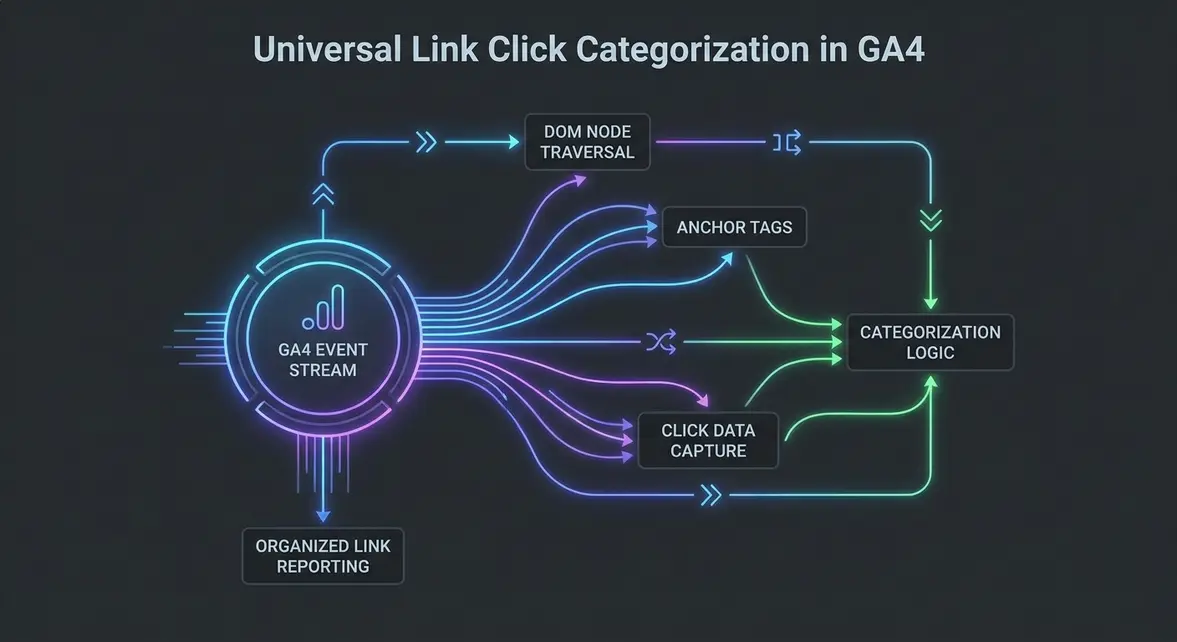
The solution deployed by Sebastian Pospischil standardizes link telemetry into a unified architecture. By implementing a single, delegated event listener that systematically inspects the Document Object Model (DOM) hierarchy upon user interaction, teams can automatically extract, sanitize, and categorize all anchor click interactions. This approach deprecates individual trigger maintenance, establishing a deterministic framework where every anchor tag is classified into precise taxonomic buckets—such as header navigation, footer, inline body content, cross-domain referral, or high-intent conversion action—prior to event dispatch.
Technical SEO & Data Architecture: Semantic Traversal and BigQuery Ingestion
Modern frontend frameworks—including Next.js, Nuxt, and Remix—render client-side routing trees that complicate naive event tracking. Standard click listeners frequently misfire or fail during DOM reconciliation when client-side hydration alters element hierarchies. Universal link tracking overcomes this through event delegation at the document level. When a user executes a click, the event bubbles up the DOM. The analytical script inspects the event target, detects the nearest enclosing anchor element (HTMLAnchorElement), and parses its relative or absolute path against window.location.hostname.
From an indexing and technical SEO perspective, structural click telemetry provides granular auditing data for internal PageRank distribution and user traversal patterns. Tracking internal click paths alongside organic landing page traffic directly exposes orphan content, user dead-ends, and low-engagement navigation clusters. Rather than relying on static crawl estimations, search engine optimization architects can query actual user traversal vectors inside BigQuery to analyze click depth relative to conversion velocity. Because GA4 limits event parameter registration to 25 custom parameters per event on standard properties, consolidating link properties into a standardized schema is critical to prevent schema bloat.
- DOM Traversal Logic: Inspects parent nodes (e.g.,
<header>,<nav>,<main>,<footer>,<aside>) to infer navigational hierarchy without requiring manual class tagging on every link. - Regex URL Resolution: Leverages the native
URLAPI to normalize relative URLs, query strings, and protocol-relative links, preventing duplicate reporting in dimensional breakdown tables. - BigQuery Partition Efficiency: Maps all link telemetry to a unified
custom_link_clickevent, reducing table fragmentation and query processing costs across the GA4 daily export schema (events_*).
Marketing Ops Implementation: Standardized Delegation & Variable Config
To implement this framework inside Google Tag Manager without injecting execution latency into the main thread, configure a Custom JavaScript Variable that parses the incoming Click Element. This script evaluates the clicked node, climbs to the closest anchor tag using Element.closest(), and assigns a normalized taxonomy string based on ancestor presence and destination targets.
Create a Custom JavaScript Variable named JS - Link Categorization with the following parsing logic:
function() {
  var target = {{Click Element}};
  var anchor = target.closest('a');
  if (!anchor) return 'non_link';

  var href = anchor.href || '';
  var currentHost = window.location.hostname;

  try {
    var url = new URL(href, window.location.origin);
    if (url.hostname !== currentHost) {
      return 'external_outbound';
    }
  } catch(e) {
    return 'malformed_url';
  }

  if (anchor.closest('header, nav')) return 'header_navigation';
  if (anchor.closest('footer')) return 'footer_navigation';
  if (anchor.closest('aside, .sidebar')) return 'sidebar_navigation';
  if (anchor.closest('main, article, .content')) {
    if (anchor.classList.contains('btn') || anchor.getAttribute('role') === 'button') {
      return 'in_content_cta';
    }
    return 'inline_editorial';
  }

  return 'internal_miscellaneous';
}
After declaring the script, bind the variable to a consolidated GA4 Event Tag. Set the Event Name to custom_link_click and define the following event parameters inside Tag Manager:
link_category: Set to{'{{JS - Link Categorization}}'}.link_url: Set to{'{{Click URL}}'}.link_text: Set to{'{{Click Text}}'}(sanitized of trailing whitespace).link_classes: Set to{'{{Click Classes}}'}.
Trigger this tag on a single 'Just Links' GTM trigger where Click URL matches RegEx .*. Ensure 'Check Validation' is enabled to prevent tracking clicks when default browser navigation is canceled by client-side errors.
B2B Growth & Pipeline Acceleration: Pipeline Scoring and Attribution
Consolidating all link interactions into a structured taxonomy directly upgrades B2B lead qualification and mid-funnel attribution models. By segmenting high-intent CTA clicks (e.g., category: in_content_cta targeting enterprise demo paths) from informational clicks (e.g., category: inline_editorial linking to API documentation), RevOps teams can construct accurate account-based engagement scores inside the CRM.
When this event stream is piped from BigQuery into tools like HubSpot or Salesforce via reverse ETL (such as Census or RudderStack), user engagement velocity replaces static lead grading. For instance, an enterprise account accumulating more than five header_navigation and in_content_cta interactions across product comparison pages within a 48-hour window can trigger automated Slack notifications to outbound SDRs. Operating on real data points derived from standardized link categorization reduces the operational overhead of tag deployment by 70%, stabilizes the tracking architecture against frontend design changes, and shortens the MQL-to-SQL qualification loop by identifying active pipeline demand faster.
System Telemetry Source: Original Engineering Report
Blueprint di Crescita Correlati
Tutti gli Esperimenti →Vuoi implementare questa architettura nella tua pipeline?
Evita i lunghi cicli di vendita e le infinite call di scoperta. Invia il tuo collo di bottiglia di acquisizione o conversione per una diagnosi tecnica approfondita in asincrono.