Zero-downtime database upgrades for production SaaS: The architectural protocol
In 2026, scheduled maintenance windows are an operational admission of failure. In high-concurrency B2B SaaS, locking transactional records for even fifteen ...
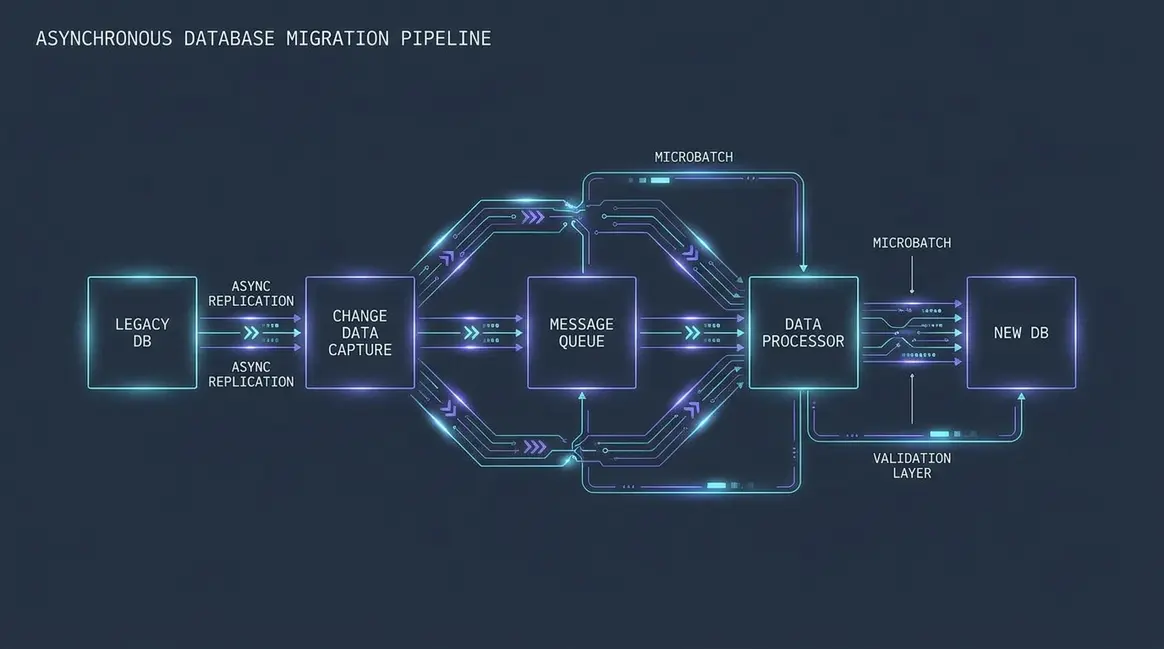
Table of Contents
- The economic reality of maintenance windows: SLA degradation and transaction dropoffs
- Decoupling schema evolution: The deterministic expand-contract pattern
- Asynchronous change data capture: Eliminating dual-write race conditions
- Shadow traffic validation: Verifying data parity without customer impact
- Database migration operational telemetry: Latency, locking, and system throughput
- Tenant-isolated multi-tenant strategies: Partitioned schema operations at scale
- The cutover and rollback state machine: Automated circuit breakers and zero-loss failover
- Engineering efficiency and margin protection: The B2B SaaS business case
The economic reality of maintenance windows: SLA degradation and transaction dropoffs
Scheduled maintenance windows are an operational relic of monolithic infrastructure that directly conflict with high-velocity SaaS economics. In continuous, globally distributed software environments, enterprise customer contracts consistently mandate availability exceeding 99.995%—a operational threshold that permits less than 2.19 minutes of total monthly downtime across all production components. Accepting deliberate outages to patch schemas ignores the compounding enterprise cost of downtime, triggering customer-facing failures, eroding net revenue retention (NRR), and immediately incurring contractual service credit penalties.
Lock Contention and Upstream Timeout Cascades
The operational degradation of legacy maintenance routines stems directly from synchronous database locking semantics. In PostgreSQL, routine schema modifications—such as adding specific constraints or running non-concurrent index creations—require an ACCESS EXCLUSIVE lock. In MySQL, equivalent updates require restrictive Metadata Locks (MDL). While the DDL statement waits for active read transactions to complete before acquiring the lock, it simultaneously blocks all incoming read and write transactions behind it in the lock queue.
This queue blockage collapses operational throughput within seconds:
- Connection Pool Exhaustion: Ingress worker threads in application connection pools (e.g., PgBouncer, HikariCP) stall instantly, exhausting available allocations within 300ms to 800ms.
- Latency Wall: Application p99 latency spikes past 5,000ms as transactional queues back up behind blocked tables.
- Cascading Timeouts: Edge load balancers and ingress reverse proxies reach read timeout limits, converting transaction queues into continuous streams of HTTP 504 and 503 errors.
Without strict, resilient error handling boundaries across service boundaries, this queue saturation propagates upstream, taking down adjacent microservices and generating systemic service blackouts.
The Mathematical Formula of Downtime Blast Radius
Modern Database Migration Ops treats database downtime not as an abstract engineering inconvenience, but as an explicit balance-sheet liability. The financial exposure of degraded migration windows can be modeled via the following transactional impact formula:
Cost = (R_tx * T_lock * V_tx) + (MRR * SLA_credit) + (ARR_exposed * Churn_prob)
- R_tx * T_lock * V_tx: The raw transactional volume permanently dropped, calculated as incoming transaction rate (
R_tx) multiplied by total lock acquisition and execution duration (T_lock), scaled by average transactional lifetime value (V_tx). - MRR * SLA_credit: Contractual SLA reimbursement penalties, triggered the moment monthly availability dips below tier limits (e.g., 10% to 50% monthly recurring revenue credits when breaching four-nines commitments).
- ARR_exposed * Churn_prob: Enterprise contract degradation risk, where high-value accounts encountering platform unreliability during business-critical workflows actively exit at renewal cycles.
Synchronous schema updates halt database availability to modify physical disk structures in place. Modern architectures avoid this entirely by switching to non-blocking, multi-phase state transitions—leveraging the expand-contract pattern, transient dual-writes, and decoupled background worker synchronization. In enterprise cloud infrastructure, scheduled database downtime is no longer an unavoidable operational reality; it is an architectural design flaw.
Decoupling schema evolution: The deterministic expand-contract pattern
Direct schema mutations on high-traffic database engines introduce catastrophic exclusive locks (ACCESS EXCLUSIVE), which cascade across connection pools and tank active transactions. In modern Database Migration Ops, zero-downtime execution relies on the expand-contract pattern—a multi-stage release mechanism that decouples database physical storage structures from application software releases.
Phase 1: Expand (Additive Non-Breaking Primitives)
The expand phase guarantees backward compatibility across all active database consumers. You must never introduce breaking constraints, non-nullable columns without defaults, or synchronous blocking indexes against live tables. Any structural additions must be completely invisible to current legacy readers while establishing the target state for future writes.
-- Step 1: Add target column as nullable to bypass full-table rewrites
ALTER TABLE billing_subscriptions
ADD COLUMN payment_token_v2 VARCHAR(255) DEFAULT NULL;

-- Step 2: Build performance primitives without table lockouts
CREATE INDEX CONCURRENTLY idx_billing_subscriptions_token_v2
ON billing_subscriptions(payment_token_v2);
By defining the new column as NULL, PostgreSQL registers the schema change in the catalog in sub-millisecond time without rewriting physical table pages. Executing index creation via CONCURRENTLY forces the database engine to run two separate table scans without holding write locks, sustaining sub-50ms query latencies throughout the build cycle.
Phase 2: Dual-Write Abstraction and Progressive Routing
Once the target storage primitives exist, the system transitions to dual-write execution. Application services write asynchronously to both the legacy structure and the new structure while continuing to read exclusively from the legacy pathway. This transition is managed at runtime using dynamic progressive feature flags, allowing engineering teams to route 1% to 100% of write traffic through validation paths without redeploying application code.
-- Dynamic trigger fallback ensures zero data loss during partial fleet deploys
CREATE OR REPLACE FUNCTION sync_payment_token_v2()
RETURNS TRIGGER AS $$
BEGIN
    IF NEW.payment_token_v2 IS NULL AND NEW.payment_token IS NOT NULL THEN
        NEW.payment_token_v2 := 'tok_' || encode(sha256(NEW.payment_token::bytea), 'hex');
    END IF;
    RETURN NEW;
END;
$$ LANGUAGE plpgsql;

CREATE OR REPLACE TRIGGER trg_sync_payment_tokens
BEFORE INSERT OR UPDATE ON billing_subscriptions
FOR EACH ROW
EXECUTE FUNCTION sync_payment_token_v2();
During this intermediate stage, an asynchronous background worker (such as an automated n8n batch worker or a managed queue consumer) backfills legacy rows into the new column schema. The data pipeline logs verification checks; only when zero-drift metrics reach 99.999% parity across both columns is the read path toggled via the configuration layer to payment_token_v2.
Phase 3: Contract (Pruning and Structural Finalization)
The contract phase finalizes the architecture once telemetry confirms zero read/write operations touch the legacy field:
- Deprecate Triggers: Remove operational synchronization triggers to eliminate compute overhead and reclaim write throughput.
- Enforce Constraints: Validate constraints asynchronously (e.g.,
ALTER TABLE ... ADD CONSTRAINT ... NOT VALID, followed byVALIDATE CONSTRAINT) to avoid serial table locks. - Prune Legacy Columns: Execute the final teardown by dropping deprecated columns and unused legacy indexes.
-- Detach intermediate sync infrastructure
DROP TRIGGER IF EXISTS trg_sync_payment_tokens ON billing_subscriptions;
DROP FUNCTION IF EXISTS sync_payment_token_v2();

-- Drop the legacy column safely after read-path validation confirms zero queries
ALTER TABLE billing_subscriptions DROP COLUMN payment_token;
This deterministic sequence transforms a high-risk schema migration into an isolated, measurable, and completely reversible operational deployment.
Asynchronous change data capture: Eliminating dual-write race conditions
Executing dual-writes within stateless application runtimes represents the most pervasive architectural flaw in modern Database Migration Ops. When application threads attempt to commit sequentially to both primary and target datastores, they invariably encounter non-deterministic network partitions, divergent execution latencies, and uncoordinated retry storms. A network blip during the secondary write leaves the primary updated while the replica silently drifts out of sync. Compounding this, out-of-order execution across horizontally scaled runtime instances guarantees that an earlier transaction can commit after a later state update, introducing irreversible data corruption without throwing fatal errors to upstream clients.
Log-Centric Extraction via Write-Ahead Log Engines
Eliminating dual-write race conditions requires decoupling synchronization from runtime logic entirely by offloading capture to the database engine's write-ahead log (WAL). Change Data Capture (CDC) utilizes logical decoding plugins—such as PostgreSQL's native pgoutput paired with Debezium connectors—to serialize committed state changes sequentially into an immutable, strictly ordered event stream. Because the transaction log commits mutations atomically prior to disk flush, WAL-based CDC guarantees zero-data-loss extraction. This architecture mirrors the high-reliability protocols deployed in continuous record replication, where downstream consumers process state transitions deterministically using Log Sequence Numbers (LSN) rather than fallible application-level timestamps.
Pipeline Topology, Backpressure, and Tombstone Ingestion
A resilient transaction streaming architecture requires strict isolation between log extraction and target consumption. Interposing a decoupled streaming broker architecture between Debezium ingestion workers and target consumers insulates both database tiers from load spikes while unlocking granular flow control.
To ensure high data integrity without degrading production write availability, engineering teams must calibrate specific operational guardrails:
- Replica Lag Thresholds: Maintain an end-to-end replication lag target of under 50ms. If processing lag crosses a 200ms circuit-breaker threshold, the ingestion layer must apply dynamic backpressure to throttle extraction workers and prevent consumer node memory exhaustion.
- Idempotent Sink Upserts: Downstream database consumers must structure mutations using deterministic upserts keyed against transaction metadata (
source_ts_msand LSN sequence numbers) to withstand inevitable at-least-once network delivery retries. - Tombstone Event Lifecycle: When upstream
DELETEstatements occur, the CDC pipeline must emit an explicit tombstone message featuring a null payload coupled to the primary key. This instructs the consumer to purge the replica record cleanly while pruning foreign-key dependents without leaving orphan references.
Shadow traffic validation: Verifying data parity without customer impact
Executing zero-downtime cutovers without an empirical validation layer is reckless engineering. Before repointing DNS records or mutating connection pools, high-throughput systems require an isolated verification harness to stress-test target schemas under real-world access patterns. In modern Database Migration Ops, this begins by mirroring incoming production read queries using a layer-7 reverse proxy or eBPF-based traffic duplication, routing payloads concurrently to both the legacy cluster and the target instance.
Deterministic Diff Engines and Convergence Thresholds
Mirroring alone does not ensure correctness. The traffic layer must tee read queries through an inline diff engine that normalizes timestamps, strips dynamic query noise, and performs byte-for-byte response comparisons. To qualify a target cluster as cutover-ready, the system must satisfy rigorous mathematical convergence criteria over a sustained 72-hour window:
- Constraint Invariance: Zero divergence across primary, foreign key, and unique constraints under concurrent read-write load.
- Cryptographic Row Parity: 100% hash parity on row representations calculated via deterministic hashing algorithms (such as streaming MD5 or xxHash64 over ordered column tuples).
- Execution Plan Stability: Cache hit ratios exceeding 99% and index hit ratios maintaining parity with legacy baselines, preventing unindexed queries from cascading into connection starvation upon cutover.
Drift Detection via Asynchronous Polling Loops
Logical replication streams are inherently susceptible to micro-drift—transient desynchronizations caused by schema migrations, dropped serialization locks, or out-of-order event ingestion. Rather than executing synchronous checks that degrade query response budgets, robust architectures offload this scrutiny to background verification workers.
These background workers poll change-data-capture (CDC) watermarks, computing checksums across partitioned key ranges. When orchestrating automated remediation sequences across distributed nodes, modern teams leverage an asynchronous verification loop architecture to repeatedly poll ingestion lag metrics, quarantine divergent rows into dead-letter tables, and trigger self-healing sync events before cutover execution.
| Verification Metric | Acceptable Variance | Telemetry Source |
|---|---|---|
| Row Hash Checksum | 0.000% | Deterministic Partition Scans |
| Replication Watermark Lag | < 50ms | WAL / CDC Consumer Offsets |
| Index Hit Ratio Delta | < 0.5% | pg_stat_user_indexes |
Automating this feedback loop eliminates human error from the migration gate. By coupling continuous traffic shadowing with deterministic data hashing, you transform high-risk database migrations into deterministic, measurable transitions.
Database migration operational telemetry: Latency, locking, and system throughput
Executing schema shifts on multi-terabyte transactional datastores without measurable degradation requires treating Database Migration Ops as a distributed telemetry discipline rather than a discrete maintenance script. When operational workloads process thousands of queries per second, the legacy pattern of applying blocking in-place Data Definition Language (DDL) creates an immediate cascading failure across the ingress layer. Autonomous zero-downtime protocols decouple schema transformation from transactional paths using Change Data Capture (CDC) and dual-writing verification pipelines.
Five-Dimensional Operational Variance: In-Place DDL vs. Autonomous Protocols
The delta between traditional schema modifications and modern, automation-governed execution becomes visible across five specific operational dimensions:
| Operational Dimension | Legacy In-Place DDL | Autonomous Zero-Downtime Protocol |
|---|---|---|
| Lock Duration | Exclusive ACCESS EXCLUSIVE lock held for up to 900 seconds during table rewrites or heavy index generation. | Transient acquisition of transactional locks strictly bounded to <5 milliseconds via defensive timeouts. |
| Query Latency Spikes | p99 latencies cascade past 30,000 milliseconds as connection pools backlog behind pending locks. | p99 variance restricted to <2 milliseconds relative to the baseline production envelope. |
| Replica Lag | Surges unpredictably across read replicas due to heavy single-threaded WAL replay bottlenecks. | Synchronous replica lag maintained under 100 milliseconds using backpressure-aware row batching. |
| Transaction Abort Rate | Exceeds 85% during lock contention windows due to application-level driver timeouts and deadlocks. | Sustained at 0.00% under normal operation, backed by automated application-side retry strategies. |
| CPU Overhead | Saturates primary database compute at 100% capacity, starving competing client workloads. | Governed background workers throttle consumption to an engineered ceiling of <15% total CPU capacity. |
In traditional setups, a standard column addition with a non-constant default value or an unindexed foreign key validation commands a table-level exclusive lock. If background transactions take 120 seconds to drain, the incoming DDL request queues behind them in the engine lock table. In turn, every subsequent SELECT, UPDATE, and INSERT queues behind the DDL request, instantly saturating thread limits. The autonomous approach inverts this risk by executing zero-downtime operations under an explicit configuration rule: SET lock_timeout = '5ms';. If the required lock cannot be acquired within 5 milliseconds, the execution plan immediately aborts, backs off with exponential jitter, and yields execution priority to tenant workloads.
Connection Pool & Telemetry Instrumentation: PgBouncer to Query Planner
Visibility into these transitions requires unified telemetry spanning connection orchestration, pool saturation, and query planner queuing states. In modern growth-stage infrastructures, database instances must run in front of a fine-tuned connection pooler such as PgBouncer utilizing pool_mode = transaction.
Telemetry pipelines monitor three critical surface areas to prevent silent degradation:
- PgBouncer Client Queue Depth (
cl_waiting): An immediate early indicator of schema-induced lock queuing. Ifcl_waitingmoves above zero during an automated migration phase, ingress traffic is pausing at the pool layer. - Engine Lock Graph Observability (
pg_stat_activity): Real-time tracing of queries wherewait_event_type = 'Lock'. Automated orchestrators dynamically parse the blocker-waiter tree to detect if a background schema backfill thread is holding resources needed by customer-facing requests. - Query Plan Stability (
pg_stat_statements): Telemetry checks verify that creating a new shadow table or migrating primary indexes does not induce unintended index invalidation or plan regressions, preventing transient full-table scans.
By wiring database metrics directly into an automated execution loop—combining telemetry collection with automated webhook triggers in platforms like n8n—the infrastructure can automatically terminate and postpone background migration sync batches the millisecond application latency breaches operational SLOs.
Tenant-isolated multi-tenant strategies: Partitioned schema operations at scale
Scaling schema evolution across distributed enterprise B2B platforms breaks down when teams treat the database tier as a monolithic, shared state. In high-concurrency environments with logically partitioned clusters or schema-per-tenant topologies, initiating a global operational freeze to execute DDL statements is an unacceptable anti-pattern. Modern Database Migration Ops enforce complete tenant isolation, decomposing database evolution into progressive, independently verifiable unit operations that mitigate systemic blast radius.
Edge Routing and Dynamic Credential Interception
Executing schema transformations without service degradation requires shifting pool orchestration upstream to the network edge. Instead of routing traffic directly to static application connection pools, edge proxies (such as Cloudflare Workers or Envoy sidecars) evaluate signed tenant routing tokens embedded within session JWTs or mTLS handshake metadata. These tokens dictate the tenant schema version and direct queries to the corresponding isolated partition or schema namespace.
- Dual-Pool Hot Swapping: The edge proxy maintains parallel connection pools for baseline schema (v1) and updated schema (v2). When a tenant migration completes, proxy routing tables flip the target connection pool in under 15ms without dropping active TCP connections.
- Dynamic Credential Leasing: Ephemeral database credentials minted via HashiCorp Vault or AWS Secrets Manager restrict the migration runner's scope exclusively to the specific tenant schema, preventing cross-tenant leakage during DDL execution.
- Write Buffer Staging: Incoming mutation traffic during transient lock acquisitions (such as unique index builds) is buffered at the ingress proxy layer and drained asynchronously immediately after validation.
Phased Canary Migrations and Automated Verification
Eliminating upgrade risk depends on canary tenant sequencing. Instead of rolling out changes to all clusters simultaneously, migrations are orchestrated through programmatic deployment rings: synthetic test tenants first, followed by internal dogfooding accounts, low-tier tenants, and finally enterprise SLA accounts. Automated pipelines orchestrated through platforms like n8n evaluate real-time error budgets, p99 query latency regressions, and replication lag before promoting downstream tenant tiers.
For organizations scaling account-per-tenant serverless architectures, this phased isolation allows teams to pinpoint edge-case query plan degradations in a single tenant sandbox without threatening platform-wide uptime.
Compliance Guardrails: SOC2 and HIPAA Partition Rigor
Altering multi-tenant partitions in regulated environments introduces strict compliance boundaries. Both SOC2 Type II trust principles and HIPAA security rules require cryptographically verifiable data segregation throughout maintenance windows. Performing concurrent schema rewrites cannot bypass Row-Level Security (RLS) policies or schema-level access control lists.
- Deterministic Audit Trails: Schema modifications must record cryptographically signed migration logs per tenant, documenting the precise DDL payload, execution window, and cryptographic tenant identifier.
- Zero Cross-Contamination: Ephemeral migration containers must execute within isolated network namespaces, ensuring that intermediate shadow tables generated during online schema migrations (like
pt-online-schema-changeorgh-ost) strictly inherit the primary partition's encryption keys and access limits. - Automated Rollback Safeguards: In the event of schema mutation failure, canary pipelines immediately execute idempotent downgrade triggers, purging transient staging partitions without mutating or exposing existing customer data.
The cutover and rollback state machine: Automated circuit breakers and zero-loss failover
Executing an atomic cutover during live production workloads represents the highest-risk phase of Database Migration Ops. To transition traffic without connection drops, transactional corruption, or measurable user disruption, the cutover must function as a deterministic, finite state machine where every state transition is monitored, verified, and reversible in sub-second intervals.
Atomic Traffic Re-Pointing Under 10 Milliseconds
Relying on DNS-level record updates for database cutovers introduces uncontrolled propagation lag due to client-side caching and ISP resolver overrides. Modern architectures decouple client connections from physical storage engines through high-performance connection routing proxies such as Envoy, PgBouncer, or ProxySQL, coupled with edge compute middleware.
The cutover orchestration proceeds through strict sequential phases:
- Write Quiescence: The routing proxy enters a fractional pause state, buffering incoming
WRITEqueries at the proxy socket level for a maximum window of 10 milliseconds rather than rejecting them. - Replication Flush: Edge middleware validates that the forward Change Data Capture (CDC) stream has drained to zero lag, ensuring that the target schema matches the source engine at the precise Log Sequence Number (LSN).
- Socket Repointing: The proxy dynamically swaps its upstream backend pool configuration to target the modernized cluster. Buffered
WRITEtransactions are then immediately released against the new primary.
This sequence drops total cutover latency below 10 milliseconds, preventing broken TCP connections and eliminating HTTP 500-series spikes at the client boundary.
Bidirectional Sync: The Reverse CDC Safety Net
Zero-loss migration models treat rollbacks not as edge cases, but as first-class, pre-provisioned operational pathways. To eliminate the risk of split-brain anomalies or irreversible data divergence post-cutover, a reverse CDC pipeline must be initialized before traffic is redirected.
The moment the modernized database assumes the primary role, automation pipelines (triggered via orchestration frameworks like n8n listening to migration state webhooks) instantly reconfigure the replication topology. Debezium connectors or native logical replication workers capture transactions committed to the newly promoted database, transform them to match legacy constraints, and stream them back to the original engine.
By keeping the legacy database warm as a downstream replica, the engineering team preserves a sub-second, zero-loss rollback route. Should application-layer bugs or edge-case schema regressions surface hours post-switchover, traffic can be redirected back to the original instance without losing data generated by users during the active window.
Automated Circuit Breakers and Abort Thresholds
Human decision-making introduces fatal latency during catastrophic regressions. Production-grade cutovers must rely on automated circuit breakers governed by strict, non-negotiable metric telemetry.
| Telemetry Metric | Trip Threshold | Automated Response |
|---|---|---|
| Read Latency (P99) | > 200ms sustained for 30 seconds | Trip circuit breaker; abort cutover; route queries to original engine. |
| Write Buffer Backpressure | > 1,000 uncommitted records in 60s | Terminate proxy buffering; restore legacy backend; log LSN delta. |
| Transaction Error Rate | > 0.05% HTTP 5xx / Query Exceptions | Trigger automatic revert sequence via reverse CDC replication target. |
If any automated threshold is violated within the verification window, the state machine triggers an immediate abort protocol. The routing proxies pivot back to the original topology, buffered operations are resolved, and the system restores baseline performance parameters before user experience degrades.
Engineering efficiency and margin protection: The B2B SaaS business case
For executive leadership in high-scale B2B SaaS, database schema evolutions and version cutovers are rarely viewed through an architectural lens—they are evaluated through the prism of unit economics, net revenue retention (NRR), and risk mitigation. Treating schema deployments as manual, disruptive maintenance windows introduces an unsustainable OPEX drag. Modernizing this workflow into deterministic Database Migration Ops transforms a high-liability engineering chore into a programmatic lever for enterprise expansion and gross margin preservation.
Eliminating the Hidden OPEX of After-Hours Maintenance
The traditional approach of executing schema changes during "low-traffic" weekend windows carries an exorbitant, rarely accounted operational cost:
- Engineering Fatigue and Attrition: Tying principal and staff engineers to 2:00 AM maintenance shifts triggers severe cognitive fatigue, directly degrading product velocity during core business hours and inflating compensation via unscheduled on-call premiums.
- Rollback Complexity: Unplanned schema lockups that occur during manual windows routinely require emergency remediation, burning hundreds of high-value engineering hours on incident post-mortems and ad-hoc data reconstruction.
- Autonomous Reliability: By decoupling database evolution from traffic lows through forward-compatible, dual-write migrations orchestratable via CI/CD and automation backbones (such as automated validation runners and telemetry-triggered event pipelines), organizations eliminate the need for heroic human intervention entirely.
Margin Protection: Metering Continuity and SLA Preservation
High-growth SaaS valuation multiples depend on maintaining 85% to 90%+ gross margins. Operational degradation during database cutovers directly erodes this metric across two critical financial fronts:
First, modern usage-based and hybrid monetization models rely on continuous, real-time ingestion pipelines. If an event collector stalls due to table locks or database connection shedding during a naive column migration, event records either queue indefinitely or drop. Dropped telemetry translates immediately to unbillable consumption—a pure, unrecoverable gross margin leakage. Maintaining deterministic zero-downtime workflows ensures that billing instrumentation remains 100% loss-free.
Second, capturing enterprise logos with annual contract values (ACV) exceeding $100,000 necessitates contractual commitments of 99.99% ("four nines") availability. Under a 99.99% SLA, your permissible cumulative downtime across an entire year is precisely 52.6 minutes. A single stalled lock acquisition or index build that blocks thread pools for 15 minutes consumes nearly 30% of your annual error budget, triggering financial service credits, contract breach penalties, and catastrophic erosion of executive trust.
Institutionalizing zero-downtime Database Migration Ops is not an engineering luxury; it is the infrastructure baseline required to defend enterprise gross margins and systematically win security-conscious, SLA-sensitive accounts.
Production engineering leaves no room for speculative database operations. If your infrastructure still requires scheduled maintenance windows, you are exposing your business to unforced operational vulnerabilities and SLA penalties. I engineer database topologies to survive continuous schema evolution without transaction drops or margin degradation. To eliminate your operational risk and benchmark your data tier against 2026 resilience standards, request a targeted architectural audit to harden your SaaS infrastructure.
Memo Strategici Correlati
Tutti i Memo →Web scraping infrastructure: Engineering resilient proxy meshes and automated captcha neutralization for intent scouring
Traditional web scraping architectures are fundamentally broken. Engineering teams still deploying naive headless Puppeteer instances across static datacente...
Engineering deterministic viral loops: Architectural blueprint for powered-by badges and distribution hooks
Client acquisition cost (CAC) inflation has rendered top-of-funnel paid media mathematically unviable for modern B2B SaaS. Relying on discretionary referral ...
Vuoi implementare questa architettura nella tua pipeline?
Evita i lunghi cicli di vendita e le infinite call di scoperta. Invia il tuo collo di bottiglia di acquisizione o conversione per una diagnosi tecnica approfondita in asincrono.