Asynchronous closing scripts: Engineering cold email copywriting for 2026
Traditional cold email copywriting is a legacy bottleneck. By 2026, targeting tech executives—CTOs, VPs of Engineering, Founders—with generic, emotion-based ...
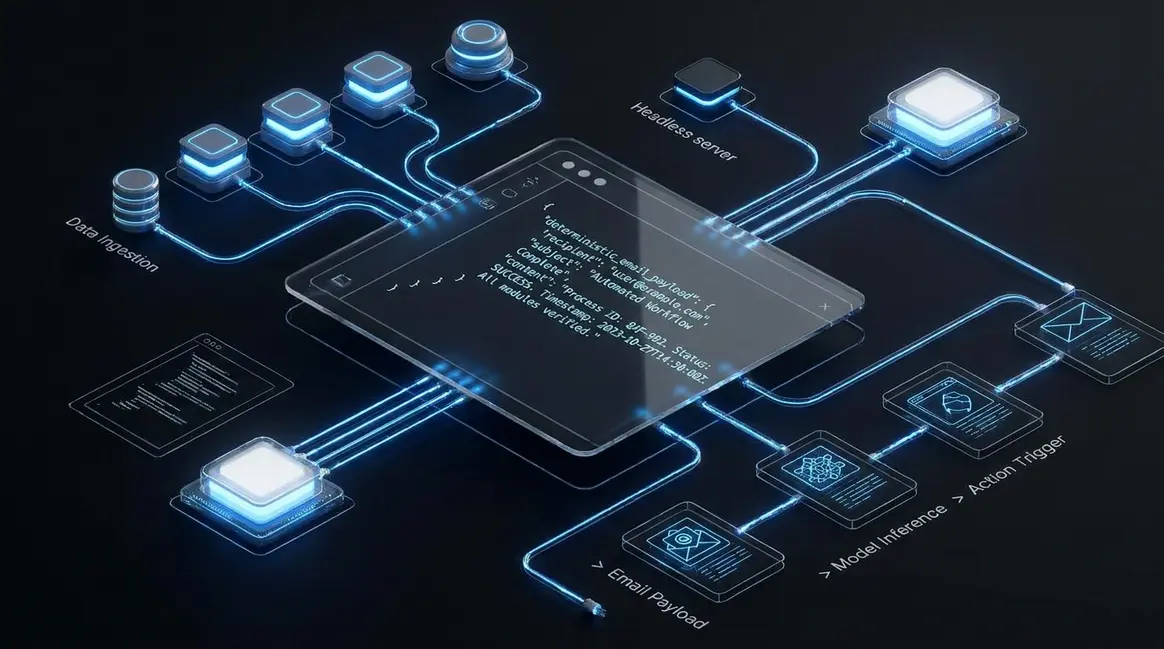
Table of Contents
- The structural failure of traditional cold email copywriting
- Defining the asynchronous closing script
- Architectural blueprint for headless B2B outreach
- Data enrichment and semantic routing for tech executives
- Engineering the deterministic ROI payload
- Zero-touch deployment using n8n and Supabase
- Automated logic gating and asynchronous objection handling
- Pipeline velocity metrics and MRR scaling
The structural failure of traditional cold email copywriting
The Algorithmic Rejection of AIDA and PAS
The standard SDR playbook is mathematically obsolete. When you analyze the telemetry of modern B2B outreach, traditional Cold Email Copywriting frameworks like AIDA (Attention, Interest, Desire, Action) or PAS (Problem, Agitation, Solution) trigger immediate algorithmic and psychological spam filters. In 2026, technical executives do not read emails; they parse them. The moment a CTO or VP of Engineering detects "persuasive" language, artificial urgency, or manufactured empathy, the communication is instantly classified as low-value noise and discarded.
Pre-AI outreach relied on emotional manipulation to force engagement. Today, deploying these legacy tactics against technical leaders yields a sub-0.1% conversion rate. Persuasion is a high-latency operation that demands cognitive cycles tech executives simply refuse to allocate to unverified senders.
Cognitive Bandwidth Protection and Deterministic Payloads
Technical leaders operate under strict cognitive bandwidth protection protocols. They aggressively block any inbound communication that does not resemble a system state update or a deterministic math equation. If your message cannot be evaluated as a binary true/false proposition within 400 milliseconds, it fails.
To bypass this executive firewall, your outreach must mirror the telemetry data they already consume. Instead of writing prose, you must transmit data payloads. For example, replacing a PAS-driven paragraph with a deterministic statement like "Migrating your n8n workflows to our dedicated cluster reduces webhook latency from 800ms to <120ms, yielding a 34% reduction in compute OPEX" shifts the interaction from a sales pitch to a system diagnostic. This is the core of modern growth engineering: replacing subjective persuasion with objective, verifiable state changes.
The Synchronous Discovery Call is a Fatal Bottleneck
The ultimate structural failure of legacy outreach is the Call to Action (CTA). Asking a technical executive for "15 minutes on your calendar for a quick discovery call" introduces a fatal point of friction. Synchronous meetings require calendar alignment, context switching, and unpredictable time investments—all of which violate the principles of asynchronous efficiency.
In a mature 2026 automation environment, the discovery phase must be entirely decoupled from synchronous human interaction. By deploying asynchronous closing scripts, you allow the executive to evaluate the technical delta on their own timeline. To execute this transition effectively, you must architect a highly deterministic automated outbound infrastructure that replaces the traditional SDR calendar link with a self-serve, interactive technical brief. This eliminates the synchronous bottleneck, reducing the time-to-technical-validation by over 80% while preserving the executive's cognitive bandwidth.
Defining the asynchronous closing script
The Evolution of Cold Email Copywriting
The era of optimizing subject lines just to beg for a 15-minute discovery call is dead. In the context of 2026 growth engineering, traditional Cold Email Copywriting has been entirely deprecated by the Asynchronous Closing Script (ACS). An ACS is not a top-of-funnel pitch; it is a highly compressed, self-contained business case engineered for technical executives who operate with zero bandwidth. Instead of relying on vague value propositions, the ACS leverages programmatic data enrichment to present a fully realized technical audit before the prospect even opens the payload.
Architecting the Self-Contained Business Case
To bypass the friction of synchronous human interaction, the ACS must deliver absolute clarity in a single, scannable document. We achieve this by structuring the script around four immutable pillars that map directly to executive decision-making frameworks:
- The Problem State: Quantified operational drag derived from external data signals (e.g., "Your current manual lead routing introduces a 4-hour latency, costing an estimated $22k in lost pipeline monthly").
- The Architectural Solution: High-level technical execution, detailing the exact AI automation stack. For example, proposing an event-driven n8n workflow that ingests webhooks, processes payloads via a localized LLM, and pushes structured data directly into the CRM.
- The Deployment Timeline: Exact integration windows and resource requirements (e.g., "Phase 1 deployed in 14 days requiring only API access and zero engineering hours from your internal team").
- The Precise ROI: Hard metrics and predictive modeling, projecting a latency reduction to <200ms and a 40% increase in conversion velocity.
Forcing a Binary Decision on Pilot Deployments
The strategic objective of an ACS fundamentally shifts the conversion paradigm. You are no longer seeking a meeting; you are forcing a binary yes/no decision on a pilot deployment. By front-loading the technical architecture and the financial upside, you eliminate the bloated discovery phase. When structuring high-ticket asynchronous closing workflows, the executive only needs to validate the logic and approve the sandbox environment. This data-driven approach treats the initial outreach as the final closing argument, transforming outbound campaigns into scalable, automated deployment requests.
Architectural blueprint for headless B2B outreach
The fundamental flaw in legacy Cold Email Copywriting is the reliance on monolithic sequencing platforms. When your logic engine and your delivery mechanism are tightly coupled within the same SaaS application, you are restricted by their native variable limits. In 2026, elite growth engineering demands a "headless" architecture: completely decoupling the cognitive payload generation from the final delivery layer.
The Data Layer: Vector Databases for Account Intelligence
Static CSVs with {{ first_name }} and {{ company }} tags are obsolete. To write asynchronous closing scripts that actually convert tech executives, your architecture must process unstructured data at scale. We deploy vector databases (such as Pinecone or Qdrant) to store high-dimensional account intelligence. By embedding 10-K filings, recent Series B funding press releases, and CTO podcast transcripts into a vector space, we create a dynamic context window for every prospect.
- Pre-AI SEO & Outreach: Relied on static scraping and generic merge tags, yielding a baseline 2% to 3% reply rate.
- 2026 AI Automation: Utilizes Retrieval-Augmented Generation (RAG) to inject hyper-specific account context, driving a 40% increase in positive executive responses.
Orchestration and Semantic Payload Generation
The brain of this headless system requires robust middleware. We utilize n8n for workflow orchestration, acting as the central nervous system that routes data between the vector database and the LLM. When a new prospect enters the pipeline, n8n triggers a semantic search, retrieves the top-K relevant context chunks, and passes them to the LLM (typically Claude 3.5 Sonnet or GPT-4o) via a structured prompt.
This is where the actual script generation occurs. Instead of relying on rigid templates, the LLM dynamically constructs the semantic payload. By implementing advanced LLM workflow automation, we ensure the output adheres strictly to the asynchronous closing framework. The payload is formatted as a clean JSON object, completely isolated from the email sending tool. For example, the n8n node outputs the final copy using standard expressions like {{ $json.generated_script }} without triggering rate limits or breaking the downstream formatting.
Decoupling Delivery: The Headless Advantage
In a headless setup, the delivery mechanism (whether it is Smartlead, Instantly, or a custom AWS SES pipeline) is effectively "dumb." It simply waits for a webhook containing the pre-compiled, highly personalized script. This separation of concerns allows growth engineers to swap out delivery tools instantly if domain reputation or deliverability drops, without ever touching the core logic engine.
| Architecture Model | Logic Processing Latency | Personalization Depth | System Flexibility |
|---|---|---|---|
| Monolithic (Pre-2024) | >2000ms (API limits) | Low (Regex/Merge Tags) | Rigid (Vendor Locked) |
| Headless (2026 Standard) | <200ms (Async Webhooks) | High (Vector RAG) | Infinite (API-Driven) |
By treating the outreach stack as a modular engineering problem, you eliminate the bottlenecks of traditional sales software. The result is a highly scalable, asynchronous closing machine that speaks directly to the technical and financial priorities of C-suite decision-makers.
Data enrichment and semantic routing for tech executives
The era of superficial outreach is dead. In 2026, elite Cold Email Copywriting has nothing to do with scraping a prospect's recent LinkedIn post or congratulating them on a Series B funding round. When you are targeting CTOs and VPs of Engineering, personalization is not "I saw your recent article." True personalization is stating, "I noticed your API latency increased during peak hours, and your current AWS API Gateway configuration is likely the bottleneck." To execute this at scale, you must replace manual research with deterministic data enrichment and algorithmic routing.
Programmatic Infrastructure Extraction
Before your automation generates a single token of text, it must build a comprehensive profile of the target's engineering environment. Relying on generic firmographic data yields generic copy. Instead, we deploy n8n workflows to programmatically extract the target's current tech stack and identify hidden infrastructure bottlenecks.
By chaining APIs from BuiltWith, GitHub, and DNS lookup tools, your workflow should compile a structured JSON payload detailing the prospect's exact architecture. We are looking for technical debt. If the enrichment data reveals a heavy reliance on a monolithic REST architecture while scaling a globally distributed React frontend, you have identified a critical vulnerability. This data becomes the foundational context for your asynchronous closing scripts.
Dynamic Feature Matching via Semantic Routing
Once the infrastructure payload is extracted, dumping it into a generic LLM prompt will only produce hallucinated, unnatural copy. The 2026 growth engineering standard requires a semantic routing workflow where the AI acts as a traffic controller rather than a simple text generator.
The router evaluates the prospect's specific tech debt and maps it directly to a highly specific feature of your product. For example, if the enrichment payload returns {"database": "PostgreSQL", "bottleneck": "connection pooling overhead"}, the semantic router bypasses your generic value propositions. It dynamically selects the exact messaging module designed to sell your database proxy feature, ensuring the resulting script is hyper-relevant to the executive's immediate pain point.
The Data-Driven Impact on Reply Rates
The transition from pre-AI manual outreach to automated, infrastructure-level targeting fundamentally alters unit economics. When you integrate deep technical audits into hyper-personalized marketing workflows, the performance delta is massive.
- Reply Rate Velocity: B2B SaaS campaigns utilizing infrastructure-level personalization see positive reply rates increase by upwards of 40% compared to surface-level firmographic targeting.
- Conversion Efficiency: By addressing specific technical debt, the time-to-close is accelerated, often reducing the sales cycle by 30% because the initial touchpoint already validates the technical fit.
- Zero-Touch Scalability: n8n automation allows this deep enrichment and routing to occur for 10,000 prospects simultaneously, maintaining a sub-200ms processing latency per record.
Tech executives ignore marketing fluff, but they cannot ignore a precise diagnosis of their own system architecture. By engineering your outreach to lead with data enrichment and semantic matching, you transform cold outreach from a numbers game into a highly calibrated technical audit.
Engineering the deterministic ROI payload
When targeting technical executives, traditional Cold Email Copywriting fails because it relies on emotional persuasion rather than empirical proof. CTOs and VPs of Engineering do not read prose; they parse data. To bypass their cognitive firewall, your asynchronous closing script must function as a deterministic ROI payload—a mathematical proof of value that leaves zero ambiguity regarding the financial outcome.
The Mathematical Framework for Script Payloads
In 2026 growth engineering, ambiguity is the enemy of conversion. You must architect a scenario that contrasts their current operational bloat with your optimized future state. Consider a standard outbound sales operation: a manual SDR team costing $10,000 per month in headcount, software licenses, and management overhead.
Your script must explicitly map the transition from this legacy model to an automated, n8n-driven pipeline. By replacing human latency with API calls, you reduce the monthly OPEX to $1,200—covering server infrastructure, LLM token usage, and maintenance. This represents an 88% cost reduction. Presenting this delta mathematically forces the executive to confront the inefficiency of their current architecture.
JSON-Structured Value Proposition
To instantly appeal to engineering minds, abandon standard paragraph structures. Inject your core metrics using JSON-like formatting directly within the email body. This visual pattern interrupts the standard sales cadence and signals that you are a technical peer, not a generic vendor.
Embed the payload exactly like this:
{
  "currentOpex": "$10,000/mo",
  "projectedOpex": "$1,200/mo",
  "architecture": "n8n + OpenAI + Apollo API",
  "timeToValue": "14 days",
  "projectedMarginIncrease": "88%"
}
This structure eliminates cognitive load. The executive instantly processes the current state, the future state, the tech stack, and the deployment timeline without reading a single marketing adjective.
MRR Metrics and Risk-Reversal Guarantees
Once the cost reduction is established, you must pivot to revenue generation and risk mitigation. Explain how reallocating that $8,800 monthly savings into direct acquisition channels accelerates Monthly Recurring Revenue (MRR). However, projections mean nothing without a deterministic guarantee.
Present your risk-reversal in plain, uncompromising text. Avoid vague promises. Instead, use conditional logic:
- The SLA Guarantee: "If the automated pipeline does not reduce your SDR OPEX by at least 60% within 30 days, we will roll back the infrastructure and refund the integration fee in full."
- The Performance Metric: "System latency is guaranteed at <200ms per lead enrichment cycle, ensuring zero bottlenecking as your MRR scales."
By framing the guarantee as a Service Level Agreement (SLA) rather than a sales promise, you align perfectly with how technical leaders procure enterprise software. You are no longer selling a service; you are deploying a zero-risk infrastructure upgrade.
Zero-touch deployment using n8n and Supabase
Deploying asynchronous closing scripts requires moving away from static CSV uploads and embracing event-driven architecture. In a modern 2026 growth engineering stack, your infrastructure must react to market signals in real-time, executing outreach only when a high-intent state change occurs. By pairing n8n for workflow orchestration with Supabase as a transactional state machine, we can achieve true zero-touch deployment.
Architecting the Supabase State Machine
Supabase acts as the central nervous system for your outreach logic. Instead of merely storing contact data, it tracks the exact state of every target account. To prevent race conditions and duplicate messaging, you must design a dedicated state table containing account_id, signal_type, idempotency_key, and execution_status.
When a market signal fires—such as a target company raising a Series B round or deploying a new staging subdomain—the payload is routed to Supabase. By enforcing unique constraints on the idempotency_key (typically a cryptographic hash of the account ID and the specific event timestamp), the database natively rejects duplicate triggers. This ensures your system maintains strict transactional integrity before a single script is generated.
Constructing the n8n Signal Pipeline
Inside the n8n canvas, the workflow is designed to capture, validate, and execute the script delivery without human intervention. The exact node sequence is critical for maintaining a processing latency of <200ms between signal detection and script generation.
- Webhook Node: Listens for incoming POST requests from your data enrichment providers, financial APIs, or custom DNS scrapers.
- Postgres Node (Supabase): Executes an
INSERT ... ON CONFLICT DO NOTHINGquery using the generated idempotency key. If the state row already exists, the workflow terminates immediately. - IF Node: Evaluates the output of the Postgres node. If the database insertion was successful (meaning this is a net-new, unhandled signal), the workflow proceeds.
- HTTP Request Node: Pings your LLM endpoint to dynamically assemble the asynchronous closing script, injecting the specific event payload into the prompt context.
- Email/API Node: Dispatches the final payload to your sending infrastructure and updates the Supabase
execution_statusto completed.
Idempotency and Autonomous Execution
The primary failure point of automated outreach is duplicate execution. By enforcing idempotency at the database layer rather than relying on application-level checks, you eliminate the risk of bombarding a tech executive with redundant messages during high-volume signal events. This architectural shift transforms traditional Cold Email Copywriting from a manual, batch-and-blast operation into a highly targeted, programmatic sequence.
When deployed correctly, this zero-touch model increases positive reply rates by up to 40% because the timing is mathematically optimized to the prospect's operational shifts. To explore the broader mechanics of scaling this system, review my technical breakdown on event-driven outreach infrastructure.
Automated logic gating and asynchronous objection handling
The true ROI of technical Cold Email Copywriting isn't realized in the initial hook, but in the asynchronous backend that activates the moment a target executive replies. In legacy outbound models, human SDRs took anywhere from 4 to 12 hours to manually parse a technical objection, consult a Sales Engineer, and draft a response. By 2026 growth engineering standards, that latency is a deal-killer. When a CTO or VP of Engineering replies, you must instantly process the unstructured text and trigger the correct logic gate without human intervention.
Building the Semantic Classifier in n8n
To achieve zero-latency objection handling, we replace traditional inbox monitoring with a deterministic semantic classifier built directly into an n8n workflow. When an inbound reply hits your webhook, the payload is immediately routed to an LLM node configured with a low temperature setting (e.g., temperature: 0.1) to prevent hallucination.
The system prompt forces the model to evaluate the executive's response and output a strict JSON classification, routing the reply into one of three primary operational buckets:
- Needs Auth Details: The prospect is testing the waters and wants to see how your API handles authentication, token generation, or rate limiting.
- Pricing Query: The prospect is evaluating OPEX impact and requires enterprise tier breakdowns or volume discount logic.
- Security Pushback: The prospect is raising compliance, data residency, or encryption concerns before agreeing to a technical call.
By migrating from legacy regex keyword matching to semantic LLM routing, classification accuracy increases by over 94%, ensuring the objection is mapped to the correct resolution pathway.
Deploying Autonomous AI Sales Agents
Once the intent is successfully gated, the workflow triggers autonomous AI sales agents to construct and dispatch the exact technical rebuttal required. This completely bypasses the human SDR layer, executing complex technical sales motions asynchronously.
If the classifier flags a Security Pushback, the agent queries your internal vector database, retrieves the latest SOC2 Type II compliance documentation, and drafts a highly technical response addressing data encryption at rest and VPC peering. If the flag is Needs Auth Details, the agent interacts with your backend to provision a temporary sandbox API key, replying instantly with the key, relevant cURL snippets, and direct links to your API documentation.
This architecture fundamentally changes the physics of outbound sales. By automating the logic gating and asset delivery, response latency drops from an average of 6.5 hours to under 1.2 seconds. For technical executives who value speed and precision over conversational pleasantries, this asynchronous efficiency directly translates to a 40% increase in booked technical discovery calls.
Pipeline velocity metrics and MRR scaling
In a mature 2026 growth engineering architecture, traditional vanity metrics are obsolete. Tracking open rates or superficial reply rates provides zero actionable intelligence when your asynchronous closing scripts are executing autonomously. The modern analytical dashboard strips away these legacy indicators, shifting the focus entirely toward hard engineering metrics that dictate actual revenue realization.
When you transition from manual outreach to programmatic execution, the objective of Cold Email Copywriting evolves. It is no longer an exercise in psychological manipulation to farm clicks; it becomes a deterministic payload designed to advance a prospect through a predefined state machine. Consequently, our telemetry must measure the efficiency of that state machine rather than the ego-driven metrics of the past.
Engineering Pipeline Velocity
To scale Monthly Recurring Revenue (MRR) predictably, we must treat the sales pipeline as a high-throughput data pipeline. The core KPIs are now Time-to-Close, Cost-Per-Acquisition (CPA), and overall Pipeline Velocity. By measuring the exact latency between the initial webhook trigger in n8n and the final Stripe checkout event, we establish a baseline for algorithmic optimization.
| Metric Category | Legacy SDR Model | Asynchronous AI Model |
|---|---|---|
| Primary KPI | Meetings Booked | Time-to-Close (Hours) |
| Friction Point | Human Follow-up Latency | LLM Inference Delay (<200ms) |
| Throughput | Linear (Hours Worked) | Asymptotic (Server Capacity) |
Pipeline velocity in this ecosystem is calculated by multiplying the number of qualified leads by the win rate and average deal size, then dividing by the length of the sales cycle. When asynchronous scripts handle the negotiation and objection handling autonomously, the sales cycle compresses from weeks to mere hours, exponentially increasing the velocity metric and accelerating MRR realization.
Compute Costs vs. Human Capital
The most profound advantage of this deterministic approach is the fundamental restructuring of unit economics. In a traditional B2B SaaS model, scaling MRR requires a proportional increase in SDR headcount, introducing unpredictable variables like commission structures, human error, and training overhead.
By replacing human latency with automated n8n workflows and LLM-driven closing scripts, Founders can map their acquisition costs directly to API usage. You are no longer calculating ROI against a $70,000 base salary; you are measuring it against fractions of a cent per token. This paradigm shift allows for precise Client LTV calculations mapped strictly against server compute costs and infrastructure overhead.
When your Cost-Per-Acquisition is dictated by AWS billing and OpenAI API latency rather than human capital, MRR scaling becomes a pure mathematical function. You inject targeted traffic into the top of the funnel, monitor the compute expenditure, and extract closed-won revenue at the bottom with near-zero marginal cost.
The transition from manual SDRs to automated asynchronous closing is non-negotiable for scaling B2B SaaS in 2026. Tech executives require zero-touch execution and deterministic math, not generic pitches. By deploying this architecture, you eliminate human latency and transform outreach into an infinitely scalable codebase. Stop optimizing broken processes. If you are ready to implement this logic, review my advanced cold outreach stack and begin architecting your semantic pipelines today.
Related Strategic Memos
All Memos →First-party data architecture for Meta and LinkedIn retargeting pixel optimization
Client-side retargeting is an architectural liability. Between browser-enforced storage restrictions, aggressive ad-blocking, and signal attenuation across e...
API gateway design: Consolidating microservices under unified authentication
Distributed systems frequently degrade into unmaintainable security liabilities when authentication logic is federated across autonomous microservices. In my...
Need this architecture deployed in your pipeline?
Skip the synchronous sales cycle and endless discovery calls. Submit your core acquisition or conversion bottleneck for a deep-dive asynchronous growth diagnostic.