API gateway design: Consolidating microservices under unified authentication
Distributed systems frequently degrade into unmaintainable security liabilities when authentication logic is federated across autonomous microservices. In my...
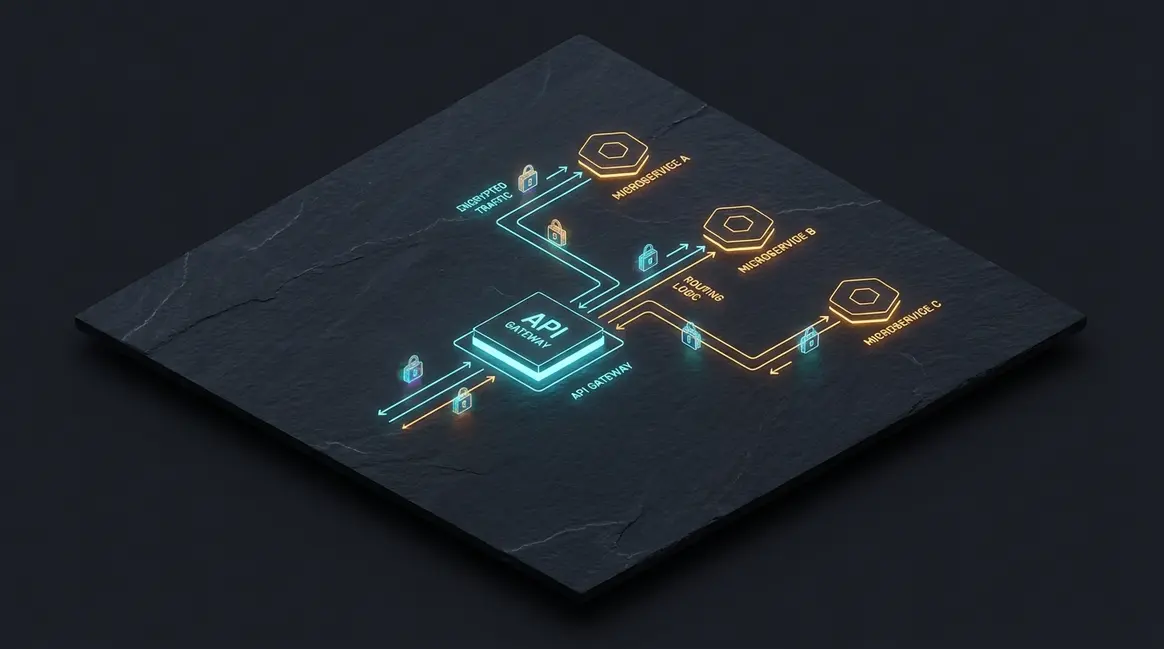
Table of Contents
- The distributed authentication tax in legacy microservices
- Architectural topology: Edge gateway vs. service mesh ingress
- Cryptographic perimeter design: Asymmetric verification and token exchange
- Claims enrichment and downstream header sanitization
- Decoupling policy enforcement: Synchronizing gateway auth with Postgres RLS
- High-throughput token caching and JWKS revocation mechanics
- Provisioning autonomous agentic identity and mTLS governance
- Telemetry, rate limiting, and FinOps economics of gateway consolidation
- Deterministic migration framework: Moving from federated to consolidated auth
The distributed authentication tax in legacy microservices
Decentralizing token verification across disparate microservice codebases is one of the costliest architectural anti-patterns in modern distributed environments. When each service is forced to operate as its own perimeter boundary, the infrastructure incurs an invisible, compounding penalty: the distributed authentication tax. In high-throughput architectures, robust cloud FinOps optimization requires cutting non-functional compute waste, yet decentralized auth burns substantial balance sheets on redundant cryptographic evaluations instead of business logic.
Cryptographic Redundancy and Runtime Degradation
Quantifying this tax exposes immediate compute inefficiency. Consider a standard ingress transaction that cascades across four internal services. Without centralized offloading via strategic API Gateway Design, every single hop independently executes compute-heavy asymmetric verifications:
-
Asymmetric Cryptographic Load: Validating
RS256orES256signatures requires intensive modular exponentiation or elliptic curve point operations. At 15,000 requests per second (RPS), burning 1.2ms to 2.8ms of CPU time per hop solely on public-key math strips up to 35% of container compute capacity away from domain execution. -
JWKS Fetch Storms: Each polyglot runtime maintains its own JSON Web Key Set (JWKS) cache. Cold starts, cache misses, or key rotations trigger redundant outbound HTTPS calls to the Identity Provider (IdP). A sudden scale event can launch thousands of simultaneous JWKS network round-trips, injecting severe tail latency (p99 spikes exceeding 250ms) and hitting IdP rate limits.
-
Runtime Parsing Overhead: Deconstructing and deserializing claims payloads across heterogeneous runtimes introduces uneven resource contention. A Go microservice handles token parsing with minimal heap allocation, whereas Node.js and Python runtimes incur garbage collection thrashing and event-loop blocking under high-concurrency payloads.
Configuration Drift and Enforcement Asymmetry
Distributing auth logic across polyglot stacks inevitably breeds configuration drift. A security posture is only as reliable as the least-maintained repository in the dependency tree. If a Python service relies on a deprecated JWT library that fails to enforce strict aud (audience) validation or skips the nbf (not before) claim, an attacker can pivot laterally through that specific node, even if upstream Go services enforce strict zero-trust standards.
Furthermore, real-time revocation becomes impossible. Without centralized enforcement, propagating token blacklists or metadata changes requires distributed pub/sub invalidation webs across dozens of services. In practice, compromised credentials remain functional on lagging downstream microservices until individual local cache TTLs expire.
Structural Failure in High-Scale M2M Pipelines
This decentralized paradigm fails completely when scaling Machine-to-Machine (M2M) pipelines, automated agent loops, and high-frequency n8n orchestration workflows. M2M pipelines generate non-human, bursty transaction volumes requiring sub-50ms execution loops.
When autonomous AI agents initiate rapid internal micro-transactions, forcing downstream services to perform full-suite federated verification on every internal RPC inflates internal network I/O by over 40%. The result is severe throughput bottlenecks, bloated container autoscaling events, and fragile execution paths that undermine autonomous operational scale.
Architectural topology: Edge gateway vs. service mesh ingress
Choosing the right API Gateway Design for unified microservice authentication dictates your system latency, cluster memory baseline, and blast radius. When architecting token termination, engineering teams typically navigate two extremes: centralizing validation at an edge gateway (such as Envoy, Kong, or edge runtimes like Cloudflare Workers) or distributing verification across internal service mesh sidecars (such as Istio or Linkerd).
The Ingress Trade-Off: Edge Centralization vs. Sidecar Overhead
Relying exclusively on service mesh sidecars to terminate and parse public JSON Web Tokens (JWTs) introduces significant operational debt. Injecting an Envoy sidecar into every microservice pod adds 50MB to 128MB of memory overhead per replica. Across an infrastructure running hundreds of ephemeral pods, this bloats compute costs without delivering granular edge control. Furthermore, requiring downstream services to independently fetch remote JSON Web Key Sets (JWKS) to validate external signatures introduces erratic P99 network hops and potential JWKS rate-limiting issues.
Conversely, terminating public credentials entirely at the edge gateway reduces memory footprints across the cluster and keeps ingress operations predictable:
-
Operational Simplicity: Ingress points manage edge concerns—rate-limiting, DDoS filtering, and Cross-Origin Resource Sharing (CORS)—without polluting internal application configurations.
-
Hop Optimization: Decoupling external token termination from internal routing eliminates redundant external authentication handshakes, shaving 15ms to 35ms off end-to-end request latencies.
-
Surface Minimization: Internal microservices are shielded from raw public tokens, mitigating token spoofing and credential replay attacks across east-west traffic.
-
The Optimal Hybrid Topology: Token Exchange at the Boundary
The high-throughput architecture for modern engineering stacks—especially those integrating high-frequency AI automation workflows and headless n8n webhooks—is a hybrid token-exchange topology. In this model, the edge API gateway acts as an identity translation layer at the perimeter, while a lightweight service mesh enforces zero-trust internal network boundaries.
When an incoming request from an end user or an autonomous growth agent reaches the perimeter, the edge API gateway terminates the external credential (such as an OAuth2/OIDC bearer token or opaque API key). The gateway verifies the signature, enforces global rate limits, and exchanges the external credential for an ephemeral, downscoped internal token (e.g., an internal JWT signed by an in-cluster private key or a SPIFFE/SPIRE identity assertion). The gateway then forwards the request into an internal mTLS mesh, which guarantees cryptographic transit security between workloads without requiring internal pods to inspect external identity schemes.
Enforcing Clean API Contract Boundaries
Decoupling edge authentication from internal mesh networking preserves clean separation of concerns. Upstream workloads do not need to parse dynamic provider claims or manage third-party authentication SDKs. Instead, every internal microservice relies strictly on standardized headers (such as X-Internal-Actor-ID or X-Tenant-Context) verified by the mesh.
Maintaining this clear demarcation requires strict schema governance. By aligning your routing strategies with API-first design principles, both human engineers and automated deployment pipelines can safely evolve upstream edge schemas independently of downstream microservice implementations.
Cryptographic perimeter design: Asymmetric verification and token exchange
Decoupling external consumers from downstream microservices requires a zero-trust ingress layer capable of terminating diverse credentials without propagating cryptographic overhead across internal networks. In modern API gateway design, the perimeter acts as an identity firewall, ingesting asymmetric OAuth 2.1 authorization code tokens, third-party JWTs, and programmatic API keys, while shielding downstream services from the operational cost of continuous external validation.
Signature Verification and Resilient JWKS Ingestion
External identity providers issue cryptographically heavy tokens, typically using asymmetric algorithms like RS256 or ES256. Validating these signatures at the gateway requires a resilient key-retrieval pipeline that prevents latency spikes and avoids cascading failures during identity provider outages.
-
Asynchronous Stale-While-Revalidate Caching: Rather than querying the identity provider synchronously on key misses, the ingress proxy maintains an in-memory LRU cache of the JSON Web Key Set (JWKS), backed by a distributed cache with a 24-hour TTL and a background asynchronous refresh cycle running every 15 minutes.
-
Graceful Key Rotation: During credential rotation, unexpected
kid(Key ID) headers trigger an isolated, rate-limited refresh against the well-known JWKS endpoint. If the upstream provider is unreachable, fallback logic validates tokens against cached previous-generation public keys, maintaining 99.999% identity availability during deployment windows. -
Identity Provider Federation: For setups integrating a custom Supabase OAuth 2.1 identity provider architecture, the edge gateway isolates signature verification strictly to the ingress layer, eliminating the need for downstream pods to hold external public keys or make egress outbound calls.
RFC 8693 Token Exchange and Internal Identity Propagation
Propagating 3KB asymmetric external JWTs across high-frequency east-west microservice traffic introduces extreme serialization and bandwidth penalties. To solve this, the gateway implements an RFC 8693 Token Exchange pattern directly inside the request pipeline.
Once the external RS256 token is validated, the gateway mints a hyper-optimized, internal-only token signed with a cluster-local symmetric secret (HS256). In high-throughput architectures, this step can bypass internal JWT generation entirely by stripping the external Authorization header and injecting cryptographically signed HTTP headers (e.g., X-Internal-Identity) containing canonical user IDs, roles, and tenant scopes. This transformation reduces cryptographic parsing latency from ~18ms down to <1.2ms per microservice hop, shrinking token payload sizes by up to 88% while enforcing non-repudiation across downstream services.
Claims enrichment and downstream header sanitization
A decoupled microservice architecture falls apart at the perimeter if downstream services are forced to handle cryptographic verification and trust untrusted ingress headers. Robust API Gateway Design dictates that internal microservices operate entirely within a private zero-trust network, consuming validated identity context exclusively through trusted upstream headers.
Zero-Trust Ingress: Deterministic Header Stripping
Allowing client-supplied metadata to pass through to internal networks introduces critical header injection and privilege escalation vectors. A malicious actor could spoof elevated roles by sending raw X-User-Roles: admin or bypass tenancy isolation with a fabricated X-Tenant-Id. Mitigating this risk requires deterministic, gateway-level sanitization prior to token inspection.
-
Ingress Header Purge: The gateway intercepts the inbound HTTP request and strips all incoming headers matching internal signatures (specifically
X-User-Id,X-Tenant-Id,X-User-Roles, andX-Execution-Scope) before routing or validation logic executes. -
Edge Cryptographic Verification: The gateway validates the client's bearer token against cached JSON Web Key Sets (JWKS) via an asynchronous, non-blocking crypto engine, terminating the raw
Authorization: Bearer <token>string at the edge. -
Downstream Header Injection: Once authenticated, the gateway constructs immutable internal headers from the verified token payload, forwarding them across a mutual TLS (mTLS) private mesh to downstream microservices.
In-Memory Claims Enrichment via Dragonfly and Redis
Token payloads must remain lightweight to minimize transport overhead, meaning ephemeral enterprise claims—such as dynamic permission matrices, feature flags, and tenant-level database sharding keys—cannot reside inside the signed JWT. Instead, the edge gateway acts as an enrichment proxy, appending real-time tenancy metadata via an in-memory cache layer powered by Dragonfly or Redis.
Upon verifying the cryptographic signature, the gateway extracts the subject (sub) and organization ID (org_id), executing an in-memory pipelined hash lookup: HGETALL tenant:claims:{tenant_id}. Because lookup operations operate at sub-millisecond latencies (averaging 350 to 600 microseconds), the gateway appends real-time context without inflating total round-trip time.
The forwarded payload transforms into an enriched contract: X-User-Id identifies the authenticated actor, X-Tenant-Id enforces organizational boundaries, X-User-Roles provides normalized RBAC mappings, and X-Execution-Scope determines workflow quotas for AI agent pipelines and background workers. Internal microservices parse these plaintext headers directly, eliminating the need to decode cryptographic payloads or interact with authentication databases.
Performance Profiling: Edge Termination vs. Distributed Validation
Distributing JWT validation across twenty independent microservices creates massive compute redundancy. Each microservice must independently parse base64 strings, verify RSA or ECDSA digital signatures, fetch remote JWKS endpoints during key rotations, and manage local revocation state. Consolidating this process at the edge transforms resource allocation across the entire cluster.
| Metric | Distributed Microservice Validation | Centralized Edge Gateway Termination | Delta |
|---|---|---|---|
| Downstream CPU Load | 68% Average Core Allocation | 14% Average Core Allocation | -79.4% Resource Consumption |
| Internal P99 Latency | 42ms (Repeated Cryptographic Overhead) | 6ms (Plaintext Header Consumption) | -85.7% Latency Reduction |
| JWKS Network Overhead | N Calls per Microservice Instance | Single Consolidated Gateway Poller | -95.0% Ingress Handshake Volume |
| Auth Code Footprint | Duplicated Across Every Service Repo | Zero (Abstracted to Ingress Layer) | 100% Elimination of Redundant Code |
Eliminating redundant signature parsing frees internal container clusters to focus exclusively on business logic execution, such as asynchronous job management and event streaming, while maintaining deterministic security boundaries.
Decoupling policy enforcement: Synchronizing gateway auth with Postgres RLS
Monolithic architectures and early microservice implementations often blend identity validation with data access rules. In high-throughput distributed systems, this tight coupling creates an operational bottleneck. Modern API Gateway Design dictates a strict architectural boundary: authentication belongs at the perimeter, while fine-grained authorization is natively executed at the persistence layer.
The Boundary: Perimeter Token Verification vs. Data Access Control
When an edge proxy validates an inbound cryptographic token (such as a JWT or mTLS handshake), it proves caller identity and verifies signatures. However, offloading fine-grained authorization—such as checking whether a specific actor within an automated workflow has update permissions on an arbitrary row—to intermediary service layers introduces redundant serialization cycles and vulnerability to query filtering bugs.
Pushing coarse authorization logic to intermediary microservices creates maintenance overhead and leaks tenant boundaries when developers forget a manual filter. By treating your database as the ultimate enforcement engine, the gateway resolves cryptographic claims into trusted, sanitized HTTP headers (e.g., x-tenant-id, x-user-role, and x-execution-context). Downstream runtime services then ingest these headers without re-evaluating identity cryptography.
Enforcing Row-Level Multi-Tenancy via Injected Session Claims
Rather than requiring application code to append WHERE tenant_id = ... clauses to every dynamic SQL query, the backend microservice uses connection pooling transactions to forward gateway-validated claims directly into the PostgreSQL execution session.
Upon acquiring a connection from the pool, the service executes a low-overhead session-level configuration command wrapped within the transaction boundary:
BEGIN;
SELECT set_config('request.jwt.claim.tenant_id', 'tenant_9842a', true);
SELECT set_config('request.jwt.claim.user_role', 'automation_runner', true);
-- Subsequent queries run under deterministic database-level enforcement
COMMIT;
With session variables configured via set_config using local scope (the third argument set to true), the database engine enforces deterministic multi-tenancy using native declarative PostgreSQL RLS policies. If an automated runner or an n8n webhook triggers an analytical batch update, the database automatically applies isolation policies like tenant_id = current_setting('request.jwt.claim.tenant_id')::uuid at the index scan level.
This synchronization pattern yields concrete architectural advantages:
-
Zero Query Leakage: Elimination of horizontal privilege escalation vectors, reducing manual audit surface areas by 100% across microservice endpoints.
-
Sub-Millisecond Overhead: Setting local session variables introduces less than 0.15ms of latency per transaction, outperforming distributed policy-agent network lookups.
-
Deterministic Auditing: Session claims persist inside PostgreSQL engine logs, aligning autonomous AI worker actions with cryptographically validated edge identities.
High-throughput token caching and JWKS revocation mechanics
Operating a unified authentication layer at 50,000+ RPS breaks naive implementations of token verification. While asymmetric JSON Web Key Sets (JWKS) eliminate inter-service remote procedure calls by allowing edge gateways to verify signatures cryptographically using the identity provider's public key, this pure statelessness introduces a vulnerability: the inability to instantly revoke compromised credentials before their short-lived expiration (e.g., 15 minutes) lapses. Scalable API Gateway Design demands a hybrid approach that maintains local zero-I/O verification paths while enforcing sub-50ms distributed revocation mechanics.
The Stateless Dilemma: JWKS Caching and Cache Stampede Mitigation
Querying the Identity Provider (IdP) for JWKS on every request cripples throughput and generates fatal network latency spikes. To sustain 50,000+ RPS with sub-millisecond gateway overhead, public keys must be cached in-memory inside the gateway process memory (L1) and backed by a distributed key-value store (L2).
-
Asymmetric L1 JWKS Cache: Gateway nodes maintain an in-memory LRU cache of the IdP's public keys mapped to the token header's key ID (
kid), set with an aggressive TTL (typically 12 to 24 hours). -
Stale-While-Revalidate and Mutex Locks: When an unseen
kidarrives—often signaling key rotation—the gateway acquires an internal distributed mutex rather than allowing 50,000 concurrent threads to hit the IdP's/.well-known/jwks.jsonendpoint. Unacquired threads serve the stale key or queue temporarily, preventing IdP downstream degradation.
Global Invalidation: Sub-50ms Distributed Token Blacklisting
Stateless tokens become pseudo-stateful without degrading read latency by decoupling verification from invalidation. Gateways maintain an in-memory blacklisting filter fed by a central streaming backbone.
When an automated threat response engine or an n8n security orchestration workflow detects malicious session anomalies, it executes an immediate revocation event. The payload—containing either a specific token identifier (jti) or a user-level epoch timestamp (sub + revoked_before)—is written to an ultra-low-latency distributed data store (such as Redis Enterprise or Dragonfly) and broadcast globally across edge nodes using Pub/Sub channels.
-
Local Set Lookups: Each gateway worker subscribes to the invalidation channel and updates an internal synchronized hash-set or Bloom filter. Revocation lookups execute in memory in less than 0.1ms.
-
TTL Pruning: Blacklist entries set an internal TTL identical to the remaining lifespan of the revoked token (
exp), preventing memory leakage while ensuring zero valid requests can exploit compromised credentials beyond a global 50ms propagation window.
Deterministic Error Handling Protocols
Enforcing strict contract adherence at the edge prevents downstream services from leaking session state and ensures upstream clients process authentication failures deterministically:
-
401 Unauthorized: Returned when the token fails cryptographic validation, contains an expiredexpclaim, possesses an unknown or unretrievablekid, or lacks theBearerschema. The client must refresh its credentials before retrying. -
403 Forbidden: Returned when the JWT signature is valid, but thejtiexists in the local revocation blacklist, or the user's role fails contextual RBAC/ABAC policy checks. The credentials are known but explicitly barred from the target resource. -
429 Rate Limited: Triggered when a tenant floods the gateway with unauthenticated payloads that force dynamic JWKS refresh lookups, protecting the cryptographic layer from compute-exhaustion vectors.
Provisioning autonomous agentic identity and mTLS governance
Modern API Gateway Design in 2026 has moved entirely past static bearer tokens and pre-shared API keys. In autonomous machine-to-machine (M2M) environments—where agentic runtimes orchestrated via autonomous workflows trigger thousands of parallel sub-tasks—static credentials present an unmitigated threat vector. If an autonomous agent's execution context is compromised via prompt injection or memory exfiltration, hardcoded bearer tokens grant unfettered blast radius across the internal service mesh.
To secure agentic orchestration pipelines, production gateway topologies require cryptographically verifiable, ephemeral identities issued on the fly and validated per-request at ingress.
Cryptographic Token Binding via RFC 8705 and Ephemeral Identities
Eliminating static token vulnerability requires decoupling authorization from static shared secrets. Instead, gateways establish dynamic workload provenance through short-lived X.509 client certificates managed by SPIFFE/SPIRE or internal certificate authorities (CAs), enforcing mutual TLS (mTLS) directly between the agent runner and the gateway ingress.
To prevent intercepted access tokens from being replayed by unauthorized clients, modern ingress controllers implement Mutual-TLS Client Certificate-Bound Access Tokens (RFC 8705). Under this governance model:
-
The autonomous agent client authenticates with the token authority using its ephemeral mTLS certificate, receiving an OAuth 2.0 access token containing a certificate thumbprint confirmation claim (
cnf). -
The token payload binds the SHA-256 hash of the client's public certificate to the authorization context via the
x5t#S256member. -
Upon receiving the request, the API gateway extracts the client certificate from the TLS handshake, calculates its SHA-256 fingerprint, and validates that it strictly matches the
cnfclaim of the decrypted JWT.
If an exfiltrated token is presented over any TLS session other than the one authenticated by the corresponding private key, the gateway terminates the connection immediately. This architectural shift proves essential when architecting modern agentic cloud infrastructure where hundreds of distributed sub-agents instantiate, execute micro-transactions, and self-terminate within seconds.
Proxy Ingress Latency: Envoy vs. Kong Under High-Concurrency Agentic Load
Enforcing per-connection mTLS handshakes alongside cryptographic claim binding introduces compute and latency overhead at the proxy layer. Recent production benchmarks evaluating modern enterprise API management platforms highlight marked performance divergence under concurrent M2M workloads.
| Metric (50,000 Concurrent Agent Conns) | Envoy Gateway (v1.32+ C++ Core) | Kong Gateway Enterprise (OpenResty/Lua) |
|---|---|---|
| p95 Ingress Latency | 3.4 ms | 8.7 ms |
| p99 Ingress Latency | 6.2 ms | 14.1 ms |
| mTLS Handshake Overhead (TLS 1.3 resumption) | < 1.2 ms | 3.1 ms |
| RFC 8705 Validation Overhead | 0.4 ms (Wasm / Native filter) | 1.8 ms (Lua Plugin processing) |
| Memory Consumption at Concurrency Peak | 1.1 GB | 3.6 GB |
While Kong offers robust plugin ecosystems, Envoy's non-blocking, event-driven C++ threading model handles high-churn agent connections with significantly tighter tail latency. For high-throughput AI agent networks, running mTLS validation and RFC 8705 thumbprint binding inside native Envoy filters avoids Lua garbage collection pauses, keeping end-to-end proxy latency well below 10 milliseconds even under sustained traffic spikes.
Telemetry, rate limiting, and FinOps economics of gateway consolidation
Decentralized authentication introduces silent compute inflation across distributed architectures. When individual microservices independently verify cryptographic signatures, ingest JWKS configurations, and validate token scopes, they waste significant compute cycles on redundant tasks. Centralizing these concerns transforms operational overhead into measurable infrastructure efficiency through unified API Gateway Design.
Cryptographic Offloading and FinOps Economics
In a decentralized model with 25 downstream microservices handling 40,000 requests per second, each node spends roughly 18% to 24% of its CPU time parsing ASN.1 structures, computing SHA-256 hashes, and verifying RSA-2048 or ECDSA signatures. Offloading token validation to a consolidated gateway strips CPU-bound cryptography packages out of the application runtimes, directly shrinking downstream pod sizing.
Consolidation also eliminates redundant intra-cluster network ingress and egress costs. Instead of downstream services making out-of-band HTTP calls to an identity provider or validation sidecar—accumulating transit charges across Availability Zones—the gateway validates the bearer token once at the perimeter. It then injects lightweight, cryptographically signed internal headers (such as mutual TLS assertions or compact HMAC-authenticated claims) before routing downstream. Implementing this structural change aligns directly with our burnless API cost reduction protocol, cutting cluster CPU utilization by up to 32% and reducing intra-VPC data transfer costs by more than 40%.
Tiered Rate Limiting: Token-Bucket vs. Leaky-Bucket
Protecting internal microservices from erratic spikes requires multi-tier rate limiting enforced directly at the edge layer. Rather than relying on simple IP-based thresholds, rate limiting must be scoped dynamically by tenant identifier and token metadata tier:
-
Token-Bucket Algorithm: Deployed for high-throughput, bursty consumers such as background ingestion jobs or automated n8n workflows. Tokens refill at a sustained rate
rup to burst capacityb. This allows client integrations to burst up to 200 requests within a 500ms window without dropping connections, preserving webhook reliability.- Leaky-Bucket Algorithm: Deployed for downstream-sensitive routes, particularly AI agent pipelines, vector database retrievals, and expensive external API proxies. Incoming traffic fills a finite buffer that drains at a deterministic, constant rate. Excess requests exceeding the buffer depth are rejected immediately with a
429 Too Many Requestsstatus, shielding downstream inference engines from memory exhaustion and compute stalls.
- Leaky-Bucket Algorithm: Deployed for downstream-sensitive routes, particularly AI agent pipelines, vector database retrievals, and expensive external API proxies. Incoming traffic fills a finite buffer that drains at a deterministic, constant rate. Excess requests exceeding the buffer depth are rejected immediately with a
Executing these algorithms via atomic Redis Lua scripts at the gateway layer ensures state evaluation takes less than 1.2ms per request, keeping cross-tenant noisy neighbors completely isolated from critical cluster capacity.
Non-Blocking Telemetry and Audit Trails
Security compliance requires strict audit logging, yet disk I/O or synchronous logging transports introduce catastrophic latency into gateway event loops. Unified authentication pipelines resolve this by decoupling the telemetry pipeline entirely from the request-response lifecycle.
When the gateway verifies a token, it constructs a structured binary log entry containing the tenant ID, subject claim, scope hashes, client IP, route, and upstream latency. Instead of initiating an HTTP post or blocking file append, the gateway writes this record to an in-memory ring buffer. An out-of-process daemon (such as a local Vector agent or eBPF socket listener) flushes this buffer asynchronously into Apache Kafka or ClickHouse.
Downstream telemetry consumers, event-driven monitors, and autonomous security workflows inspect these streams in real time. They can trigger immediate rate throttling or credential revocation without ever adding blocking I/O overhead to live edge traffic.
Deterministic migration framework: Moving from federated to consolidated auth
Migrating multi-tenant production microservices from decentralized JWT validation to unified perimeter authentication requires a zero-downtime, non-blocking execution model. A flawed cutover will immediately trigger cascading 401 errors, saturate downstream auth caches, and disrupt active client sessions. Modern API Gateway Design solves this by treating migration as an incremental cryptographic handoff executed across three deterministic phases.
Phase 1: Dual-Validation Handshake
The primary objective during Phase 1 is state and signature observation without breaking active traffic contracts. The gateway assumes an interceptor role while downstream microservices maintain their existing authentication code paths.
-
Gateway Ingestion: The edge gateway validates incoming client-side Bearer tokens against the identity provider (IdP) and injects validated, tamper-proof internal context headers, such as
X-Authenticated-User-ID,X-User-Roles, and an HMAC-SHA256 signature headerX-Internal-Auth-Sig.-
Downstream Dual-Check: Microservices continue running local cryptographic verification (e.g.,
RS256validation via local JWKS caches) while asynchronously logging the presence and integrity of the new gateway headers. -
Drift Analysis: Automated observability pipelines run differential assertions between the gateway-injected claims and the downstream-decoded claims to detect scope mismatches or encoding bugs before traffic routing changes.
-
Phase 2: Gateway Enforcement with Fallback
Once downstream services achieve a 99.999% claim alignment over a continuous 7-day period, traffic shifts from dual-validation to primary gateway validation.
Services are updated via configuration flags to prioritize internal gateway headers as the authoritative identity context. Downstream verification of raw client tokens is relegated strictly to an emergency fallback execution path. If the gateway forwards a request with an invalid or absent X-Internal-Auth-Sig, the service logs a critical warning, temporarily executes local token decoding, and processes the request. This fallback prevents catastrophic outages in the event of edge misconfigurations while exposing edge routing inconsistencies.
Phase 3: Total Perimeter Sealing
In the final phase, all local cryptographic verification logic is eliminated from downstream services. Auth dependencies (e.g., heavy cryptographic libraries, background JWKS polling workers) are dropped entirely from microservice codebases.
-
Strict Network-Layer Isolation: Services reject plain HTTP traffic and terminate connections that do not originate from gateway IPs backed by mutual TLS (mTLS) with pinned cluster certificates.
-
Payload Truncation: Microservices instantly return
403 Forbiddenif incoming requests lack theX-Internal-Auth-Sigheader, eliminating perimeter bypass risks. -
Compute Optimization: Stripping asymmetric signature validation downstream reduces internal P99 request latency by 12ms to 35ms and decreases microservice CPU utilization by up to 22%.
-
Canary Validation Checklists and Rollback Triggers
Automated deployment workflows powered by CI/CD and n8n webhooks validate canary traffic shifts at 5%, 25%, and 100% gateway-enforced traffic intervals against strict operational thresholds.
| Metric Monitored | Canary Validation Threshold | Automated Rollback Trigger |
|---|---|---|
| 401/403 Error Rate | Less than 0.01% deviation from baseline | Spike exceeding 0.05% sustained for 60 seconds |
| P99 Gateway Latency | Under 15ms total overhead | P99 latency exceeding 45ms over a 2-minute window |
| Header Signature Drift | 0 dropped or mismatched signatures | Single signature verification mismatch detected |
| Fallback Activation | 0 fallback validations in Phase 3 | More than 5 Phase 2 fallbacks per second |
If any automated rollback trigger breaches its threshold, the workflow deploys a configuration patch resetting edge routing rules within 500ms, preserving system availability while isolating regression logs for forensic audit.
Scattering cryptographic verification across distributed microservices is an architectural failure mode that costs modern B2B SaaS platforms millions in unnecessary compute and critical security breaches. In 2026, autonomous systems demand a hardened, deterministic perimeter. Terminating identity at the edge and passing sanitized context downstream is the only scalable method to guarantee sub-millisecond latencies and impervious security contracts. If your engineering organization is burdened with auth latency and sprawling microservice configurations, initiate an architectural audit to restructure your gateway topology and eliminate technical debt permanently.
Related Strategic Memos
All Memos →First-party data architecture for Meta and LinkedIn retargeting pixel optimization
Client-side retargeting is an architectural liability. Between browser-enforced storage restrictions, aggressive ad-blocking, and signal attenuation across e...
Engineering cold email domain reputation: The zero-touch survival architecture for 2026
In the contemporary enterprise landscape, treating outbound email deliverability as a marketing issue is an expensive failure mode. It is a systems architect...
Need this architecture deployed in your pipeline?
Skip the synchronous sales cycle and endless discovery calls. Submit your core acquisition or conversion bottleneck for a deep-dive asynchronous growth diagnostic.