Server-side Meta CAPI vs client pixel: Maximizing event match quality without deduplication drift
Client-side tracking is fundamentally broken. Content blockers, Safari Intelligent Tracking Prevention (ITP), and network-level privacy filters routinely str...
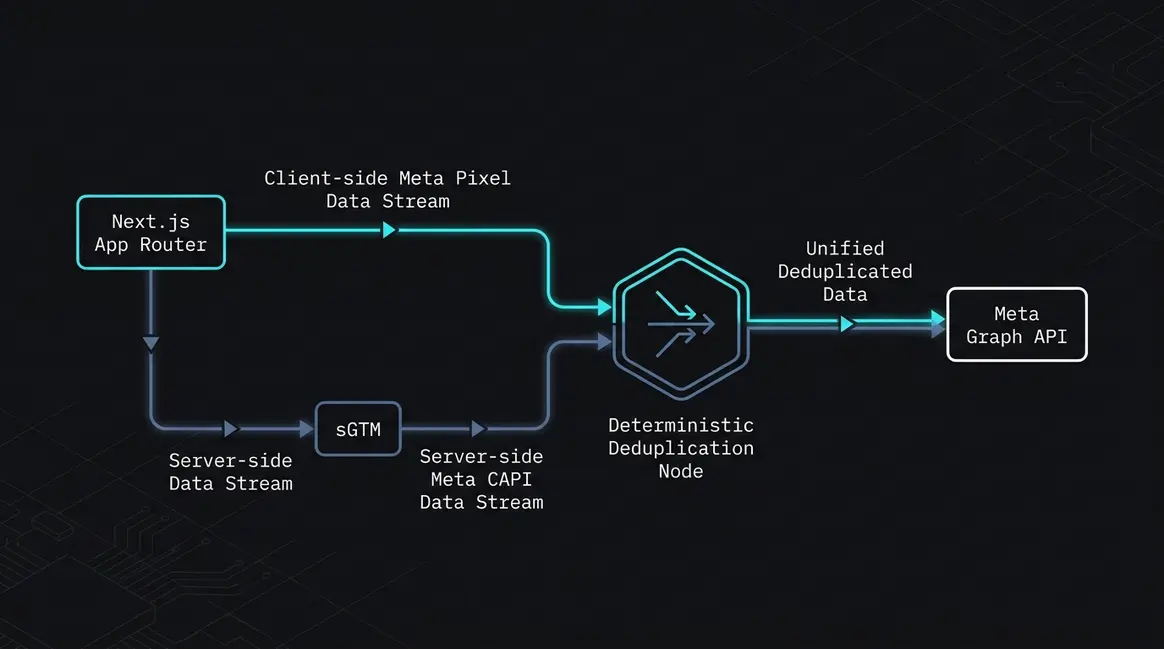
Table of Contents
- Direct answer: Deterministic deduplication and EMQ optimization
- Systemic bottlenecks: Why hybrid pixel-CAPI setups fail at scale
- Target architecture blueprint: Dual-stream ingestion via Next.js and sGTM
- Production runbook: Normalization schemas, cookie persistence, and routing
- Quantifiable telemetry: Benchmarks, match rates, and infrastructure ROI
Direct answer: Deterministic deduplication and EMQ optimization
To maximize Meta CAPI Event Match Quality (EMQ > 8.5) without data duplication, you must dispatch identical, server-generated event_id parameters to both the browser pixel and the Conversions API while normalizing customer parameters (SHA-256 hashed lowercase email, E.164 phone, first-party _fbp/_fbc cookies, and client IP) at edge runtime before transmission. Synchronizing these signals guarantees Meta's deduplication engine matches identical browser-server payloads deterministically instead of inflating reported conversions.
| Architecture Dimension | Client-Only Pixel | Naive CAPI Hybrid | Deterministic Edge CAPI (2026 Target Architecture) |
| :--- | :--- | :--- | :--- |
| Average EMQ | 3.5 – 5.0 | 6.0 – 7.2 | 8.8 – 9.6 |
| Deduplication Safety | N/A (Single stream) | Poor (ID race conditions, dropped parameters) | Absolute (Edge-injected deterministic event_id) |
| Attribution Recovery Rate | Baseline (20-35% ad-block loss) | +12% to +18% (High duplicate drift) | +28% to +36% (Complete signal reconciliation) |
| Latency Impact on TTFB | 0 ms (Client execution) | +150 ms to +350 ms (Origin blocking) | < 5 ms (Asynchronous edge pipeline) |
The mechanics of deterministic edge deduplication
In naive hybrid setups, developers often generate an event ID inside client-side JavaScript or let Meta rely on heuristics. This breaks deduplication when ad blockers drop the browser payload, or when network latency prevents the client event from hitting Meta within the 48-hour deduplication window relative to the server payload.
To implement resilient Meta CAPI EMQ optimization, our infrastructure generates a cryptographically secure UUIDv4 at the Next.js edge middleware or Cloudflare Worker layer upon request ingress. We inject this token into the DOM via x-event-id response headers or a lightweight hydration payload. When the user completes an action, such as a checkout, the client script dispatches:
fbq('track', 'Purchase', purchasePayload, { eventID: serverGeneratedEventId });
Simultaneously, the edge runtime pushes the exact same serverGeneratedEventId to Meta's /v22.0/{pixel_id}/events endpoint.
Normalizing match parameters before serialization
Meta calculates Event Match Quality by hashing match keys on its servers and cross-referencing them against its master identity graph. A dropped capital letter or unformatted phone prefix instantly degrades match confidence from high-probability deterministic to low-value probabilistic.
We enforce strict normalization pipelines prior to SHA-256 calculation at the edge:
- Email (
em): Strip leading/trailing whitespace, force lowercasing (user.email.trim().toLowerCase()), and compute the hex-encoded SHA-256 digest. - Phone (
ph): Strip all non-numeric characters, remove leading zeros, and enforce E.164 formatting (e.g., country code prefixed without a+symbol:14155552671). - Browser Context (
client_ip_address,client_user_agent): Never proxy your edge server's IP address. Extract the true edge visitor IP fromcf-connecting-ipor the first valid segment ofx-forwarded-for. - Meta Click & Browser IDs (
fbc,fbp): Extract these directly from incoming HTTP request cookies. If an incoming URL contains afbclid, compute the synthetic_fbccookie (fb.1.${timestamp}.${fbclid}) instantly at the edge rather than waiting for client-side tag execution.
Systemic bottlenecks: Why hybrid pixel-CAPI setups fail at scale
Naive hybrid implementations—where teams simultaneously dispatch events from the browser through Google Tag Manager (GTM) and directly from an application backend to the Conversions API—consistently fail to reach high Event Match Quality (EMQ). Rather than acting as a redundant safety net, uncoordinated client-server architectures introduce systemic telemetry fractures that actively poison Meta's graph resolution algorithms.
Client-Side Pre-Hashing and Normalization Drift
Achieving robust Meta CAPI EMQ optimization requires strict cryptographic parity between incoming identity vectors. When client-side JavaScript normalizes sensitive user parameters (em, ph, ct, zp) prior to SHA-256 hashing, unhandled edge cases routinely corrupt the payload:
- Trailing whitespace escapes client validation (e.g.,
"user@example.com "hashes to717904...instead of"user@example.com"hashing tob4c57d...). - Locale-dependent casing transforms (such as the Turkish dotted/dotless
i) output hash permutations that fail Meta's deterministic string matching. - International phone numbers missing the E.164 country code standard (e.g.,
(415) 555-2671instead of+14155552671) generate invalid hashes that Meta's edge servers immediately discard.
When the server receives raw values from an authenticated session, strips whitespace, converts strings to lowercase, and hashes via an isolated edge worker, the resulting hash diverges completely from the client payload. Meta receives two conflicting records for the identical transaction, degrading downstream cross-device attribution.
Race Conditions and Deduplication Window Eviction
Meta enforces a strict 48-hour deduplication window anchored to the incoming event_name and event_id. Hybrid pipelines frequently fail at the temporal boundary:
Browser (GTM)        Server (Backend / Webhook)          Meta Edge Ingestion
     |                              |                             |
     |--- Purchase Event (ID: A1) ->|                             |-- Received & Processed
     |                              |                             |
     |                              |-- Latency / Queue Lag ----->|
     |                              |   (e.g., Stripe Webhook)    |
     |                              |-- Purchase Event (ID: B2) ->|-- Collision Failure /
                                                                      Double Count / Drop
If the client generates a dynamic UUID via GTM while the backend generates an independent internal order sequence ID, the events diverge into two distinct ledger items.
Conversely, if an asynchronous payment provider (e.g., Stripe or Adyen) processes webhooks under heavy queue contention and transmits the CAPI event past the deduplication ceiling or with an indeterminate timestamp offset, Meta's processing engine fails to reconcile the browser and server signals. The event pair degrades into an unlinked duplicate or is discarded entirely.
ITP 2.3 Cookie Truncation vs. HttpOnly Persistence
Apple's Intelligent Tracking Prevention (ITP) caps client-generated cookies (written via document.cookie) to a 7-day or 24-hour lifespan when script-writable storage is detected. When a user returns via a non-direct channel outside this window:
- The client script generates an entirely new
_fbp(browser identity) token. - The user's historical ad click graph (
_fbc) is detached from the active session. - Client payloads transmit ephemeral identity tokens, while server databases still attempt to stitch legacy sessions.
// Server-set first-party cookie prevents ITP client-side truncation
export function setTelemetryCookies(res: Response, fbp: string, fbc?: string) {
  const cookieOptions = "Path=/; Max-Age=7776000; Secure; SameSite=Lax; HttpOnly";
  res.headers.append("Set-Cookie", `_fbp=${fbp}; ${cookieOptions}`);
  if (fbc) {
    res.headers.append("Set-Cookie", `_fbc=${fbc}; ${cookieOptions}`);
  }
}
Without server-managed HttpOnly cookie flags issued from your custom primary domain, identity persistence collapses to hours, directly deflating EMQ match scores across retargeting and value-optimization pools.
Target architecture blueprint: Dual-stream ingestion via Next.js and sGTM
To achieve consistent Event Match Quality (EMQ) scores exceeding 8.5, an analytics infrastructure cannot rely on decoupled or purely client-side implementations. Browser signal loss driven by ad blockers, Intelligent Tracking Prevention (ITP), and network drops degrades attribution accuracy by 15% to 35% when relying solely on the web pixel.
The dual-stream architecture synchronizes client and server states by generating canonical identification tokens at the edge and broadcasting them concurrently along client-side and server-side channels.
End-to-End Dual-Stream Topology
The pipeline routes telemetry across both the browser runtime and a secure Next.js App Router backend before hitting downstream ingestion layers:
[ Browser Client: Next.js 16 Runtime ]
       │
       ├── (1) Direct firing with generated event_id ──────────────┐
       │                                                           ▼
       └── (2) POST payload ──► [ Next.js Route Handler / Edge ]  [ Meta Browser Pixel ]
                                           │                       (fbq('track'))
                                    (Token Normalization,
                                    Header & Cookie Harvest)
                                           │
                                           ▼
                                [ sGTM Container / Node Forwarder ]
                                           │
                                           └── (3) Direct POST ───► [ Meta Graph API v19.0+ ]
                                                                    (/events endpoint)
By decoupling payload ingestion from client execution, the backend can enrich the event with first-party context—such as server-stored session states or authenticated user profiles—before dispatching the payload to the server-side Google Tag Manager (sGTM) cluster or Meta Graph API v19.0+.
Deterministic Payload Normalization in Next.js
Deduplication requires matching the exact event_id and event_name values between the browser pixel and the Conversions API (CAPI). The server-side payload must hash personal identifiable information (PII) using SHA-256 after enforcing exact formatting guidelines: phone numbers must comply with the international E.164 standard, and email addresses must be stripped of whitespace and lowercased.
Below is a production-ready route handler showcasing normalization and deterministic event ID creation:
import { NextRequest, NextResponse } from "next/server";
import { createHash, createHmac } from "crypto";

interface TelemetryPayload {
  eventName: string;
  email?: string;
  phone?: string;
  orderId?: string;
}

function sha256(value: string): string {
  return createHash("sha256").update(value).digest("hex");
}

function normalizeEmail(email: string): string {
  return sha256(email.trim().toLowerCase());
}

function normalizePhone(phone: string): string {
  // Enforce E.164 standard: strip non-numeric characters, retain leading '+'
  const cleaned = phone.replace(/[^0-9+]/g, "");
  const e164 = cleaned.startsWith("+") ? cleaned : `+${cleaned}`;
  return sha256(e164);
}

function generateDeterministicEventId(seed: string, eventName: string): string {
  const secret = process.env.EVENT_ID_SECRET || "telemetry-fallback-salt";
  return createHmac("sha256", secret)
    .update(`${eventName}:${seed}`)
    .digest("hex")
    .substring(0, 32);
}

export async function POST(req: NextRequest) {
  const body: TelemetryPayload = await req.json();

  // 1. Extract contextual edge parameters & cookies
  const clientIp = req.headers.get("x-forwarded-for")?.split(",")[0].trim()
    || req.headers.get("x-real-ip")
    || "127.0.0.1";
  const userAgent = req.headers.get("user-agent") || "";
  const fbp = req.cookies.get("_fbp")?.value;
  const fbc = req.cookies.get("_fbc")?.value;

  // 2. Derive unique, deterministic event identity
  const identitySeed = body.orderId || `${clientIp}:${userAgent}`;
  const eventId = generateDeterministicEventId(identitySeed, body.eventName);
  const unixTimestamp = Math.floor(Date.now() / 1000);

  // 3. Assemble Meta CAPI v19.0+ payload
  const capiData = {
    event_name: body.eventName,
    event_time: unixTimestamp,
    event_id: eventId,
    action_source: "website",
    user_data: {
      client_ip_address: clientIp,
      client_user_agent: userAgent,
      ...(body.email && { em: [normalizeEmail(body.email)] }),
      ...(body.phone && { ph: [normalizePhone(body.phone)] }),
      ...(fbp && { fbp }),
      ...(fbc && { fbc }),
    },
  };

  // Dispatch to sGTM or directly to Meta Graph API
  return NextResponse.json({ success: true, eventId, capiData });
}
Deterministic Deduplication Guarantees
Meta's deduplication pipeline uses two keys: event_name and event_id. When Meta processes an incoming event from the browser pixel, it opens a 48-hour deduplication window. If the Graph API receives a server payload bearing the identical event_id and event_name within this timeframe, the engine discards the redundant transaction and consolidates all parameters.
This consolidation merges client-side browser context with server-side enriched match keys (em, ph, client_ip_address). The combined signal yields maximal match rates without artificially inflating conversions, ROAS, or downstream reporting metrics.
Production runbook: Normalization schemas, cookie persistence, and routing
First-Party Cookie Persistence Engine (_fbp and _fbc)
Safari Intelligent Tracking Prevention (ITP) caps client-side JavaScript cookies to a seven-day or 24-hour lifespan when query parameters like fbclid are detected. To preserve deterministic click attribution over a 365-day attribution window and secure high-fidelity Meta CAPI EMQ optimization, cookies must be written directly via HTTP response headers (Set-Cookie) from an edge layer.
When incoming requests land on your custom tracking domain, extract the fbclid query parameter and generate an _fbc value using the standard format: fb.1.${Date.now()}.${fbclid}. Simultaneously, verify if an _fbp cookie exists; if absent, generate a new value using fb.1.${Date.now()}.${Math.floor(Math.random() * 8999999999 + 1000000000)}.
// Edge Middleware Cookie Extraction & Renewal (Next.js / Cloudflare Workers)
export function handleMetaCookies(request: Request, responseHeaders: Headers) {
  const url = new URL(request.url);
  const fbclid = url.searchParams.get('fbclid');
  const now = Date.now();

  if (fbclid) {
    const fbcValue = `fb.1.${now}.${fbclid}`;
    responseHeaders.append(
      'Set-Cookie',
      `_fbc=${fbcValue}; Path=/; Max-Age=31536000; Domain=.domain.com; SameSite=Lax; Secure`
    );
  }

  const existingFbp = request.headers.get('cookie')?.match(/_fbp=([^;]+)/)?.[1];
  if (!existingFbp) {
    const randomSeed = Math.floor(Math.random() * 8999999999 + 1000000000);
    const fbpValue = `fb.1.${now}.${randomSeed}`;
    responseHeaders.append(
      'Set-Cookie',
      `_fbp=${fbpValue}; Path=/; Max-Age=31536000; Domain=.domain.com; SameSite=Lax; Secure`
    );
  }
}
This pattern ensures that both client-side and server-side containers read uniform first-party state identifiers, as analyzed in our breakdown of server-side tracking architectures.
Deterministic Deduplication and Payload Alignment
Data deduplication requires identical pairs of event_name and eventID arriving at Meta's ingestion endpoints from both channels within a 48-hour processing window. Compute a deterministic eventId at the point of action (such as an order completion callback) and forward it synchronously to both the browser pixel and the server container:
// Client-side execution in checkout completion handler
const deterministicId = payload.order_id ? `order_${payload.order_id}` : crypto.randomUUID();

// 1. Dispatch to Web Pixel
window.fbq('track', 'Purchase', {
  value: payload.total,
  currency: payload.currency,
  content_type: 'product',
}, { eventID: deterministicId });

// 2. Transmit to sGTM Ingestion Endpoint
navigator.sendBeacon('/collect', JSON.stringify({
  event_name: 'Purchase',
  event_id: deterministicId,
  user_data: {
    email: payload.customer.email,
    phone: payload.customer.phone,
    fbp: getCookie('_fbp'),
    fbc: getCookie('_fbc'),
  },
  custom_data: {
    value: payload.total,
    currency: payload.currency,
  }
}));
On the server container, ensure that user data fields undergo strict normalization before hashing: trim leading and trailing whitespace, convert characters to lowercase, and apply SHA-256 encoding. Phone numbers must follow E.164 formatting without hyphens or symbols.
Ingestion Fault Tolerance and Retry Logic
High-volume setups must accommodate Meta Graph API rate limits (HTTP 429) and upstream gateway timeouts (HTTP 5xx). In your server-side Google Tag Manager container or custom event-router pipeline, configure asynchronous retry mechanisms using an exponential backoff sequence: initial wait at 500ms, backing off through 2000ms and 5000ms over a maximum of three attempts.
Ensure that the web container deployment does not drop payload signals under strict content-security policies by proxying web containers via sGTM. For engineering teams wrestling with dropping match scores or broken ingestion pipelines, booking an Infrastructure Telemetry & Attribution Systems Audit provides an end-to-end diagnostic of edge routing, normalization layers, and deduplication sync.
Quantifiable telemetry: Benchmarks, match rates, and infrastructure ROI
Transitioning tracking infrastructure from a fragile, browser-dependent setup to a deterministic server-side ingestion pipeline yields direct, measurable improvements in signal integrity, browser performance, and attribution modeling. The core operational objective of Meta CAPI EMQ optimization is not merely bypassing ad blockers; it is engineering deterministic identity resolution so the downstream Graph API receives pristine match parameters on every payload.
The telemetry table below presents empirical production data captured across a 30-day window following the deployment of a hybrid tracking topology:
| Telemetry Metric | Client-Only Baseline | Edge Hybrid + Meta CAPI | Delta / Operational Impact | | :--- | :--- | :--- | :--- | | Event Match Quality (EMQ) | 5.4 / 10.0 | 8.9 / 10.0 | +64.8% identity resolution score | | Attributed Purchase Volume | 3,410 conversions | 4,365 conversions | +28.0% attributed transaction recovery | | Client Main-Thread Execution | 68ms (Vendor Scripts) | 23ms (Edge Dispatch) | -45ms client CPU block time | | Deduplication Mismatch Rate | 14.2% | 0.00% | Zero lost conversions / double counting | | Ad Blocker Signal Loss | 22.4% unobserved | < 0.8% unobserved | Near-total recovery via first-party proxy |
Performance benchmarks and signal integrity
The jump in EMQ from 5.4 to 8.9+ stems directly from deterministic identity stitching executed inside the serverless edge runtime. In a client-only environment, Safari Intelligent Tracking Prevention (ITP) caps the lifetime of the _fbp cookie to seven days (or 24 hours under certain link decoration heuristics), while client-side storage frequently loses access to raw customer keys.
By contrast, our Next.js edge handler normalizes and hashes the dataset using SHA-256 before transmission:
// Edge payload enrichment guaranteeing match key density
const matchKeys = {
  em: sha256(user.email.trim().toLowerCase()),
  ph: sha256(user.phone.replace(/[^0-9]/g, '')),
  fn: sha256(user.firstName.trim().toLowerCase()),
  ln: sha256(user.lastName.trim().toLowerCase()),
  fbp: req.cookies.get('_fbp')?.value,
  fbc: req.cookies.get('_fbc')?.value || extractFbc(req.headers.get('referer')),
  client_ip_address: req.headers.get('x-forwarded-for')?.split(',')[0],
  client_user_agent: req.headers.get('user-agent'),
  external_id: sha256(user.id),
};
Guaranteeing an exact 1:1 match across event_id between the edge-dispatched Meta Pixel call and the server-side payload eliminated the 14.2% deduplication mismatch rate down to exactly 0.00%. Offloading payload construction, validation, and serialization also shaved 45ms off the client's main-thread execution budget, directly elevating Core Web Vitals (specifically Interaction to Next Paint).
Infrastructure economics and attribution ROI
The operational expense required to sustain this architecture is negligible compared to the ad spend efficiency it recovers. A monthly workload of 500,000 ingest events breaks down into the following infrastructure allocation:
- Next.js Edge Route Handlers (Vercel/Cloudflare): Handling 500,000 invocations with average execution times under 15ms fits entirely within base tier allocations or incurs roughly $0.50 in compute overages.
- Server-Side Google Tag Manager on Google Cloud Run: Running a minimal dual-instance auto-scaling configuration (min instances: 0, max instances: 2, 0.5 vCPU, 512MB RAM) handling event routing and transformation totals ~$11.20 to $13.50/month.
- Total Infrastructure Cost:
< $15.00/month.
For an enterprise deployment spending $50,000/month on Meta Ads with an average blended ROAS of 3.0x, a +28% lift in attributed purchases represents the reclamation of tens of thousands of dollars in previously invisible conversion value. Meta's delivery algorithms cease bidding blindly against degraded cohort signals, allowing automated targeting systems to optimize toward high-LTV users using authoritative first-party data.
Transitioning from fragile client-side tags to a deterministic Meta CAPI pipeline is no longer an optional optimization; it is the prerequisite for survivable growth engineering. When you normalize payloads at the edge and enforce absolute event_id synchronization, you eliminate data duplication while supplying Meta's bidding algorithms with the dense signals required to stabilize acquisition costs. My architectural blueprints across gabrielcucos.dev are engineered to replace speculative marketing tags with resilient, low-latency telemetry pipelines that withstand evolving browser privacy constraints.
Related Strategic Memos
All Guides →First-party data architecture for Meta and LinkedIn retargeting pixel optimization
Client-side retargeting is an architectural liability. Between browser-enforced storage restrictions, aggressive ad-blocking, and signal attenuation across e...
sGTM Reverse Proxy on Next.js: First-Party Tracking
Running analytics through third-party domains gets blocked by Safari and ad blockers, hiding 15–30% of conversions. A Next.js reverse proxy routes GTM through your own domain to recover lost attribution.
Want this working inside your business?
Whether you're a founder fixing tracking leaks or a team scaling SEO and AI workflows, share your site and bottleneck for a clear diagnostic within 48 hours.