Automated Cookie Audits via BigQuery and Headless Chrome
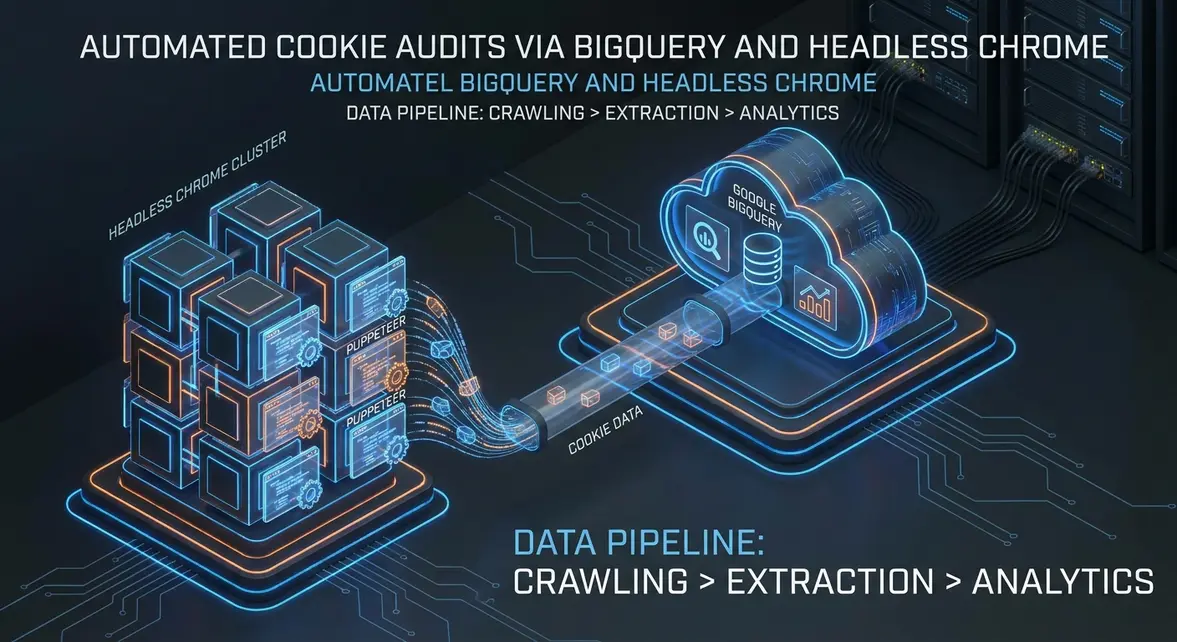
Automating Client-Side State Extraction with Headless Puppeteer and BigQuery
Standard client-side tracking configurations suffer from silent tag proliferation and unmanaged cookie persistence. Enterprise web applications aggregate scripts across disparate marketing deployments, consent management platforms (CMPs), and third-party advertising SDKs. Historically, digital analytics teams executed cookie compliance and governance audits through point-in-time manual browser inspect sessions or rudimentary static crawlers. These legacy methods fail to execute modern JavaScript single-page application (SPA) lifecycles, cannot resolve dynamic CMP injections, and miss cookies instantiated during specific user-interaction sequences.
By leveraging an asynchronous headless crawler built on Puppeteer and containerized on Google Cloud Run or Compute Engine, engineers can programmatically crawl full domain hierarchies. This pipeline records the document state, extracts the complete document.cookie payload alongside storage APIs (localStorage, sessionStorage), and streams the structured telemetry directly into Google BigQuery using the BigQuery Storage Write API. This continuous integration pattern shifts tag governance from an ad-hoc manual checklist to an automated observability pipeline.
Data Architecture: Scraping Runtime Execution vs. Static DOM Verification
Static scrapers that parse raw HTML responses miss up to 80% of dynamic tracking tags. Contemporary trackers like the GA4 Measurement Protocol client-side wrapper, Meta Pixel, and attribution scripts are injected dynamically via Google Tag Manager container evaluation. Capturing this state requires a full Chrome browser runtime capable of handling JavaScript execution queues, Web Workers, and network thread lifecycles.
When Puppeteer navigates to a designated URL, it waits for network idle conditions (networkidle2) to allow all asynchronous analytics requests to fire. The crawler interrogates the Chrome DevTools Protocol (CDP) session via Network.getCookies or evaluates JavaScript execution contexts directly. This mechanism isolates whether a cookie was dropped via HTTP response headers (Set-Cookie) with the HttpOnly or Secure flags enabled, or injected directly into the DOM via document.cookie assignments.
The engineering benefits of routing this data into BigQuery include:
- Historical State Comparison: Querying time-series snapshots to detect unapproved vendors dropping identifiers prior to explicit CMP consent firing.
- Performance Telemetry Correlation: Joining cookie inventory tables with Core Web Vitals datasets (such as Interaction to Next Paint (INP) and Total Blocking Time (TBT)) to isolate which third-party marketing tags degrade main-thread execution.
- Consent String Validation: Tracking whether third-party trackers respect Global Privacy Control (GPC) headers and the IAB TCF v2.2 transparency strings passed down the DOM.
Marketing Operations Runbook: Headless Crawler Setup and BigQuery Ingestion
Implementing this automated audit requires deploying a Node.js runtime with Puppeteer, configuring a BigQuery destination schema, and automating the extraction schedule via Cloud Scheduler and Cloud Run.
First, define the destination BigQuery table schema using partitioned ingestion timestamps to control query costs and enable historical diffing across weekly crawl cycles:
CREATE TABLE `project_id.analytics_governance.cookie_audit` (
  crawl_timestamp TIMESTAMP,
  page_url STRING,
  cookie_name STRING,
  cookie_value STRING,
  cookie_domain STRING,
  cookie_path STRING,
  cookie_expiry TIMESTAMP,
  is_http_only BOOLEAN,
  is_secure BOOLEAN,
  same_site STRING,
  consent_state STRING
)
PARTITION BY DATE(crawl_timestamp)
CLUSTER BY cookie_domain, cookie_name;
Next, configure the Puppeteer crawler logic to extract cookies via CDP, capture the runtime consent variable like {{Consent State}}, and format the records for the BigQuery client library:
const puppeteer = require('puppeteer');
const { BigQuery } = require('@google-cloud/bigquery');
const bigquery = new BigQuery();

async function auditPage(targetUrl) {
  const browser = await puppeteer.launch({ headless: 'new' });
  const page = await browser.newPage();

  await page.goto(targetUrl, { waitUntil: 'networkidle2' });

  // Extract all cookies via Chrome DevTools Protocol
  const client = await page.target().createCDPSession();
  const { cookies } = await client.send('Network.getAllCookies');

  // Capture zero-party CMP consent state directly from runtime
  const consentState = await page.evaluate(() => {
    return window.dataLayer?.find(event => event.event === 'consent_update')?.consent || 'default';
  });

  const rows = cookies.map(cookie => ({
    crawl_timestamp: new Date().toISOString(),
    page_url: targetUrl,
    cookie_name: cookie.name,
    cookie_value: cookie.value,
    cookie_domain: cookie.domain,
    cookie_path: cookie.path,
    cookie_expiry: cookie.expires ? new Date(cookie.expires * 1000).toISOString() : null,
    is_http_only: cookie.httpOnly,
    is_secure: cookie.secure,
    same_site: cookie.sameSite || 'Unspecified',
    consent_state: JSON.stringify(consentState)
  }));

  await bigquery
    .dataset('analytics_governance')
    .table('cookie_audit')
    .insert(rows);

  await browser.close();
}
Revenue Operations Impact: Vendor Governance, Attribution Hygiene, and Enterprise Compliance
For B2B software enterprises scaling past $20M ARR, data leakage and non-compliant cookie distribution present severe material risks during SOC 2 Type II compliance reviews and enterprise client vendor security assessments. Unsanctioned trackers dropped by ad network tags often scrape user IDs, leading to compliance breaches under GDPR and CCPA. By maintaining an automated BigQuery cookie catalog, growth teams can immediately flag rogue pixels injected by unauthorized Google Tag Manager workspaces, preventing regulatory penalties of up to 4% of annual global turnover.
Furthermore, attribution hygiene directly impacts customer acquisition cost (CAC) calculations. When affiliate networks or multi-touch attribution vendors drop mid-funnel cookies on organic landing pages without user interactions, conversion attribution is artificially stolen from organic search and direct enterprise discovery. Automating BigQuery audits provides growth engineering teams with an indisputable audit trail to identify attribution fraud, prune bloated third-party vendor tags, and reclaim upwards of 200ms in main-thread execution time, directly stabilizing organic Core Web Vitals metrics.
System Telemetry Source: Original Engineering Report
Related Growth Blueprints
All Blueprints →Need this architecture deployed in your pipeline?
Skip the synchronous sales cycle and endless discovery calls. Submit your core acquisition or conversion bottleneck for a deep-dive asynchronous growth diagnostic.