Safari ITP Realities & GA4 Pipeline Resilience
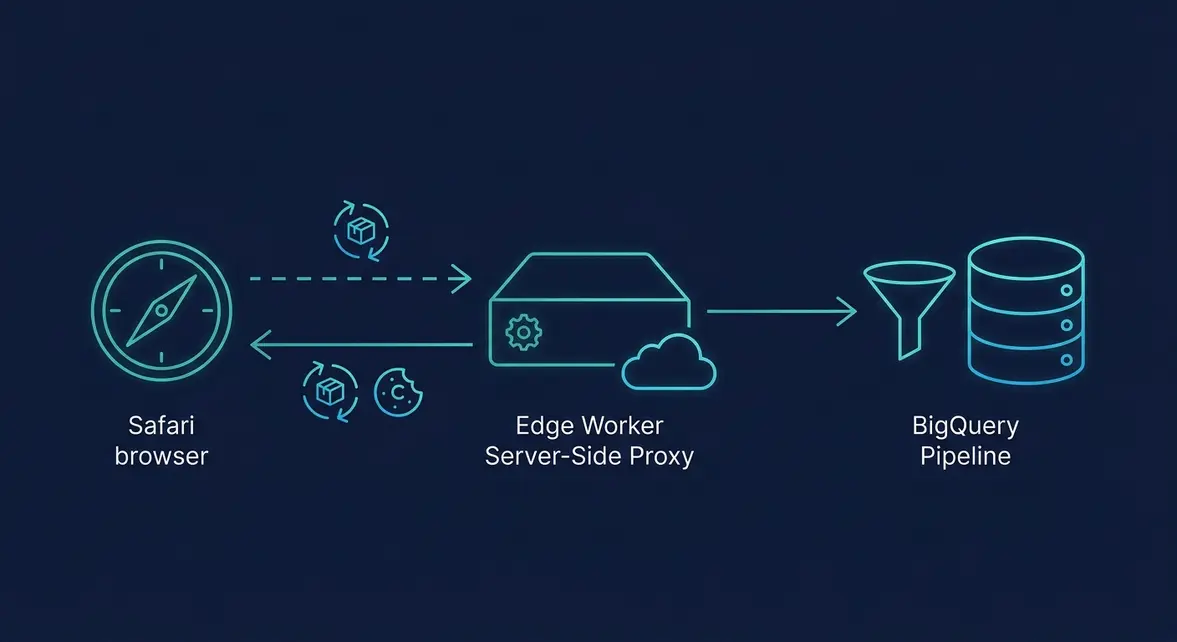
Deconstructing Safari ITP Signals vs Execution Realities
During Apple's WWDC disclosure of Safari 14 and subsequent Intelligent Tracking Prevention (ITP) iterations, industry speculation repeatedly claimed that Apple WebKit initiated hard network-level blocking against Google Analytics scripts (analytics.js, gtag.js). This premise conflates runtime network script blocking with client-side state storage mitigation. WebKit does not terminate requests dispatched to Google Analytics endpoints. Instead, Safari's Privacy Report visualizes cross-site profiling attempts via third-party tracking classifications, whereas first-party analytics collection executes unimpeded across the runtime network layer.
The technical primitive governing Safari's privacy framework is not a domain-level firewall; it is the progressive truncation of client-writable state. Legacy analytics setups that rely exclusively on browser-set storage via document.cookie face strict TTL (Time-To-Live) caps, typically 7 days or 24 hours when inbound links contain tracking parameters (gclid, fbclid, or custom UTMs). Understanding this runtime boundary is essential for engineering accurate tracking architectures: Google Analytics continues to collect and record session telemetry, but visitor stitching collapses across fragmented short-lived identifier windows unless server-side state overrides are deployed.
Technical Architecture: Client State Truncation vs Server-Side State Resolution
The operational threat to technical tracking infrastructure is not direct script drop-off, but attribution decay. When ITP restricts client-side cookies to a 7-day or 24-hour expiration window, standard B2B attribution pipelines misattribute multi-touch, 60-day enterprise sales cycles as separate, net-new organic search or direct traffic visits. This artificially inflates organic discovery metrics while destroying measured conversion paths from mid-funnel content and technical documentation.
To eliminate client-side state truncation without incurring cross-site tracking classification, data engineering teams must decouple visitor state management from the front-end browser context. Routing telemetry through a Server-Side Google Tag Manager (sGTM) cluster operating under a first-party custom domain (e.g., metrics.enterprise.com) leverages direct HTTP responses to set cookies using the Set-Cookie header with the HttpOnly and Secure directives. Because ITP specifically targets JavaScript-written storage (document.cookie), server-issued cookies preserve identifier persistence throughout multi-week enterprise evaluations.
-
Runtime Storage Demarcation: Scripts evaluated on the client context execute requests asynchronously without increasing Total Blocking Time (TBT), preserving Core Web Vitals thresholds.
-
First-Party CNAME vs A/AAAA Records: Apple WebKit detects CNAME cloaking when tracking domains map to third-party endpoints. Deploying reverse proxies or dedicated Node.js edge routers sharing the site's primary IP network block circumvents CNAME heuristics.
-
Attribution Window Stability: Moving client identification to an immutable server session preserves the original campaign source and landing page attribution across extended 90-day evaluation windows.
By shifting from browser-side DOM storage to edge-layer session coordination, teams bypass ITP's client storage limits while remaining fully transparent within Safari's WebKit audit constraints.
Marketing Ops Implementation: Edge State Rehydration Runbook
The following runbook provisions an edge-level proxy using a Cloudflare Worker or Node.js edge runtime that intercepts outgoing analytics payloads, provisions an ITP-immune first-party cookie via the Set-Cookie response header, and routes requests to a private sGTM endpoint.
// Cloudflare Worker / Edge Runtime: ITP-Proof GA4 Client Proxy
export default {
  async fetch(request, env, ctx) {
    const url = new URL(request.url);
    const clientCookie = request.headers.get('Cookie') || '';

    // Match or generate a persistent UUID for user identification
    let fpId = clientCookie.match(/(?:^|; )__Secure-fp_id=([^;]*)/)?.[1];
    const isNewId = !fpId;
    if (!fpId) {
      fpId = crypto.randomUUID();
    }

    // Route to internal sGTM cluster instead of direct Google endpoints
    const targetUrl = new URL(url.pathname + url.search, 'https://sgtm.company.com');
    const modifiedRequest = new Request(targetUrl, {
      method: request.method,
      headers: request.headers,
      body: request.body,
    });
    modifiedRequest.headers.set('X-Forwarded-For', request.headers.get('CF-Connecting-IP') || '');
    modifiedRequest.headers.set('X-First-Party-Id', fpId);

    const response = await fetch(modifiedRequest);
    const newResponse = new Response(response.body, response);

    // Set-Cookie via HTTP response header bypasses client-side 7-day truncation
    if (isNewId) {
      newResponse.headers.append(
        'Set-Cookie',
        `__Secure-fp_id=${fpId}; Path=/; Max-Age=31536000; Secure; HttpOnly; SameSite=Lax`
      );
    }
    return newResponse;
  },
};
Once client telemetry arrives in the BigQuery GA4 export, verify session continuity across long-horizon evaluation journeys. The following SQL query measures Safari vs Chromium attribution persistence by calculating returning visitor identification rates beyond the 7-day ITP boundary.
-- BigQuery: Audit Safari Identifier Lifespan vs Chrome Benchmarks
WITH visitor_cohort AS (
  SELECT
    user_pseudo_id,
    device.web_info.browser AS browser,
    MIN(TIMESTAMP_MICROS(event_timestamp)) AS first_seen,
    MAX(TIMESTAMP_MICROS(event_timestamp)) AS last_seen
  FROM
    `enterprise-analytics.analytics_123456789.events_*`
  WHERE
    _TABLE_SUFFIX BETWEEN '20240101' AND '20240331'
    AND device.web_info.browser IN ('Safari', 'Chrome')
  GROUP BY
    user_pseudo_id,
    browser
)
SELECT
  browser,
  COUNT(user_pseudo_id) AS total_tracked_users,
  COUNTIF(TIMESTAMP_DIFF(last_seen, first_seen, DAY) > 7) AS users_retained_over_7d,
  ROUND(COUNTIF(TIMESTAMP_DIFF(last_seen, first_seen, DAY) > 7) / COUNT(user_pseudo_id) * 100, 2) AS retention_rate_percentage
FROM
  visitor_cohort
GROUP BY
  browser;
B2B Growth & MRR Pipeline Impact: Attribution Integrity
Misinterpreting privacy telemetry causes growth teams to misallocate performance marketing spend and distort technical SEO ROI. When B2B software prospects research products on Safari (predominant across enterprise executive macOS and iOS hardware), fragmented cookies segment a single evaluation path into 4 to 6 discrete visits. Under default GA4 last-non-direct attribution models, high-intent organic technical guides and mid-funnel landing pages are stripped of assisted-conversion credits, driving spurious adjustments in paid search bids and budget distributions.
By engineering a resilient server-side proxy architecture with HTTP-level cookie persistence, marketing engineering teams capture uninterrupted attribution trails for target accounts navigating 30-to-90-day purchase journeys. Eliminating cookie churn stabilizes CAC tracking, restores pipeline attribution across organic search touchpoints, and ensures SOC 2 compliance through edge-level PII redaction before outbound data delivery.
System Telemetry Source: Original Engineering Report
Related Growth Blueprints
All Blueprints →Need this architecture deployed in your pipeline?
Skip the synchronous sales cycle and endless discovery calls. Submit your core acquisition or conversion bottleneck for a deep-dive asynchronous growth diagnostic.