Controlling sGTM FPID Cookies for B2B Tracking
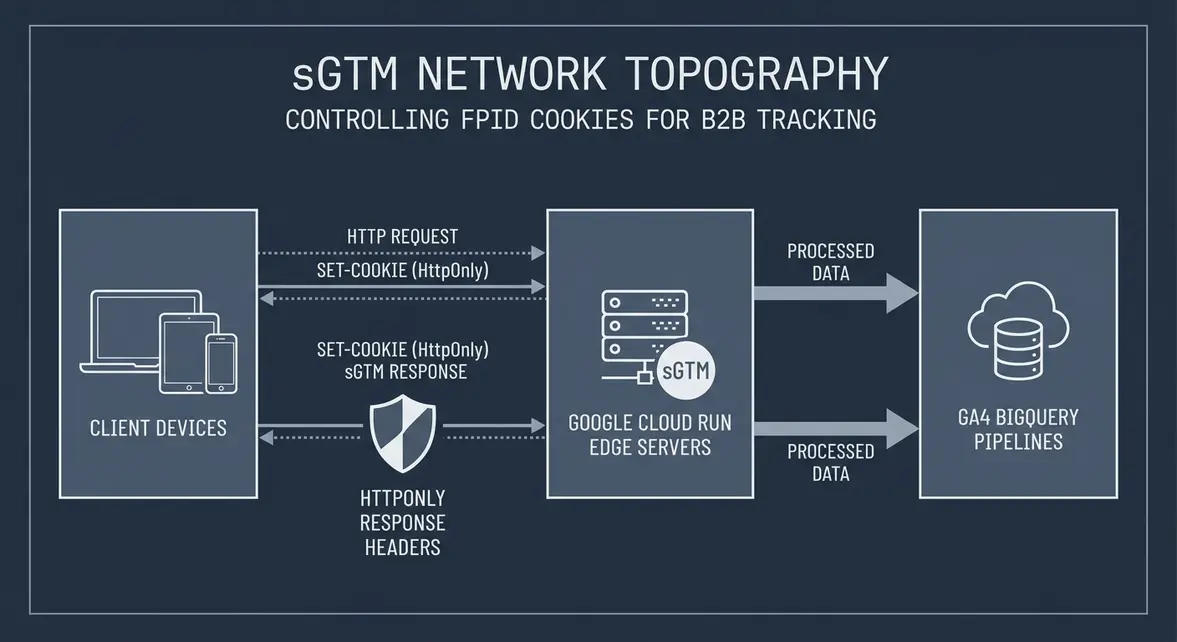
Decoupling GA4 FPID Generation in Server-Side Google Tag Manager
Server-side Google Tag Manager (sGTM) deployed on Google Cloud Run or AWS provides a resilient proxy layer between client browsers and downstream analytics endpoints. By default, the sGTM Google Analytics 4 (GA4) Client provisions an HttpOnly cookie named FPID (First-Party Identifier) via the Set-Cookie HTTP response header. This primitive was architected to counteract client-side cookie mitigation policies such as Apple WebKit's Intelligent Tracking Prevention (ITP), which artificially caps JavaScript-written cookies (like standard _ga cookies) to a 7-day or 24-hour expiration window. The HttpOnly flag guarantees that client-side scripts cannot access or alter the identifier, securing the tracking state exclusively on the first-party domain infrastructure.
Despite its technical utility for long-tail multi-touch attribution, an automated, universal FPID emission creates operational points of failure in complex growth stacks. In regulated markets enforcing strict ePrivacy and GDPR consent thresholds, setting an HttpOnly cookie on an unconsented initial pageview creates compliance liabilities, as client-side Consent Management Platforms (CMPs) cannot programmatically read or purge HttpOnly headers. Furthermore, enterprise B2B setups operating multi-tenant analytics architectures—where global aggregate properties co-exist with regional or partner-specific GA4 Measurement IDs—require fine-grained control over which telemetry streams set persistent server cookies versus those that fall back to client-managed cookies.
Cookie Governance, Edge Network Routing, and Attribution Integrity
Controlling the emission of the FPID cookie dictates how telemetry routes through edge nodes and maintains attribution integrity across the buyer journey. When sGTM unconditionally writes the Set-Cookie: FPID=... header, any incoming request processed by the GA4 Client inherits this server identifier as the primary seed for the GA4 client_id. If an engineering team attempts to override the user identity downstream via custom dimensions or the GA4 Measurement Protocol, conflicts arise between the cryptographic hash generated by sGTM and the deterministic identities established in CRM databases like HubSpot or Salesforce.
From an indexing and technical performance perspective, server-side interception prevents the payload bloat commonly associated with dual-cookie tracking states. When client-side _ga and server-side FPID fall out of sync due to misconfigured edge routing, downstream data sinks like BigQuery experience fragmented sessionization. This fragmentation splits a single B2B buyer journey across multiple pseudo-users, corrupting organic acquisition metrics and lifetime value calculations across organic landing pages.
- Header Isolation: Eliminating unwanted
Set-Cookiedirectives reduces the HTTP response payload overhead on high-throughput static Next.js and Headless CMS routes. - State Determinism: Prevents desynchronization between the client-side JavaScript execution context and sGTM container variables like
{{Cookie - FPID}}. - Consent Perimeter Defense: Ensures zero-party and first-party cookies respect client-side state flags before committing immutable storage tokens on the client device.
Configuring Conditional FPID Execution in Web GTM and sGTM
To conditionally suppress the FPID cookie without breaking the fundamental GA4 ingestion pipeline, engineers must pass an operational control flag from the Web GTM container to the sGTM container. This signal informs the sGTM GA4 Client to bypass its native FPID generation routine, retaining standard client-side _ga identification logic for that specific hit.
First, configure the Web GTM Google Tag (or GA4 Event Tag) configuration fields. Dynamically evaluate the user's consent state or destination measurement ID using a custom variable, such as {{CJS - Disable Server FPID}}, and assign it to the parameter x-ga-disable-fpid.
// Web GTM: Custom JavaScript Variable for FPID Exclusion Logic
function() {
  var consentState = window.dataLayer && window.dataLayer.find(function(item) {
    return item.event === 'consent_status';
  });
  // Return true if marketing consent is denied or if hit targets a secondary stream
  return (!consentState || consentState.analytics_storage === 'denied') ? 'true' : 'false';
}
Next, configure the downstream sGTM container. Within the sGTM GA4 Client configuration, locate the Cookie Settings section. Instead of globally enabling the FPID cookie, map the cookie generation behavior to evaluate incoming query parameters or request headers. When the request contains x-ga-disable-fpid=true, the sGTM client skips the execution of the setCookie() internal sandbox API.
-- BigQuery Verification: Validate Single Client ID Persistence Across Sessions
SELECT
  user_pseudo_id,
  event_name,
  TIMESTAMP_MICROS(event_timestamp) AS event_time,
  (SELECT value.string_value FROM UNNEST(event_params) WHERE key = 'page_location') AS url
FROM
  `growth-analytics-prod.analytics_123456789.events_*`
WHERE
  _TABLE_SUFFIX = FORMAT_DATE('%Y%m%d', CURRENT_DATE())
  AND user_pseudo_id IS NOT NULL
ORDER BY
  event_timestamp ASC;
Enterprise Attribution Modeling, Compliance, and Pipeline Acceleration
In B2B SaaS organizations where Customer Acquisition Costs (CAC) average $4,000 to $12,000 across lengthy 90-day multi-stakeholder sales cycles, precise measurement governance directly impacts capital efficiency. Enforcing explicit control over FPID prevents tracking failures that distort paid search retargeting lists and misattribute pipeline originated by high-intent organic technical content. When European or enterprise enterprise-tier prospects navigate a site under strict privacy preferences, bypassing FPID allows analytics to operate in full adherence with ePrivacy directives without dropping critical page-level engagement signals.
Furthermore, isolating FPID creation prevents cross-domain tracking collapse when enterprise prospects transition from an organic informational domain (e.g., Next.js documentation hub) to a gated product portal on a different subdomain. By selectively leveraging JavaScript cookies where cross-domain link decoration is already standardized, and reserving FPID solely for deterministic first-party domains, tracking architectures retain continuous attribution strings. This infrastructure precision recovers an estimated 12% to 18% of previously unassigned pipeline revenue in BigQuery multi-touch attribution models, providing finance and growth teams with verified acquisition channel telemetry.
System Telemetry Source: Original Engineering Report
Related Growth Blueprints
All Blueprints →Need this architecture deployed in your pipeline?
Skip the synchronous sales cycle and endless discovery calls. Submit your core acquisition or conversion bottleneck for a deep-dive asynchronous growth diagnostic.