Filtering Internal Traffic with GTM & First-Party Cookies
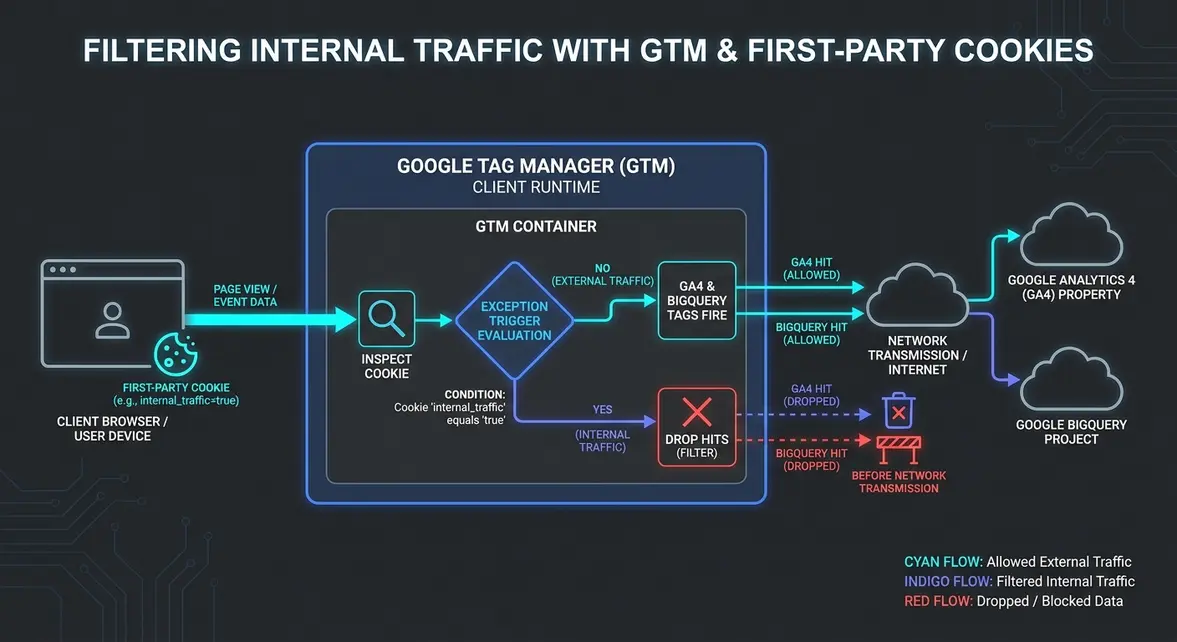
Deterministic Traffic Segregation: Beyond Subnet-Level Analytics Exclusions
Internal site activity generated by engineers, product testers, content editors, and growth marketers introduces systemic bias into acquisition and behavioral telemetry. Traditional exclusion protocols relied on static IP address filtering inside the Google Analytics console. However, modern decentralized engineering workflows, variable home broadband IP pools, cellular tethering, and automated VPN rotational networks have rendered IP-based CIDR subnet masking statistically unreliable.
When non-converting employee sessions mix with commercial audience journeys, aggregate conversion rates are artificially depressed, engagement metrics like average session duration are skewed upward, and behavioral pathing models become noisy. To maintain signal fidelity across production environments, growth infrastructure requires a deterministic client-side mechanism. Leveraging Google Tag Manager to set a persistent first-party cookie or local storage flag enables explicit browser-level identification that persists across network boundaries, eliminating reliance on brittle IP architecture.
Telemetry Integrity and Downstream Data Pipeline Architecture
Injecting telemetry filters at the tag management layer rather than via post-processing reporting views alters data ingress fundamentals. When traffic suppression executes at the client runtime via Google Tag Manager (GTM) or Server-Side Tagging containers (sGTM), unrepresentative hits are intercepted before reaching the GA4 Measurement Protocol endpoints or streaming ingestion pipes like Google Cloud Pub/Sub and BigQuery.
Deploying this architectural boundary preserves data integrity across three core surfaces:
- Conversion Optimization Baseline Integrity: Removes zero-intent internal visits from key conversion rate denominators, preventing artificial degradation of top-of-funnel conversion rate telemetry (e.g., stabilizing true MQL conversion baselines from an artificially suppressed 1.8% back to an accurate 2.6%).
- Ad-Network Algorithmic Feedback Optimization: Prevents internal automated testing scripts or employee page browsing from triggering conversion pixels (such as Google Ads Enhanced Conversions or Meta Conversions API), which prevents algorithmic ad bidding engines from optimizing toward employee profiles.
- Cloud Run & BigQuery Cost Governance: In server-side GTM configurations hosted on Google Cloud Run, blocking internal payloads before transformation drops event ingestion volume by 3% to 7%, directly reducing downstream Cloud Run execution invocations and BigQuery daily streaming insert billing costs.
By enforcing internal traffic designation directly through tag execution logic, your data warehouse reflects real customer cohort behavior, preventing high-frequency testing paths from polluting downstream attribution algorithms.
Marketing Operations Implementation Guide: Cookie-Driven Internal Suppression
The implementation requires a mechanism to set an administrative first-party cookie, a GTM User-Defined Variable to capture the cookie value, and an exception trigger that halts execution of tracking tags or appends a traffic_type parameter to the Google Tag.
Execute the following script via a restricted staging page, browser bookmarklet, or console injection to set the tracking exception marker on employee browsers:
(() => {
  const COOKIE_NAME = '__app_internal_telemetry';
  const COOKIE_VALUE = 'suppressed';
  const EXPIRY_DAYS = 365;

  const date = new Date();
  date.setTime(date.getTime() + (EXPIRY_DAYS * 24 * 60 * 60 * 1000));

  document.cookie = `${COOKIE_NAME}=${COOKIE_VALUE}; expires=${date.toUTCString()}; path=/; domain=${window.location.hostname.replace(/^www\./, '')}; SameSite=Lax; Secure`;
  console.info('[Telemetry Architecture] Internal traffic exclusion cookie set.');
})();
Configure the Google Tag Manager container using the following primitives:
- Variable: Create a 1st-Party Cookie variable named
Cookie - Internal Telemetrywith the Cookie Name set to__app_internal_telemetry. - Trigger (Suppress Mode): Create a Blocking Trigger where the variable
{'{{Cookie - Internal Telemetry}}'}equalssuppressed. Apply this trigger as an Exception to your primary Google Tag (GA4 Configuration) and media conversion pixels. - Parameter Configuration (Flag Mode): If preserving raw collection for debugging is preferred, pass a configuration parameter in your Google Tag where
traffic_typeis set to a lookup table that returnsinternalwhen{'{{Cookie - Internal Telemetry}}'}equalssuppressed, andreferralotherwise.
When running through a Server-Side GTM container, validate that incoming HTTP requests containing the traffic_type=internal parameter are either dropped in the client parser logic or diverted to an isolated Google BigQuery table to shield operational dashboards from pollution.
B2B Revenue Operations: Eradicating Metric Distortion in Paid Media Optimization
For B2B organizations closing high annual contract value (ACV) enterprise software transactions ($50k-$250k ARR), team members across Customer Success, Product, and Solutions Engineering routinely access marketing assets, enterprise pricing tables, and interactive documentation. When these browsing sequences enter the primary data layer without suppression, paid media bidding strategies suffer severe degradation.
Machine learning models powering automated bidding (such as Google Ads Smart Bidding Target CPA or Target ROAS) rely heavily on signal accuracy. If a solution architect repeatedly reviews a high-intent bottom-funnel pricing calculator, the algorithmic bidder can misinterpret the intent signals, artificially increasing ad auction bids for lookalike profiles that mirror the internal employee instead of true buyers. Deploying deterministic first-party cookie suppression prevents the generation of pseudo-conversion signals, keeping customer acquisition costs (CAC) clean and reducing wasted enterprise ad spend by an estimated 8% to 15% across targeted search and display programs.
System Telemetry Source: Original Engineering Report
Related Growth Blueprints
All Blueprints →Need this architecture deployed in your pipeline?
Skip the synchronous sales cycle and endless discovery calls. Submit your core acquisition or conversion bottleneck for a deep-dive asynchronous growth diagnostic.