Browser Page Load Mechanics for Technical SEO
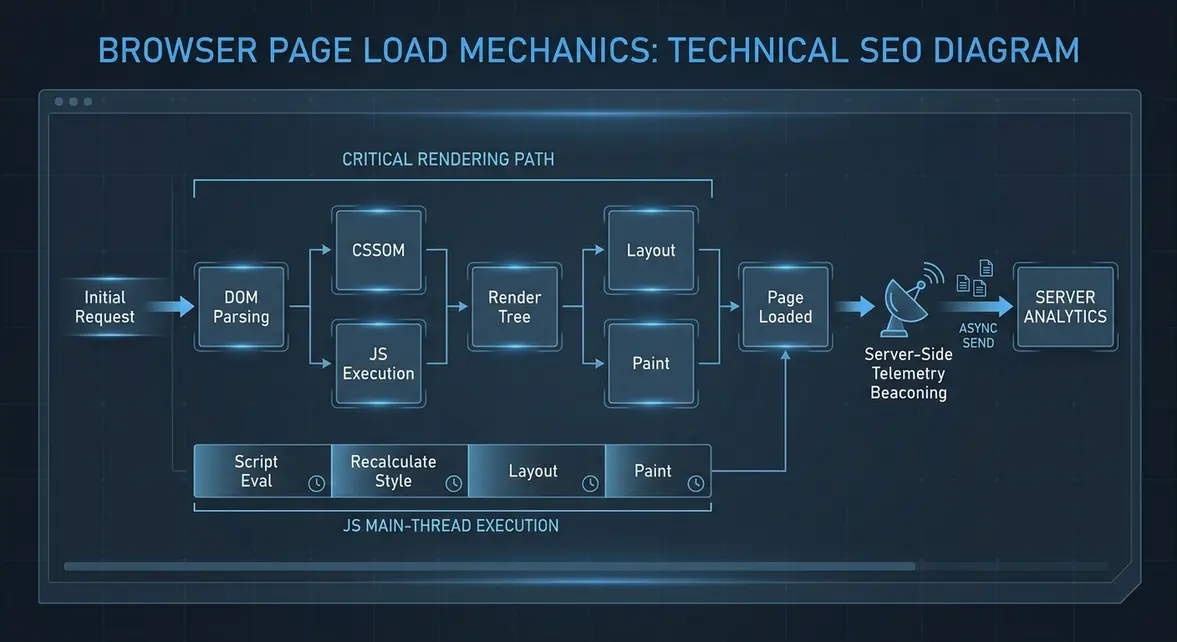
Browser Execution Lifecycles and Client-Side Tag Execution Mechanics
Most analytics infrastructures treat client-side tracking as a black box: an asynchronous tag script injects into the DOM, binds to document listeners, and dispatches network payloads. When evaluating data integrity and Core Web Vitals, this abstraction collapses. Browsers parse HTML sequentially, constructing the Document Object Model (DOM) and CSS Object Model (CSSOM) into a render tree. Standard measurement scripts introduced via inline snippets or tag management containers compete directly for execution priority on the single-threaded JavaScript execution context.
Historically, platforms like Google Analytics relied on synchronous scripts that blocked HTML parsing outright. Modern implementations leverage async attributes on containers like Google Tag Manager (gtm.js) or Google tag (gtag.js). However, async only decouples script download from HTML parsing; script compilation and execution still interrupt the main thread the moment the payload finishes downloading. If this execution coincides with layout calculations or client-side JavaScript hydration in frameworks like Next.js, it directly inflates Total Blocking Time (TBT) and degrades Interaction to Next Paint (INP).
Technical SEO & Data Architecture: Main-Thread Contention and Beaconing
The core conflict between data capture and technical search optimization centers on the critical rendering path. Search engine crawlers evaluate page experience metrics—such as Largest Contentful Paint (LCP) under 2.5s and INP under 200ms—as algorithmic signals. When client-side analytics tools instantiate multiple third-party libraries, each script incurs CPU overhead from parse, compile, and garbage collection cycles. Furthermore, when users bounce before the window.load or DOMContentLoaded event triggers, conventional tracking tags fail to execute entirely, leading to systemic attribution leakage.
Modern analytics architecture solves this through architectural shifts in transport and execution priority:
- Transport Layer Decoupling: Replacing legacy image pixels and synchronous XHR posts with the
navigator.sendBeaconAPI orfetch()withkeepalive: true. This hands delivery off to the browser network stack asynchronously, ensuring payloads transmit even during document unload without blocking navigation. - Execution Offloading to Server-Side GTM (SSGTM): Moving transformation logic, cookie consolidation, and multi-vendor forwarding off the client main thread. The client sends a single, lightweight consolidated stream to a first-party proxy endpoint, reducing client script payload sizes by 40-70%.
- Timing Decoupling with Event Hydration: Deferring non-critical behavioral tags past browser idle periods using
requestIdleCallbackor the Web Performance Observer API, keeping the main thread clear during primary LCP element rendering.
By shifting processing away from synchronous browser execution cycles and utilizing server-side consolidation, tracking reliability increases while preserving optimal search performance signals.
Marketing Ops Implementation: Non-Blocking Telemetry and Event Hydration
To eliminate main-thread bottlenecks without sacrificing data completeness, implement a lightweight listener that captures browser performance milestones and transmits them over a persistent network channel. In Google Tag Manager, references to variables such as {{Page Path}} or {{Event}} should align with specific browser milestones rather than arbitrary DOM-ready flags.
Step 1: Deploy a non-blocking performance observer to record Core Web Vitals and performance navigation marks before flushing data via sendBeacon.
// Non-blocking instrumentation capturing PerformanceNavigationTiming
(function() {
  if (!('performance' in window) || !('PerformanceObserver' in window)) return;

  const observer = new PerformanceObserver((list) => {
    list.getEntries().forEach((entry) => {
      const payload = JSON.stringify({
        eventName: 'web_vital_metric',
        metricName: entry.name,
        metricValue: Math.round(entry.startTime + entry.duration),
        path: window.location.pathname
      });

      const endpoint = 'https://collect.yourdomain.com/v1/telemetry';
      if (navigator.sendBeacon) {
        navigator.sendBeacon(endpoint, payload);
      } else {
        fetch(endpoint, { method: 'POST', body: payload, keepalive: true });
      }
    });
  });

  observer.observe({ type: 'navigation', buffered: true });
})();
Step 2: Transition client-side GTM containers away from aggressive page-load triggers. Restrict standard tags to fire on custom events queued in the dataLayer only after the main thread exhibits idle activity. Configure a GTM Custom JavaScript variable to parse the PerformanceNavigationTiming payload for transmission to your server container:
function() {
  var navTiming = performance.getEntriesByType('navigation')[0];
  if (!navTiming) return null;
  return {
    dns_lookup: Math.round(navTiming.domainLookupEnd - navTiming.domainLookupStart),
    dom_interactive: Math.round(navTiming.domInteractive),
    load_event_end: Math.round(navTiming.loadEventEnd)
  };
}
B2B Growth & Attribution Leverage: Eliminating Attribution Leakage and Lowering Blended CAC
B2B marketing pipelines typically face significant tracking drop-offs on high-cost paid channels (e.g., LinkedIn Ads and Google Search). When prospective buyers click an ad and encounter a slow or main-thread-blocked landing page, users on mobile or constrained networks abandon the session within 1.5 to 3.0 seconds. If tracking relies on late-stage lifecycle events like window.load, the click is billed to your ad account, but the source and session drop out of your CRM and attribution models entirely, inflating apparent Customer Acquisition Cost (CAC) by 12% to 20% due to orphan conversions.
By refactoring the client telemetry stack to initialize within the first 100 milliseconds via navigator.sendBeacon and first-party SSGTM ingestion, marketing operations captures the initial attribution touchpoint (UTM parameters, referrer, and click identifiers like gclid) before the full DOM renders. This guarantees end-to-end multi-touch attribution continuity in downstream data warehouses (e.g., Google BigQuery or Snowflake). B2B organizations adopting this architectural pattern consistently recover 8% to 15% of previously untracked inbound enterprise lead sources, eliminating wasted ad spend and directly optimizing bidding algorithms toward high-pipeline enterprise prospects.
System Telemetry Source: Original Engineering Report
Related Growth Blueprints
All Blueprints →Need this architecture deployed in your pipeline?
Skip the synchronous sales cycle and endless discovery calls. Submit your core acquisition or conversion bottleneck for a deep-dive asynchronous growth diagnostic.