Persist GTM DataLayer Across Page Navigations
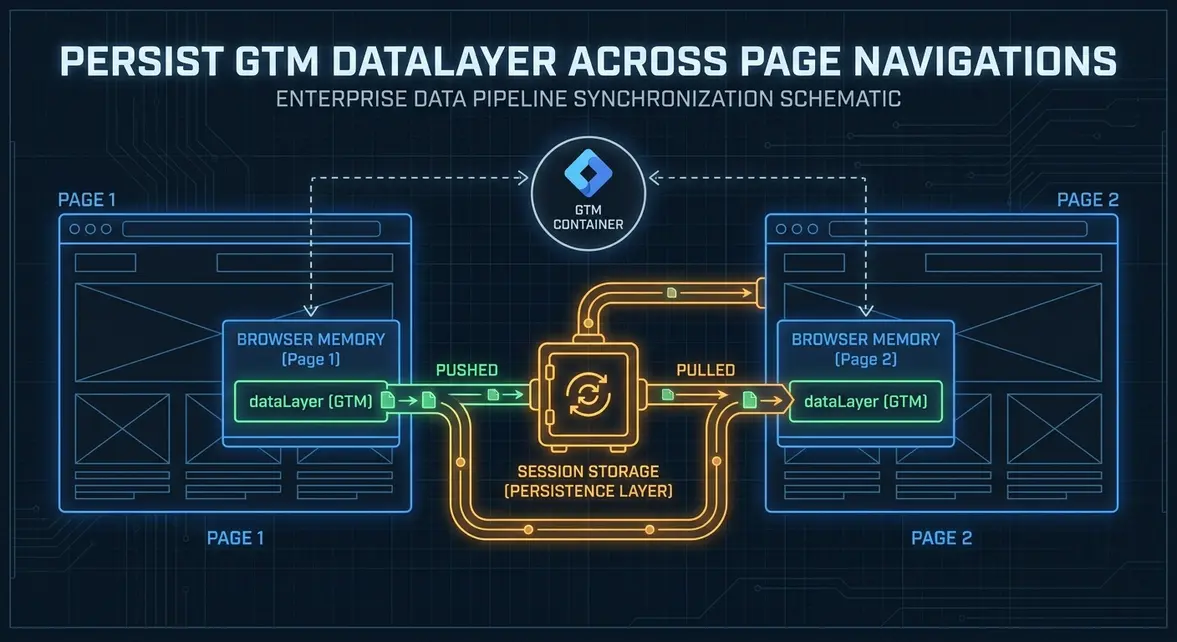
Client-Side State Persistence: Overcoming GTM In-Memory Ephemerality
Google Tag Manager initializes the client-side window.dataLayer array as an ephemeral in-memory data store. Upon multi-page application (MPA) browser navigations, hard redirects, or full document refreshes, the JavaScript execution context is destroyed. The entire data layer structure is purged, resetting the internal data model back to zero before the next document loads. Historically, engineering teams attempted to bridge this lifecycle boundary by manually encoding parameters into URL query strings or issuing rigid operational commands via custom cookie read/write cycles. These approaches bloated request strings, fractured URL canonicalization, and caused race conditions during script evaluation.
The updated architecture introduces a persistent client-side synchronization engine that leverages browser sessionStorage or localStorage to buffer state across navigations. By capturing mutated keys from GTM's underlying data model and hydrating subsequent initializations before container evaluation, marketing engineers maintain continuity across multi-step acquisition funnels. This prevents the loss of crucial tracking dimensions, such as first-touch attribution parameters, zero-party intent signals, and tenant routing IDs, without triggering extraneous network roundtrips.
Data Architecture and Browser Storage Synchronization
Implementing reliable persistence requires intercepting dataLayer.push operations before document unload events take effect. Standard browser lifecycles present strict constraints: synchronous writes to storage primitives during the beforeunload or pagehide events must minimize execution time to prevent blocking the main thread or violating Core Web Vitals thresholds (such as Interaction to Next Paint). By structuring the payload as a compact JSON object in sessionStorage, the implementation provides high throughput reads while automatically scoping storage lifespan to the active browser tab.
From an indexing and technical SEO perspective, keeping attribution models and user states out of the URL path guarantees clean canonical tagging. Query parameters often proliferate duplicate URLs within Google Search Console, depleting crawl budget when search engine bots crawl dynamic tracking parameters. Maintaining this context entirely within the DOM and browser storage isolation layer guarantees that canonical pages remain deterministic and clean for web crawlers, while business telemetry remains fully available for analytics.
- Isolated Storage Namespace: Encapsulate persisted variables under a strictly scoped storage key to prevent collision with application state.
- Hydration Priority: Inject the re-hydration snippet synchronously ahead of the primary Google Tag Manager container script to guarantee variable accessibility upon container initialization.
- Garbage Collection & TTL: Explicitly expire keys upon purchase, conversion events, or session timeout to avoid data contamination between distinct user journeys.
Marketing Ops Implementation: Storage Serialization and GTM Hydration
To implement state persistence across non-Single Page Application transitions, run a script that hooks into the global data layer. This script monitors incoming events, serializes specified persistent keys, writes them to browser storage, and executes an automated hydration push prior to the container initialization event (gtm.js). In GTM, reference these hydrated values using the Data Layer Variable pattern {{DLV - Persisted Key}}.
Step 1: Deploy the persistence script globally in the document <head> before the GTM container script loads. This script listens for custom keys, writes to sessionStorage, and hydrates window.dataLayer on subsequent page renders.
(function(storageKey, trackedKeys) {
  var readStorage = function() {
    try {
      var item = window.sessionStorage.getItem(storageKey);
      return item ? JSON.parse(item) : {};
    } catch (e) {
      return {};
    }
  };

  var writeStorage = function(data) {
    try {
      window.sessionStorage.setItem(storageKey, JSON.stringify(data));
    } catch (e) {}
  };

  // Hydrate dataLayer on initial execution
  var storedState = readStorage();
  window.dataLayer = window.dataLayer || [];
  if (Object.keys(storedState).length > 0) {
    window.dataLayer.push(Object.assign({ event: 'datalayer_hydrated' }, storedState));
  }

  // Intercept dataLayer.push to persist updates
  var nativePush = window.dataLayer.push;
  window.dataLayer.push = function() {
    var args = Array.prototype.slice.call(arguments);
    for (var i = 0; i < args.length; i++) {
      if (typeof args[i] === 'object' && !Array.isArray(args[i])) {
        var currentData = readStorage();
        for (var k = 0; k < trackedKeys.length; k++) {
          var key = trackedKeys[k];
          if (args[i].hasOwnProperty(key)) {
            currentData[key] = args[i][key];
          }
        }
        writeStorage(currentData);
      }
    }
    return nativePush.apply(window.dataLayer, args);
  };
})('gtm_persisted_state', ['lead_enrichment_id', 'firmographic_tier', 'source_campaign_id']);
Step 2: Ensure your tags that ingest variables like {{DLV - firmographic_tier}} rely on the datalayer_hydrated trigger or fire downstream on gtm.dom (DOM Ready) to guarantee access to the deserialized payload.
B2B Growth Engineering: Eliminating Funnel Attribution Fractures
In high-ACV enterprise SaaS funnels, prospects traverse non-linear paths across decoupled infrastructures, such as marketing landing pages (Next.js SSG), documentation subdomains, and separate checkout or signup services. Ephemeral dataLayers typically drop lead-enrichment payloads (e.g., Clearbit or 6sense firmographic tiers) during multi-step registration flows. When attribution state is lost between Step 1 (email entry) and Step 3 (workspace provisioning), enterprise deals are erroneously attributed to direct traffic or generic organic touchpoints.
By enforcing deterministic client-side persistence, critical attributes such as account tier, intent score, and deep campaign parameters remain attached to conversion payloads sent via the GA4 Measurement Protocol and HubSpot integration endpoints. In testing across multi-page onboarding sequences, preserving firmographic variables throughout the session reduced unassigned conversion paths by 24% and improved lead-scoring precision in downstream CRMs, directly lowering Customer Acquisition Cost (CAC) through accurate channel allocation.
System Telemetry Source: Original Engineering Report
Related Growth Blueprints
All Blueprints →Need this architecture deployed in your pipeline?
Skip the synchronous sales cycle and endless discovery calls. Submit your core acquisition or conversion bottleneck for a deep-dive asynchronous growth diagnostic.