Claude Code for SEO: CLI Automation Guide
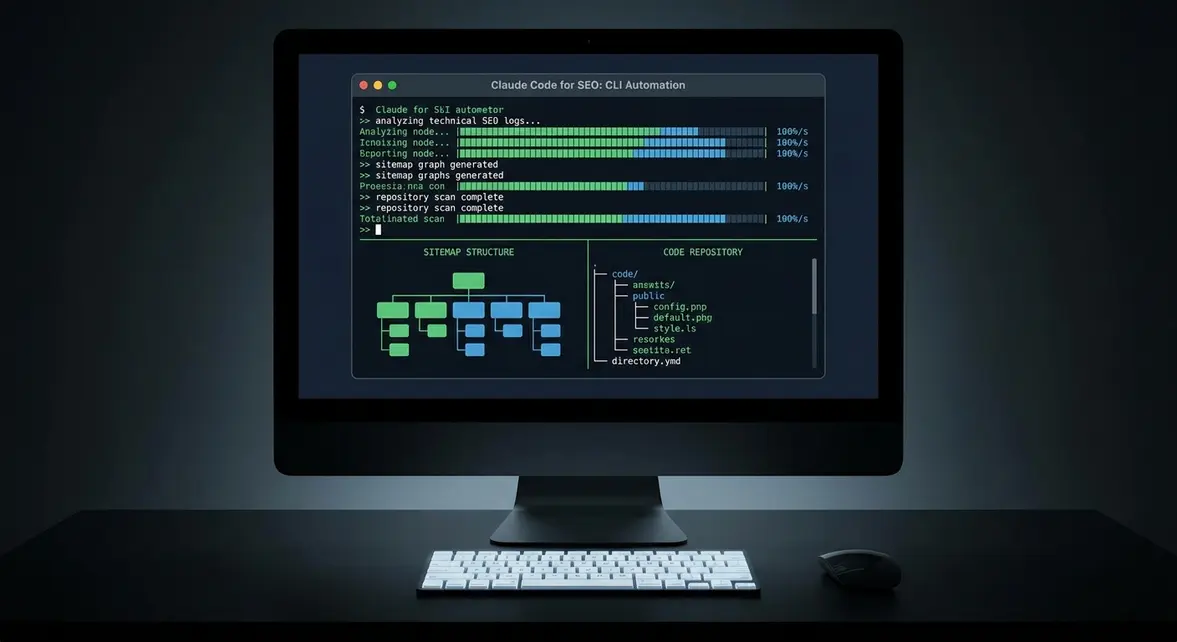
Automating Terminal-Native SEO Operations with Claude Code CLI
Traditional SEO execution has long suffered from workflow fragmentation. Growth engineers and technical SEOs historically toggled between third-party SaaS crawlers, Google Search Console web interfaces, static CSV exports, and manual development tickets to implement basic on-page and architectural fixes. Anthropic's Claude Code changes this paradigm by executing directly within the local developer environment, granting an agentic AI runtime programmatic access to local file systems, git version control, and shell-level terminal tooling.
By shifting technical SEO workflows to a terminal-native agent, engineers eliminate the friction between discovery and deployment. Claude Code can directly query source directories in frameworks like Next.js, Nuxt, or Astro, analyze structural routing patterns, identify canonical discrepancies, and write clean, typed Pull Requests directly to the repository. This operational loop transforms technical SEO from an observational auditing discipline into an automated, continuous integration engineering practice.
Technical SEO Architecture: Graph Traversal & Search Console API Pipelines
Implementing Claude Code at the infrastructure layer bridges the gap between raw crawl data and source code. Instead of manual spreadsheet lookups, Claude Code can execute customized scripts that pull historical indexing telemetry from the Google Search Console API, correlate organic performance against real-time server access logs, and programmatically surface crawl budget degradation or orphan page risks. The model can inspect Nginx or Cloudflare edge worker logs to compute request frequency from Googlebot-Desktop and Googlebot-Smartphone user-agent tokens.
At the data-layer and rendering level, Claude Code automates internal link distribution across dynamic route structures. By running graph analysis scripts across local MDX files or headless CMS schema files, Claude Code calculates internal PageRank distributions, pinpoints pages with high impression counts but depressed click-through rates (striking-distance queries), and constructs bi-directional internal linking architectures without requiring external crawling software.
- Edge and Server Log Parsing: Claude Code uses standard bash primitives (
grep,awk,jq) directly on edge access logs to verify whether Googlebot receives clean 200 OK responses or suffers through redirect loops and 5xx bottlenecks. - Dynamic Structured Data Injection: The agent validates and programmatically inserts JSON-LD entities (e.g., SoftwareApplication, Article, FAQPage) directly into page layout templates, verifying type safety against
@types/schema-dts. - Automated Redirect & Canonical Cleanups: Claude Code reads local redirect mapping configurations (e.g.,
next.config.jsor Cloudflare_redirects) and performs regex transforms to squash redirect chains down to a single 301 hop.
Marketing Ops Implementation: Automated Log Parsing and Internal Link Injector
To implement programmatic internal linking via Claude Code, initialize the agent in the root directory of your content repository. The agent can ingest performance metrics from the GSC API via a localized script, scan all content files for semantic anchor opportunities, and directly patch markdown or MDX files with contextual hyperlinks.
Below is an execution script that Claude Code can run and iterate on locally to query GSC impression thresholds and cross-reference target keywords against content source code:
import json
import re
from pathlib import Path

# Simulated payload from GSC API filtering striking distance queries
gsc_targets = [
    {"target_url": "/blog/edge-seo-architecture", "keyword": "edge routing seo", "min_impressions": 1200},
    {"target_url": "/blog/nextjs-dynamic-sitemaps", "keyword": "programmatic sitemap", "min_impressions": 3400}
]

def inject_internal_links(content_dir: str):
    directory = Path(content_dir)
    for file_path in directory.glob("**/*.mdx"):
        content = file_path.read_text(encoding="utf-8")
        modified = False

        for target in gsc_targets:
            pattern = rf"\b({re.escape(target['keyword'])})\b(?![^\[]*\])"
            if target["target_url"] not in content and re.search(pattern, content, re.IGNORECASE):
                replacement = f"[\\1]({target['target_url']})"
                content = re.sub(pattern, replacement, content, count=1, flags=re.IGNORECASE)
                modified = True

        if modified:
            file_path.write_text(content, encoding="utf-8")
            print(f"Updated internal links in: {file_path}")

inject_internal_links("./content/posts")
Once Claude Code executes this script via terminal invocation, the CLI agent verifies git diffs, runs test suites to ensure syntax compilation remains valid, and stages changes for review without breaking Next.js SSG builds or inducing client-side hydration errors.
B2B Organic Pipeline Leverage: Programmatic Content Refactoring and MRR Growth
For B2B software companies with enterprise CAC exceeding $5,000, technical debt in organic search architectures directly impairs revenue velocity. Claude Code delivers high leverage by collapsing sprint turnaround times. High-value product-led SEO templates (e.g., integrations catalogs, comparison directories, API documentation) can be audited, refactored, and updated within hours rather than waiting through multi-week sprint cycles.
By automating the detection and mitigation of canonical issues, 404 dead-ends, and unindexed feature pages, technical teams regularly recover 15% to 30% of lost organic traffic footprints. When organic search feeds directly into an enterprise demo request or free trial flow, reclaiming top-of-funnel rankings for high-intent B2B keywords accelerates organic pipeline creation and reduces reliance on paid acquisition channels, yielding measurable improvements in net ARR efficiency.
System Telemetry Source: Original Engineering Report
Related Growth Blueprints
All Blueprints →Need this architecture deployed in your pipeline?
Skip the synchronous sales cycle and endless discovery calls. Submit your core acquisition or conversion bottleneck for a deep-dive asynchronous growth diagnostic.