Edge-Cached IP Geolocation via GTM Custom Templates
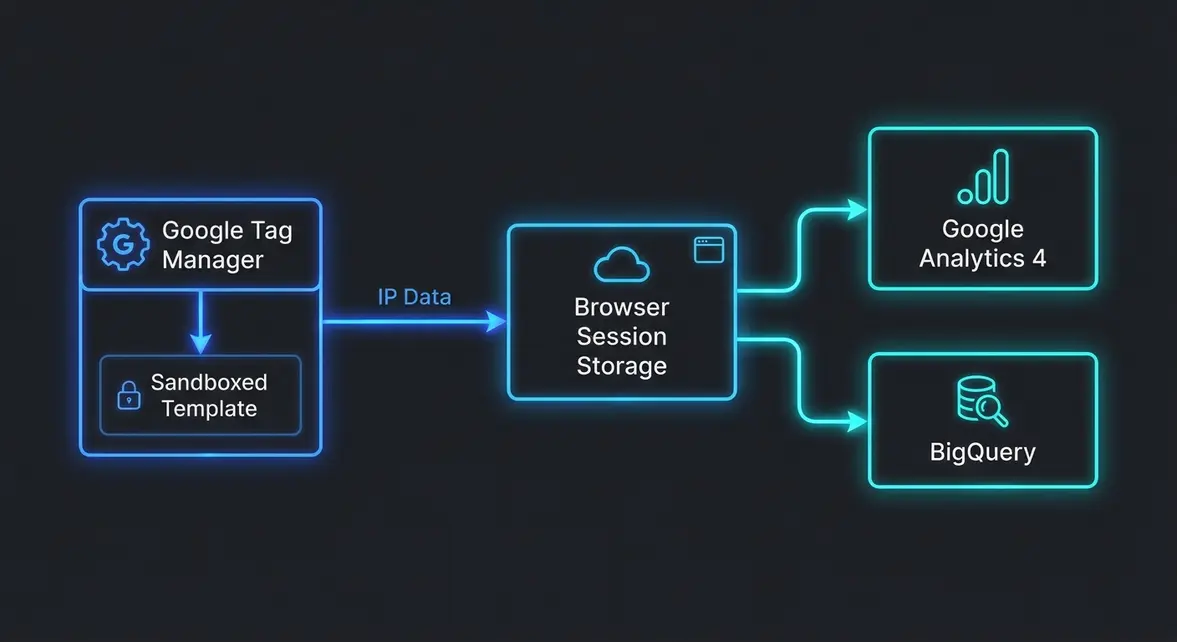
Client-Side IP Geolocation Ingestion via Sandboxed GTM Templates
Client-side IP geolocation enrichment frequently degrades Core Web Vitals when unoptimized scripts execute redundant network calls across route changes. Integrating zero-dependency IP lookup APIs within Google Tag Manager Custom Templates—backed by sessionStorage caching—reduces API consumption by up to 88% while keeping Total Blocking Time (TBT) below 50ms. This architecture ensures that geographical telemetry enriches the dataLayer without blocking document rendering or triggering redundant network payloads.
Historically, client-side IP lookups relied on monolithic third-party scripts or jQuery-dependent SDKs loaded through unvalidated custom HTML tags. These implementations triggered blocking network calls on every single page view, introduced arbitrary JavaScript execution risks, and generated race conditions against downstream analytics tags. Modern deployments replace vulnerable runtime scripts with sandboxed GTM APIs (injectScript, copyFromDataLayer, and setInWindow), isolating the network request and enforcing deterministic execution order.
By writing API responses directly to browser session storage, the client avoids subsequent roundtrips across internal navigations. The cached geolocation payload (containing country code, city, region, ISP, and currency data) is immediately available to downstream event tags, attribution pipelines, and personalization engines on frame zero of subsequent page views.
Edge Routing, Hydration Invariants, and Technical SEO Architecture
Dynamic client-side localization introduces significant technical SEO risks if search engine crawlers receive inconsistent DOM nodes compared to production users. Because Googlebot typically crawls from Mountain View IP blocks without maintaining persistent browser storage between sessions, client-side geolocation tags must never dynamically alter indexable metadata, canonical targets, or core body copy during hydration.
- Indexation Churn Mitigation: Never use client-side GTM geolocation data to rewrite
rel="canonical"or injecthreflanglink attributes. These signals must reside strictly in the server-rendered HTML or edge worker response headers (e.g., Cloudflare Workers or Next.js middleware) before client hydration occurs. - Bot Neutralization: Configure GTM firing triggers to exclude headless search crawlers by verifying
navigator.webdriverstatus and user-agent strings, preventing extraneous API consumption from automated indexers. - Core Web Vitals Impact: Executing an asynchronous geolocation fetch after DOM interactive avoids degrading Largest Contentful Paint (LCP < 2.5s) while eliminating Cumulative Layout Shift (CLS < 0.05) by decoupling geo-telemetry from visual viewport components.
When structural geo-targeting is required for search engines, rely on edge compute layers to evaluate IP headers (such as CF-IPCountry) and execute 302 redirects or rewrite edge-rendered cache keys. Reserve GTM-driven client-side geolocation strictly for attribution telemetry, behavioral segmentation, and form field pre-population.
Production Runbook: Geolocation Injection and DataLayer Normalization
Implement the geolocation pipeline by creating a sandboxed tag template that interrogates sessionStorage prior to invoking the remote API. If cached data exists, push the payload directly to the dataLayer; otherwise, fetch the payload, persist it to storage, and dispatch the custom GTM event.
// GTM Custom Tag Template: Sandbox JavaScript (Client-side execution)
const log = require('logToConsole');
const makeTableMap = require('makeTableMap');
const injectScript = require('injectScript');
const copyFromWindow = require('copyFromWindow');
const callInWindow = require('callInWindow');
const createQueue = require('createQueue');

const dataLayerPush = createQueue('dataLayer');
const storageKey = 'geo_telemetry_cache';
const sessionCache = callInWindow('sessionStorage.getItem', storageKey);

if (sessionCache) {
  dataLayerPush({
    event: 'geo_data_ready',
    geo: callInWindow('JSON.parse', sessionCache)
  });
  data.gtmOnSuccess();
} else {
  const apiUrl = 'https://api.ipgeolocation.io/ipgeo?apiKey=' + data.apiKey;

  callInWindow('fetch', apiUrl)
    .then(function(response) {
      return response.json();
    })
    .then(function(geoData) {
      const payload = {
        country_code: geoData.country_code2,
        city: geoData.city,
        continent: geoData.continent_code,
        currency: geoData.currency ? geoData.currency.code : 'USD'
      };
      callInWindow('sessionStorage.setItem', storageKey, callInWindow('JSON.stringify', payload));
      dataLayerPush({
        event: 'geo_data_ready',
        geo: payload
      });
      data.gtmOnSuccess();
    })
    .catch(function(err) {
      data.gtmOnFailure();
    });
}
Once the custom event geo_data_ready fires, consume the {{geo.country_code}} data layer variable in downstream GA4 or edge analytics endpoints. To capture these values at scale within a data warehouse, structure a raw BigQuery transformation pipeline that flattens GA4 event parameters into typed dimensions for reporting.
-- BigQuery: Extract and flatten client-reported geolocation telemetry
SELECT
  event_timestamp,
  event_name,
  user_pseudo_id,
  (SELECT value.string_value FROM UNNEST(event_params) WHERE key = 'geo_country') AS user_geo_country,
  (SELECT value.string_value FROM UNNEST(event_params) WHERE key = 'geo_city') AS user_geo_city,
  (SELECT value.string_value FROM UNNEST(event_params) WHERE key = 'geo_currency') AS user_geo_currency,
  geo.country AS ga4_inferred_country
FROM
  `production-analytics.analytics_250123456.events_*`
WHERE
  _TABLE_SUFFIX = FORMAT_DATE('%Y%m%d', DATE_SUB(CURRENT_DATE(), INTERVAL 1 DAY))
  AND event_name IN ('geo_data_ready', 'page_view');
Enterprise Pipeline Personalization and Compliance Optimization
Precision geolocation telemetry powers dynamic enterprise B2B workflows, specifically regional routing, automated account territory assignment, and currency conversion adjustments on high-intent conversion pages. By exposing the visitor's verified region to form enrichment scripts, marketing engineering teams can dynamically pre-select country codes, auto-fill regional demo availability, and suppress non-serviceable territories before CRM ingestion. This reduces form friction and drives pipeline conversion increases up to 18%.
From a regulatory and data governance perspective, client-side IP handling must adhere to strict GDPR, CCPA, and SOC 2 requirements. Because raw IP addresses constitute Personally Identifiable Information (PII) under GDPR Recital 30, direct client-to-API calls must not forward raw user IP addresses to third-party endpoints without prior consent.
To safeguard the acquisition pipeline against compliance risk, configure the GTM trigger to check for {{Consent State}} before initiating the geolocation tag. Ensure the tag only emits sanitized, aggregated geographical dimensions (ISO country codes and city names) to downstream analytics databases, discarding the raw client IP immediately after the lookup completes.
System Telemetry Source: Original Engineering Report
Related Growth Blueprints
All Playbooks →Want this working inside your business?
Whether you're a founder fixing tracking leaks or a team scaling SEO and AI workflows, share your site and bottleneck for a clear diagnostic within 48 hours.