Programmatic GTM Governance via Tag Manager API
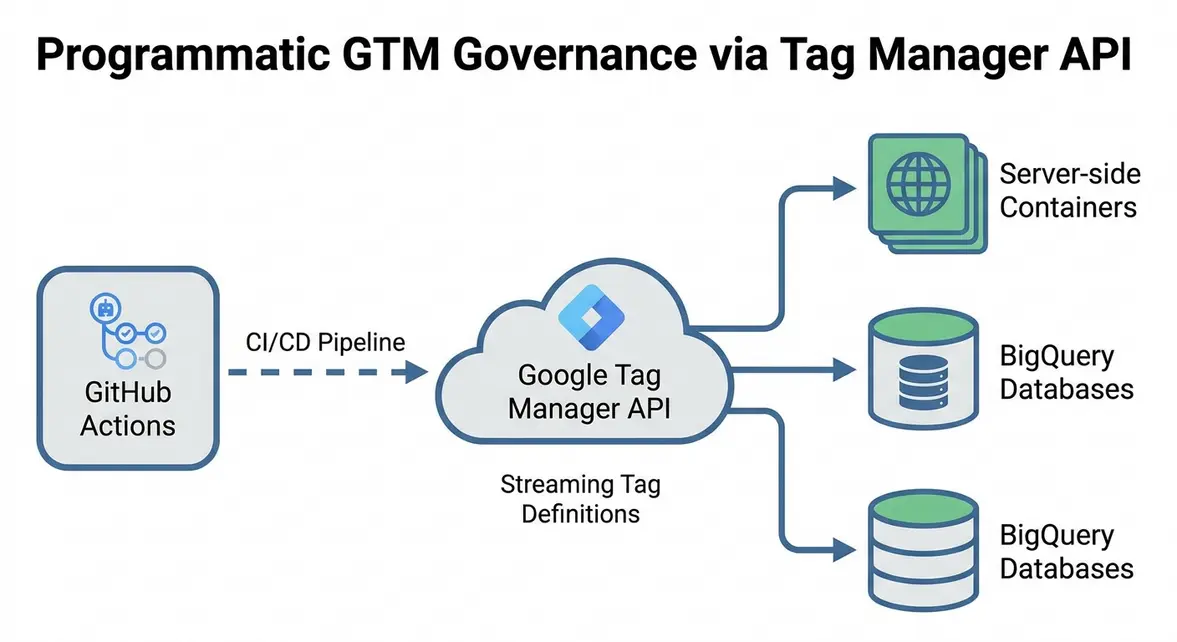
Automated Tag Governance via the Google Tag Manager API
Manual container configuration in the Google Tag Manager (GTM) web interface introduces configuration drift, unvetted third-party JavaScript injection, and severe tracking discrepancies across enterprise multi-tenant properties. Transitioning from visual point-and-click container maintenance to headless programmatic tag management using the GTM API v2 shifts tag deployment into a deterministic software engineering lifecycle. This transition eliminates rogue vendor tags and establishes reproducible tagging pipelines.
Legacy tracking setups rely on distributed marketing teams manually deploying custom HTML scripts and triggers directly inside the production workspace. This visual workflow creates unmonitored script proliferation, unvalidated dataLayer push calls, and frequent race conditions that corrupt analytics schema consistency. The GTM API v2 provides programmatic endpoints to inspect, export, diff, clone, and publish tags, triggers, and variables across isolated workspaces through CI/CD pipelines.
Technical SEO and Client-Side Execution Bottlenecks
Client-side GTM containers executed via legacy script loaders directly compromise Core Web Vitals, specifically Interaction to Next Paint (INP) and Total Blocking Time (TBT). When marketing stacks bloat containers with dozens of redundant DOM-scraping triggers and unminified third-party pixels, the main browser thread locks up during critical initial load windows.
From a technical SEO standpoint, excessive main-thread work delays hydration and client-side rendering evaluation by Googlebot. While Googlebot executes JavaScript, heavy script execution queues can exceed execution budget limits, leading to missed indexable states or incomplete hydration of structured metadata. Programmatic container inspection allows engineering teams to audit trigger conditions, prune dead DOM scrapers, and migrate third-party execution off the client thread.
Key architectural requirements for programmatic container auditing include:
- Enforcing explicit firing rules: Restricting all non-critical vendor tags to fire after
gtm.domor via Server-Side GTM HTTP webhooks. - Schema validation: Programmatically validating that every variable referenced in a custom script resolves to a strictly typed key in the unified dataLayer.
- Dependency tree graphing: Parsing tag firing orders, parent-child trigger dependencies, and blocking triggers to identify circular references prior to container export.
Marketing Ops Implementation: CI/CD Container Deployment
The following runbook establishes automated GTM workspace governance. The first script uses the @googleapis/tagmanager Node.js client to extract container configurations, check for unauthorized custom HTML tags, and export the sanitized JSON architecture.
import { google } from 'googleapis';
import * as fs from 'fs';

interface AuditResult {
  unauthorizedTags: string[];
  totalTags: number;
  containerId: string;
}

async function auditGtmContainer(accountId: string, containerId: string, workspaceId: string): Promise<AuditResult> {
  const auth = new google.auth.GoogleAuth({
    scopes: ['https://www.googleapis.com/auth/tagmanager.readonly'],
  });

  const tagmanager = google.tagmanager({ version: 'v2', auth });
  const parent = `accounts/${accountId}/containers/${containerId}/workspaces/${workspaceId}`;

  const response = await tagmanager.accounts.containers.workspaces.tags.list({ parent });
  const tags = response.data.tag || [];

  const unauthorizedTags: string[] = [];

  for (const tag of tags) {
    // Flag raw Custom HTML tags lacking engineering review
    if (tag.type === 'html') {
      unauthorizedTags.push(tag.name || 'Unnamed HTML Tag');
    }
  }

  const result: AuditResult = {
    containerId,
    totalTags: tags.length,
    unauthorizedTags,
  };

  fs.writeFileSync('gtm-audit-report.json', JSON.stringify(result, null, 2));
  return result;
}

auditGtmContainer('12345678', '98765432', '10');
The second component is a GitHub Actions automation workflow that runs container validation scripts on every pull request. This pipeline verifies that no raw script modifications breach security policies or reference undefined variables like {{Page URL}} without standard normalization wrappers.
name: GTM Container Linter and Security Gate

on:
  pull_request:
    paths:
      - 'tracking-schema/**'

jobs:
  audit-container:
    runs-on: ubuntu-latest
    steps:
      - name: Checkout Source Code
        uses: actions/checkout@v4

      - name: Setup Node.js Runtime
        uses: actions/setup-node@v4
        with:
          node-version: '20.x'
          cache: 'npm'

      - name: Install Dependencies
        run: npm ci

      - name: Execute GTM API Governance Audit
        env:
          GOOGLE_APPLICATION_CREDENTIALS: ${{ secrets.GTM_SERVICE_ACCOUNT_KEY }}
        run: |
          node scripts/audit-gtm.js
          UNAUTHORIZED_COUNT=$(jq '.unauthorizedTags | length' gtm-audit-report.json)
          if [ "$UNAUTHORIZED_COUNT" -gt 0 ]; then
            echo "Security check failed: Detected $UNAUTHORIZED_COUNT unapproved Custom HTML tags."
            exit 1
          fi
B2B Growth Acceleration and Enterprise Risk Mitigation
Programmatic container management directly impacts enterprise B2B unit economics by insulating revenue attribution models from human tracking errors. When deploying tracking architectures across international localized subdomains or multi-tenant SaaS application subpaths, deploying templates via script eliminates weeks of manual setup per workspace. This pipeline reduces deployment lead time by over 90% while ensuring uniform identity resolution parameters across Google Analytics 4, HubSpot, and warehouse destinations.
From a risk mitigation and compliance perspective, headless governance acts as a deterministic barrier against GDPR and SOC 2 Type II compliance breaches. By using the GTM API to inspect tag firing mechanics, data engineers can programmatically assert that conversion pixels execute only when explicit consent parameters (such as {{Consent State}}) evaluate to granted. This eliminates the financial risk of rogue tracking tags extracting personally identifiable information (PII) before consent confirmation, protecting enterprise revenue pipelines.
System Telemetry Source: Original Engineering Report
Related Growth Blueprints
All Blueprints →Need this architecture deployed in your pipeline?
Skip the synchronous sales cycle and endless discovery calls. Submit your core acquisition or conversion bottleneck for a deep-dive asynchronous growth diagnostic.